







Get yourself on board with active learning
Starting a new teaching method can feel unfamiliar in the beginning. As a lecturer, you can’t fully rely anymore on that routine you’ve built over years, or that good decade-old slide deck. Luckily, active learning doesn’t require a complete overhaul of your teaching identity.
Below is explained how you can gradually build a classroom that is student‑engaging without having to ditch all your previously built successes; by starting small and aligning activities with your existing goals.
Activate, adapt, but do what fits you
Implementing active learning doesn’t mean that you can’t lecture anymore, and you don’t have to redesign everything at once. It also doesn’t mean that everything you’ve been doing so far has been wrong, or that you have to change who you are as a lecturer. But it does ask for a different teaching style in certain activities. That often includes more moments of  student interaction, and you’ll be more coaching rather than telling in tutorials, and furthermore it can take some flexibility and, optionally, digital tools.
Choosing a method that suits yourself as a lecturer is as important as choosing a method that fits the content
There are various levels of complexity of active teaching methods, ranging from small tweaks and brief interactive moments in a lecture, to simple activating workflows to apply in tutorials, to complete redesigns of course structure. Even with a few small tweaks, you can already obtain important results, and gain experience.
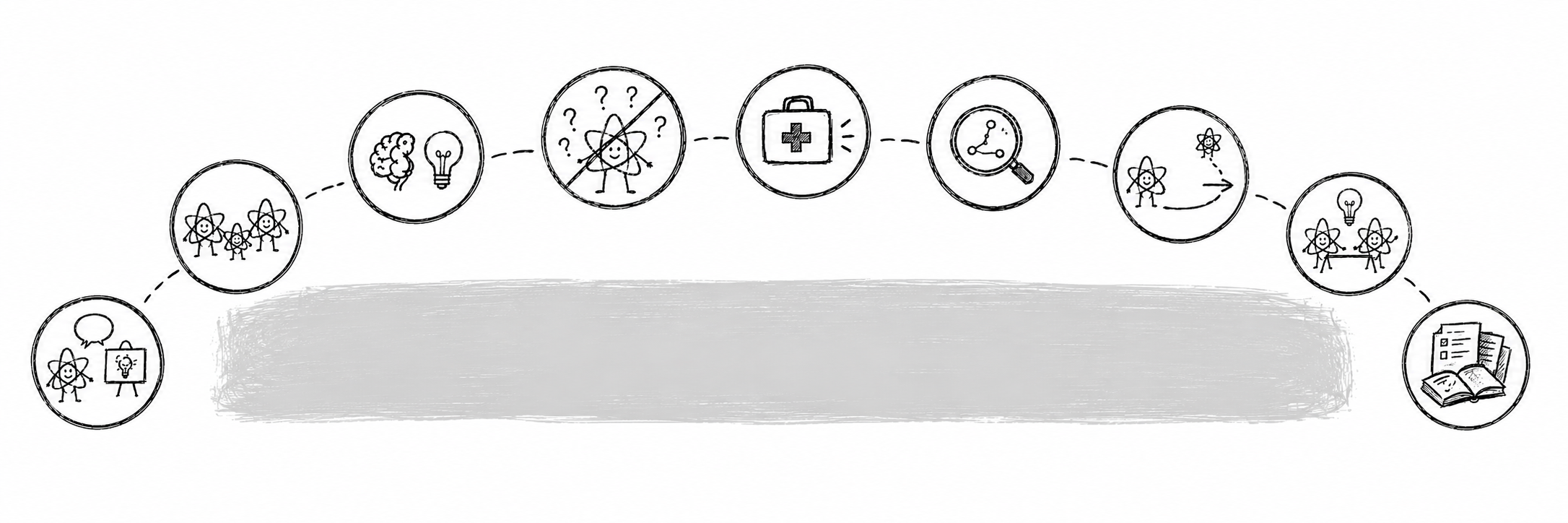
You can find examples of workflows in the STEM active learning activity finder and in the best practice stories of your peers. Here, we share 6 tips (and a pep-talk) to familiarize yourself and start with active teaching methods.
1. Re-frame the mindset: expand your existing experience
View active learning as adding to what you already do. Small, evidence‑informed tweaks can be layered onto a familiar lecture. That way the lecture remains the backbone; the activity adds depth. You can start small, for example with with something simple like adding a 3 minute interactive activity after each 15 minutes of lecture theory, or one 5-10 minute problem solving activity per lecture, and see how that works. In the process, you expand your experience with new techniques. It’s never too late to learn or try something new.
- Check simple examples of ‘quick-fixes’ to apply in lectures here.
- Set targets for yourself and decide in advance how many new techniques you’ll test each semester. Knowing you have a limited, planned number of experiments removes the pressure.
- Note down or draw/sketch for yourself: “What is already going well in my course? Where do I see a need (or room) for active teaching methods?” This helps to affirm your courses’ strength and at the same time recognize spaces where you can improve and try something new.
- Choose specific topics where you feel most comfortable experimenting with a new method. Focus on those. For example, topics that students struggle with, find dry or ‘boring’, or a topic that you are specially passionate about that you want to highlight more.
2. You don’t have to be an expert; start with what you’re comfortable with
You don’t have to be tech- or computer savvy to implement active learning. Technology is a tool, not a requirement. Hand‑raising, think‑pair‑share, or simple paper worksheets work just as well.
Some tools are more simple than others. If you don’t have the time or ambition to dive into the more complex tools, stick with simpler ones.
Also, you don’t have to be a flashy show-host or a great actor to implement active teaching methods. As with scientific presentations, a well-built structure and good preparation are key for the students to understand and go along with the activity.
- Check the STEM active learning activity finder for inspiration, and randomly read a few workflows. Note down what types of activities resonate with you, and what types give you an immediate ‘no’.
- Analyse: What can you imagine yourself doing? Why? And what definitely not? Why not? This will help you build an image of what you feel comfortable with.
- The activities database also includes information on the teaching style and a key teaching advice of each workflow. These can help you decide whether it’s suitable for you, or not.
- Check the digital Tool Selector for an overview digital tools that are supported at UvA and that can be integrated into Canvas.
3. Choose a method that fits your course
What works for your course depends on several factors, such as the type of content, the number of students, how many contact or teaching hours you have, how much time for preparation, and whether are you teach alone or with co-lecturers and TAs.
While active teaching methods are proven to be effective in STEM, not all of the methods that pop up on the internet or in literature are directly suitable for quantitative work.
On the other hand, certain factors are independent of a topic. Students should always feel safe and welcome to learn, to experience a sense of belonging, and to connect with peers. This supports an optimal learning experience and motivation. Thus, cater to your own course, but don’t forget the ‘softer’ aspects of a successful learning activity.
- Connect activities to specific exam questions or assignment rubrics. You can make a 3‑column table for yourself: Learning outcome → In‑class activity → Exam question/ assignment criterion. For each activity you have planned, fill in at least one exam question or rubric line it prepares students for. If you can’t find a match, adjust the activity or drop it. This keeps your active methods tightly tied to assessment.
- In the STEM active learning activity finder, you can filter on several of these factors to find activities that fit your needs (or that can be adapted to fit your needs).
- Check with peers who teach similar topics what they’ve already tried in their course.
- Also look at these best practice stories from peer lecturers for inspiration.
- If it feels odd to include a ‘softer’ activity, use an activity that’s ‘soft’, but also connected to the topic (e.g. this ice-breaker activity that has successfully been designed by a peer), and again, start small.
- A simple statement or ‘dilemma’ on your opening slide that students can discuss with a neighbor and/or share with you (by raising a hand or by using Wooclap) is an easy way to break the ice in a lecture.
4. Give a new method (and yourself) a chance to be successful
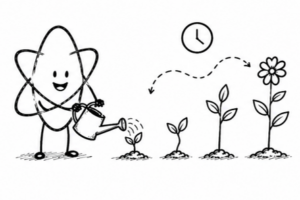 Few things in life work perfectly on the first try. New teaching methods can need some time and experience to fit smoothly into your course. Celebrate the act of trying, not just the result.
For students it’s not bad at all to see the lecturer as a real person, who is an expert on the course topic, but also a learner in other ways. When you’re open about the novelty of your course, that generally warms students up for it as long as you validate the goal and your effort to give them the best learning outcome. It tells them that experimentation is a valued part of the learning environment. See also: Get your students on board with active learning.
- Treat a new activity as an experiment and reframe mistakes as information. Imagine a hypothesis: “Students will be able to apply X after this problem”. When it doesn’t go as expected, ask yourself, “What did that tell me about my students/the material/the timing?”
- Collect such information as above in a document; over time that becomes a record of adaptation and progress.
- Explicitly acknowledge your own and the students’ effort. For example, at the end of a week in which you introduced a new method, post a brief note on Canvas: “We tried a short group problem‑solving session this week. Thanks for giving it a go. I’m aware that it may have started a bit messy, but I also noted that many of you made an important thinking step.”
- Note down course data that interest you (average exam scores, failure rates, or student evaluations, etc). After a semester of using active‑learning integration, compare the numbers. Even a small improvement validates the effort.
- Ask students for a small evaluation after new activities, or halfway the course, with simple questions like “What did the activity help you with”, “What have you missed” or “On a scale of 1-5, how well did this activity help you …”.
5. Connect teaching goals to personal development goals
As you’re trying a new teaching style, you’re simultaneously developing your personal teaching style. Setting clear goals for yourself next to goals for your course helps to motivate yourself and dive into the process, and it can lead to extra or unexpected gains.
- After a successful activity, note it in a teaching journal and share it with a colleague, or peers, for example at a weekly/monthly meeting. Celebrate your wins!
- Connect to a personal trajectory (e.g., UTQ), when applicable.
- Schedule an ‘analyse and reflect’ moment for yourself to review what you tried, what worked, and what to tweak.
6. No need to reinvent the wheel
 Instead, you can check the STEM active learning ctivity finder, or be inspired by best practice stories from peers. Colleagues who already use certain methods or tools will have a good idea of what works well and what doesn’t. They might even have workflows or templates to share.
You can also contact TLC Science for personalized advise, brainstorming, or co-creating a course with you. Or to connect you to a peer who’s been there, done that.
Knowing you’re not alone reduces anxiety and creates a built‑in support network for celebrating successes and troubleshooting hiccups.
- Connect with a fellow instructor who also wants to try something new. Run the same active workflow in your classes and meet afterward to compare notes.
- Observe a colleague who already uses active learning methods. Take notes on how they transition between lecture and activity.
- Co‑teach a single class session with a peer. Share the workload: One person leads the lecture, the other facilitates the activity.
- Ask computer savvy TAs to help you manage digital assignments or tools. They can maybe make Wooclap-quizzes, Canvas-quizzes, or Codegrade assignments for you. NB: Do keep in mind what a TA’s responsibilities are. Grading policies and course content should be in your own hands.
- Ask UvA AI Chat to crystallize or tweak ideas and examples. If you’re interested in a certain workflow, but don’t see how you could concretely use that in your course, it can help you adapt it to your goal/topic/nr of students.
Allen, G. K., Wedman, J. F., & Folk, L. C. (2001). Looking Beyond the Valley: A Five-Year Case Study of Course Innovation. Innovative Higher Education, 26(2), 103-119. https://doi.org/10.1023/A:1012288421619
Apkarian, N., Henderson, C., Stains, M., Raker, J., Johnson, E., & Dancy, M. (2021). What really impacts the use of active learning in undergraduate STEM education? Results from a national survey of chemistry, mathematics, and physics instructors. PLOS ONE, 16(2), e0247544. https://doi.org/10.1371/journal.pone.0247544
Balsamo, M., Lauriola, M., & Saggino, A. (2012). Personality and College Major Choice: Which Come First? Psychology (Savannah, Ga.). https://doi.org/10.4236/psych.2012.35056
Beckerson, W. C., Anderson, J. O., Perpich, J. D., & Yoder-Himes, D. (2020). An Introvert’s Perspective: Analyzing the Impact of Active Learning on Multiple Levels of Class Social Personalities in an Upper Level Biology Course. Journal of College Science Teaching, 49(3), 47-57.
Coenen, J., Borghans, L., & Diris, R. (2021). Personality traits, preferences and educational choices: A focus on STEM. Journal of Economic Psychology, 84, 102361. https://doi.org/10.1016/j.joep.2021.102361
Condon, M., & Ruth-Sahd, L. (2013). Responding to introverted and shy students: Best practice guidelines for educators and advisors. Open Journal of Nursing, 3(7), 503-515. https://doi.org/10.4236/ojn.2013.37069
Deslauriers, L., McCarty, L. S., Miller, K., Callaghan, K., & Kestin, G. (2019). Measuring actual learning versus feeling of learning in response to being actively engaged in the classroom. Proceedings of the National Academy of Sciences, 116(39), 19251-19257. https://doi.org/10.1073/pnas.1821936116
Dzaiy, A., & Abdullah, S. (2024). The Use of Active Learning Strategies to Foster Effective Teaching in Higher Education Institutions. Zanco Journal of Humanity Sciences, 28(4). https://doi.org/10.21271/zjhs.28.4.18
Flanagan, K. M., & Addy, H. (2019). Introverts Are Not Disadvantaged in Group-Based Active Learning Classrooms. Bioscene: Journal of College Biology Teaching, 45(1), 33-41.
Freeman, S., Eddy, S. L., McDonough, M., Smith, M. K., Okoroafor, N., Jordt, H., & Wenderoth, M. P. (2014). Active learning increases student performance in science, engineering, and mathematics. Proceedings of the National Academy of Sciences, 111(23), 8410-8415. https://doi.org/10.1073/pnas.1319030111
Gaffney, J. D. H., & Gaffney, A. L. H. (2016). Student satisfaction in interactive engagement-based physics classes. Physical Review Physics Education Research, 12(2), 020125. https://doi.org/10.1103/PhysRevPhysEducRes.12.020125
Gilbert, R. O., & Gilbert, D. R. (2025). Student evaluations of teaching do not reflect student learning: An observational study. BMC Medical Education, 25(1), 313. https://doi.org/10.1186/s12909-025-06896-3
Miller, E., Fowler, J., Johns, C., Johnson Jr., J., Ramsey, B., & Snapp, B. (2021). Increasing Active Learning in Large, Tightly Coordinated Calculus Courses. PRIMUS, 31(3-5), 371-392. https://doi.org/10.1080/10511970.2020.1772923
Nguyen, K. A., Borrego, M., Finelli, C. J., DeMonbrun, M., Crockett, C., Tharayil, S., Shekhar, P., Waters, C., & Rosenberg, R. (2021). Instructor strategies to aid implementation of active learning: A systematic literature review. International Journal of STEM Education, 8(1), 9. https://doi.org/10.1186/s40594-021-00270-7
Pekrun, R. (1992). The Impact of Emotions on Learning and Achievement: Towards a Theory of Cognitive/Motivational Mediators. Applied Psychology, 41(4), 359-376. https://doi.org/10.1111/j.1464-0597.1992.tb00712.x
Ryan, R. M., & Deci, E. L. (2020). Intrinsic and extrinsic motivation from a self-determination theory perspective: Definitions, theory, practices, and future directions. Contemporary Educational Psychology, 61, 101860. https://doi.org/10.1016/j.cedpsych.2020.101860
Semanko, A. M., & Ladbury, J. L. (2020). Using the Reasoned Action Approach to Predict Active Teaching Behaviors in College STEM Courses. Journal for STEM Education Research, 3(3), 387-402. https://doi.org/10.1007/s41979-020-00038-8
Shamsi, S. Z. Z., Mehmood, S., Mahmoona, S., & Fakhar-Ul-Zaman. (2024). Designing Effective Teaching Strategies for Introverted Learners: A Practical Classroom Framework. `, 2(No.03), 1-16.
Tharayil, S., Borrego, M., Prince, M., Nguyen, K. A., Shekhar, P., Finelli, C. J., & Waters, C. (2018). Strategies to mitigate student resistance to active learning. International Journal of STEM Education, 5(1), 7. https://doi.org/10.1186/s40594-018-0102-y
Theobald, E. J., Hill, M. J., Tran, E., Agrawal, S., Arroyo, E. N., Behling, S., et al. (2020). Active learning narrows achievement gaps for underrepresented students in undergraduate science, technology, engineering, and math. Proceedings of the National Academy of Sciences, 117(12), 6476-6483. https://doi.org/10.1073/pnas.1916903117