







Get your TAs on board with active learning
You’ve decided to implement active teaching methods in your course, and you may have created new activities or changed the course-structure. If new activities are applied in sessions led by TAs, it’s crucial to get your TAs up to date and on board with your (new) philosophy.
Why invest in getting TAs on board?
For TAs to join in and teach any educational activity best, they have to feel comfortable teaching it. They should understand the rationale behind it, and know exactly what to do, and what’s expected of them in their – possibly new or altered – role. Also for students it is important to know that it doesn’t matter which TA they ‘get’, as they all get taught using the same method and receive similar grading and guidance.
Below, we share 7 tips on how to support TAs and smoothly get them along with your new plans.
1. Kick-off with a TA team-building and instruction session
 To make a success of any new course design, it is important to tackle the new design as a team. TAs often guide tutorials and they are in close contact with the students; so it is essential that they understand and support the design. Create team-building and a common goal during a live meeting, before the course starts.
Practical steps:
- If you teach together with co-lecturers in your course, discuss TA expectations with your team beforehand.
- Get all the TAs there: If you make it a 1 hour session, include that hour in the TAs work-hours (if they are student TAs). If they miss out for some reason, make sure they can catch-up or get informed by one of their peers.
- Spend some time on getting-to-know-each-other and team-building before diving into course details.
- If you have co-lecturers in your course, discuss TA expectations with your team beforehand. Or, plan the kick-off meeting with the full team.
- Prepare a visual / timeline / flowchart / DataNose overview of the course to take the TAs along.
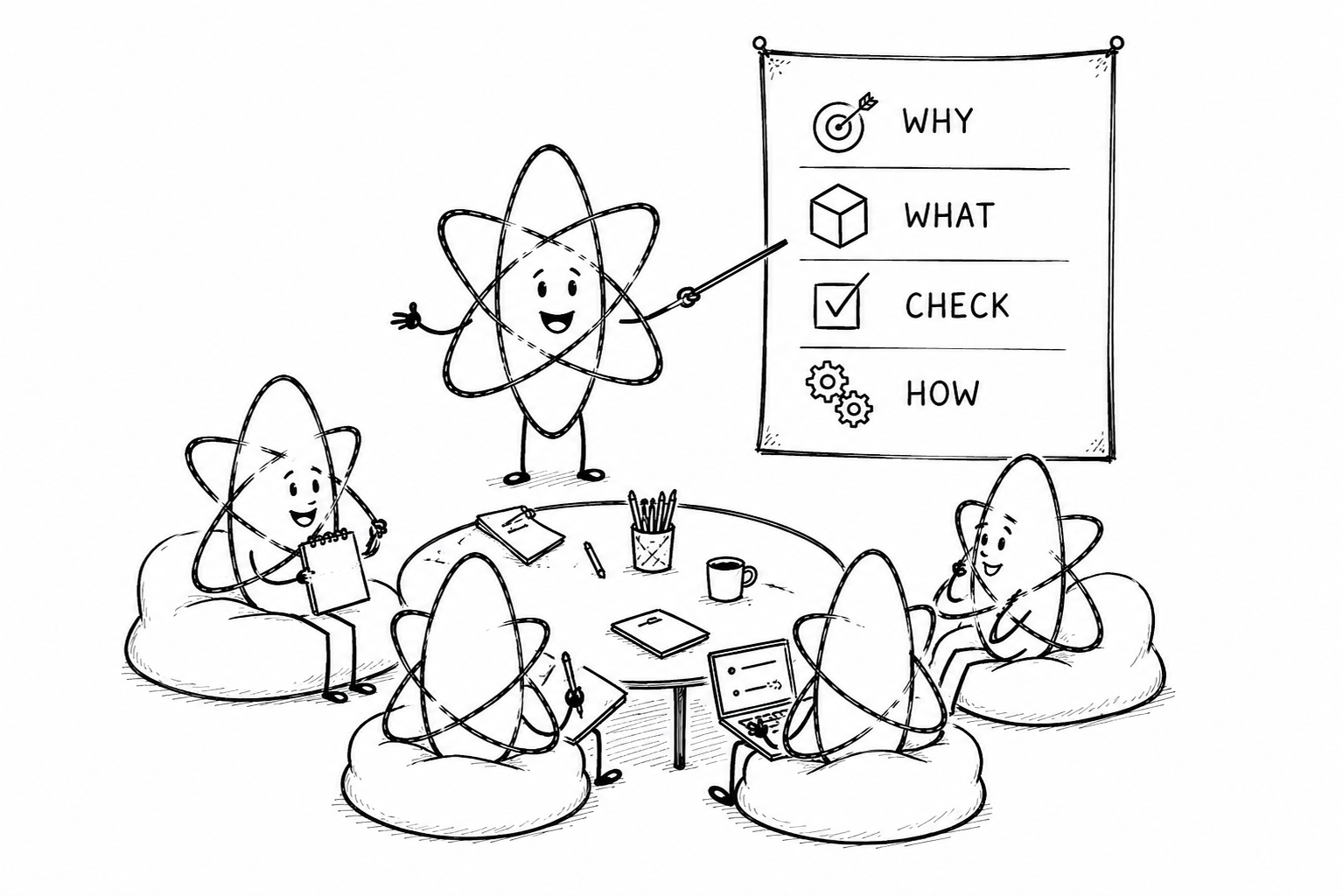
- Use a “Who – why – what – check – how” structure: You can use these template slides for a TA kick-off meeting following that structure.
- Who? (~15 min): Build team spirit and open communication. Make sure everyone knows who is who and who to contact for what. Use an icebreaker and a short introduction round; let everyone briefly share their vision/experience with teaching.
- Why this course design? (~5–10 min) Clarify the purpose and added value of the design for students (short and long term). Explain why you chose this design/workflow and how it fits the ILOs. Share experiences and pitfalls from the previous design and how active teaching addresses them.
- What are we going to do? (~5–10 min) Walk through the course plan step by step and indicate where TAs are involved. Make your expectations explicit; TAs will likely do more than just answer questions. Use visual aids where possible.
- Check if everything is clear? (~5–10 min) Create space for questions and concerns. Invite TAs to offer tips or tweaks, as they are close to the students. If the design is unconventional, check whether TAs feel comfortable; if not, and ask what they need to become comfortable.
- How are we going to do it? (~20 min) Cover practicalities: Time investment, materials, group division, lesson plans, schedules, slides, grading model, rubrics, etc.
2. Provide ongoing coaching: keep everyone engaged
While a kick-off sets a good start, it is also important to keep energy and motivation high along the road to make the course a success.
Practical steps:
- If you teach your course with co-lecturers in your course, discuss TA expectations and how you’ll support TAs with your team beforehand.
- Check-in in classes; pass by tutorials every now and then for support and to show involvement. See how it’s going, point out something the TA does well (good explanation, walking around, pleasant contact with students, drawing a good visual, etc.).
- Promote an active attitude; a TA sitting still behind a desk, idly waiting for questions, does not motivate students to work. Students literally write that in course evaluations. If TAs struggle to be active, or if they feel shy, help them by giving them practical tips how to engage with students and encourage them to keep trying.
- Provide support where necessary; if, for example, you want TAs to do a plenary start and closing, offer them a lesson plan and a template slide. The first aid for passivity emergencies tips can be very handy for beginning TAs and junior teachers!
- Provide some extra support for shy, inexperienced or introverted TAs: they may feel more anxious about classroom management or non-content related questions. Practical handles on how to open conversation with a student, or a check-in about what could help them feel confident in a classroom are a good start (you can ask via e-mail or in person, or during the kick-off).
- Let TAs do a peer observation in each others’ class. Make duo buddies, or rotate who observes whom. One TA watches another’s facilitation and gives a short, focused feedback note with tips and tops.
- Hold a weekly or bi-weekly short update meeting where you review the activity, discuss what went well, and troubleshoot any hiccups.
- Collect a quick metric after each new activity (e.g., % of correct poll answers, number of exit‑ticket insights). Or ask quick student feedback on a paper slip (one top, one tip, what helped you, what not?). Review trends together with the TAs.
3. Empower TAs according to their strengths
 Some TAs choose their job because they enjoy teaching, others because they were good at the course themselves last year, and some TAs (mainly PhD students) get appointed by the course coordinator to assist in a course. Each TA brings their own quality, (in)experience, motivation and personality.
Practical steps:
- Leave room for personal flavour: Encourage TAs to teach actively, but in their preferred style (they may like sharing their own experiences with the course, or showing worked examples, or using humor, or excel at give one on one support, or enjoy puzzles, etc). Provide a basic lesson plan or slides, plus a menu of flavour options they can pick from or customise. For example, if a TA is comfortable with technology, let them set up online quizzes. If another is great with original kick-off activities, let them come up with practical ideas that others can choose from.
- You can use this basic lesson plan for TA-led tutorials and adapt it for your course.
- Encourage ownership by asking each TA to propose one tweak or new activity each month. This keeps them invested and surfaces fresh ideas.
- Mentor new TAs, e.g. by pairing experienced TAs with newcomers.
4. Communicate expectations clearly
Building forward on the previous point, with a team coming in from different backgrounds and experiences, it is important to be clear about what is expected of everyone. This prevents misinterpretations and ensures that all parallel groups get a similar amount of guidance and fair grading.
Practical steps:
- Make sure that TAs know what to do and when: What active‑learning methods will be used and when, how TAs will assess student participation (e.g., collect exit tickets, record poll results), and what feedback they must provide to you (e.g., weekly summary of student misconceptions, time spent on each activity).
- Be available: Make sure that TAs know how to reach you, in case of difficult situations or cases that go beyond their responsibilities as a TA.
- Provide a template lesson plan and or template slides as a solid base. Including what good TA behaviour looks like during active teaching, troubleshooting tips, and frequently asked questions.
5. Reduce workload with clear course logistics
 Good planning, scheduling and organisation of materials prevent extra work, mix-ups, messy last minute arrangements and wondering ‘if everyone read that last night memo’ during the course.
Practical steps:
- Provide findable online AND physical resources; store all worksheets, poll questions, and exit‑ticket prompts in a shared folder (Teams). TAs can copy and modify rather than start from scratch. Store physical resources at one accessible location, for example a certain cabinet or office.
6. Celebrate successes!
Pride and success are some of the strongest motivators to perform. You’ve worked hard to redesign your course and you’re handling it as a teaching team. Highlight that everyone’s efforts are worthwhile and appreciated.
Practical steps:
- Highlight what’s going well; for example, in a weekly shout‑out or in a Teams channel. Highlight an especially effective activity (e.g. share a student comment or a data point), or a positive student comment or e-mail you’ve received (do keep it anonymous). You can individually compliment all TAs with something they did well. Or highlight how well the students have done in assignments with TA guidance.
- Invite TAs to reflect on successes themselves. Ask “what moment made you feel like the class really worked?” This reinforces ownership and motivation.
- At meetings or in Teams, let TAs share a successful activity tweak, explanation strategy, or engagement trick with the rest of the team. This way a Teams channel (or other platform) is not just for last minute changes and/or emergency situations but also for celebrations.
- Recognise TAs who became more confident, who improved their teaching skills, or who experimented with new approaches.
7. Evaluate and provide future outlook
 For the TAs, their teaching activity simultaneously forms a learning moment; developing their teaching skills. For you, their experiences are valuable information to adjust the course in the next iteration, if necessary.
Practical steps:
- Have a closing session at the end of the course, with co-lecturers and TAs, to evaluate concrete outcomes and personal experiences. Collect this valuable information for the next iteration of the course, and celebrate successes (see point 6).
- Have TAs write a brief “lesson‑learned” memo (what worked, what didn’t?).
- Make a ‘kill-keep-add’ wall, and let TAs use sticky notes to place elements of the course at each theme.
- Provide snacks and/or sweets to lift-up coffee breaks and show appreciation.
- Recognise TAs who became more confident, who improved their teaching skills, or who experimented with new approaches.
Interested to get even more out of TA potential?
If you want to do more than just have TAs on board, and fully use their potential, consider including your TAs, optionally together with co-lecturers, from the start and let them think along with the design of the course. Start with a brainstorm session with TAs (and lecturers) how to (re)design your course. Do keep in mind what a TAs responsibilities can be and don’t assign course coordinator tasks to them.
You can use this template slide deck for hosting a structured brainstorm session.
Allen, G. K., Wedman, J. F., & Folk, L. C. (2001). Looking Beyond the Valley: A Five-Year Case Study of Course Innovation. Innovative Higher Education, 26(2), 103-119. https://doi.org/10.1023/A:1012288421619
Apkarian, N., Henderson, C., Stains, M., Raker, J., Johnson, E., & Dancy, M. (2021). What really impacts the use of active learning in undergraduate STEM education? Results from a national survey of chemistry, mathematics, and physics instructors. PLOS ONE, 16(2), e0247544. https://doi.org/10.1371/journal.pone.0247544
Balsamo, M., Lauriola, M., & Saggino, A. (2012). Personality and College Major Choice: Which Come First? Psychology (Savannah, Ga.). https://doi.org/10.4236/psych.2012.35056
Beckerson, W. C., Anderson, J. O., Perpich, J. D., & Yoder-Himes, D. (2020). An Introvert’s Perspective: Analyzing the Impact of Active Learning on Multiple Levels of Class Social Personalities in an Upper Level Biology Course. Journal of College Science Teaching, 49(3), 47-57.
Coenen, J., Borghans, L., & Diris, R. (2021). Personality traits, preferences and educational choices: A focus on STEM. Journal of Economic Psychology, 84, 102361. https://doi.org/10.1016/j.joep.2021.102361
Condon, M., & Ruth-Sahd, L. (2013). Responding to introverted and shy students: Best practice guidelines for educators and advisors. Open Journal of Nursing, 3(7), 503-515. https://doi.org/10.4236/ojn.2013.37069
Deslauriers, L., McCarty, L. S., Miller, K., Callaghan, K., & Kestin, G. (2019). Measuring actual learning versus feeling of learning in response to being actively engaged in the classroom. Proceedings of the National Academy of Sciences, 116(39), 19251-19257. https://doi.org/10.1073/pnas.1821936116
Dzaiy, A., & Abdullah, S. (2024). The Use of Active Learning Strategies to Foster Effective Teaching in Higher Education Institutions. Zanco Journal of Humanity Sciences, 28(4). https://doi.org/10.21271/zjhs.28.4.18
Flanagan, K. M., & Addy, H. (2019). Introverts Are Not Disadvantaged in Group-Based Active Learning Classrooms. Bioscene: Journal of College Biology Teaching, 45(1), 33-41.
Freeman, S., Eddy, S. L., McDonough, M., Smith, M. K., Okoroafor, N., Jordt, H., & Wenderoth, M. P. (2014). Active learning increases student performance in science, engineering, and mathematics. Proceedings of the National Academy of Sciences, 111(23), 8410-8415. https://doi.org/10.1073/pnas.1319030111
Gaffney, J. D. H., & Gaffney, A. L. H. (2016). Student satisfaction in interactive engagement-based physics classes. Physical Review Physics Education Research, 12(2), 020125. https://doi.org/10.1103/PhysRevPhysEducRes.12.020125
Gilbert, R. O., & Gilbert, D. R. (2025). Student evaluations of teaching do not reflect student learning: An observational study. BMC Medical Education, 25(1), 313. https://doi.org/10.1186/s12909-025-06896-3
Miller, E., Fowler, J., Johns, C., Johnson Jr., J., Ramsey, B., & Snapp, B. (2021). Increasing Active Learning in Large, Tightly Coordinated Calculus Courses. PRIMUS, 31(3-5), 371-392. https://doi.org/10.1080/10511970.2020.1772923
Nguyen, K. A., Borrego, M., Finelli, C. J., DeMonbrun, M., Crockett, C., Tharayil, S., Shekhar, P., Waters, C., & Rosenberg, R. (2021). Instructor strategies to aid implementation of active learning: A systematic literature review. International Journal of STEM Education, 8(1), 9. https://doi.org/10.1186/s40594-021-00270-7
Pekrun, R. (1992). The Impact of Emotions on Learning and Achievement: Towards a Theory of Cognitive/Motivational Mediators. Applied Psychology, 41(4), 359-376. https://doi.org/10.1111/j.1464-0597.1992.tb00712.x
Ryan, R. M., & Deci, E. L. (2020). Intrinsic and extrinsic motivation from a self-determination theory perspective: Definitions, theory, practices, and future directions. Contemporary Educational Psychology, 61, 101860. https://doi.org/10.1016/j.cedpsych.2020.101860
Semanko, A. M., & Ladbury, J. L. (2020). Using the Reasoned Action Approach to Predict Active Teaching Behaviors in College STEM Courses. Journal for STEM Education Research, 3(3), 387-402. https://doi.org/10.1007/s41979-020-00038-8
Shamsi, S. Z. Z., Mehmood, S., Mahmoona, S., & Fakhar-Ul-Zaman. (2024). Designing Effective Teaching Strategies for Introverted Learners: A Practical Classroom Framework. `, 2(No.03), 1-16.
Tharayil, S., Borrego, M., Prince, M., Nguyen, K. A., Shekhar, P., Finelli, C. J., & Waters, C. (2018). Strategies to mitigate student resistance to active learning. International Journal of STEM Education, 5(1), 7. https://doi.org/10.1186/s40594-018-0102-y
Theobald, E. J., Hill, M. J., Tran, E., Agrawal, S., Arroyo, E. N., Behling, S., et al. (2020). Active learning narrows achievement gaps for underrepresented students in undergraduate science, technology, engineering, and math. Proceedings of the National Academy of Sciences, 117(12), 6476-6483. https://doi.org/10.1073/pnas.1916903117