







Misconception 2: Active learning means a total, time-consuming redesign
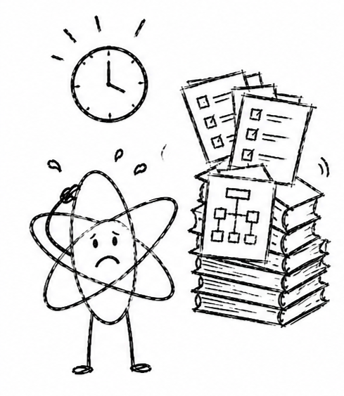
Many lecturers hesitate because they think active learning means tearing up their whole course and starting from scratch. In reality, you can begin with tiny changes that leave your overall design intact and still make a difference. Gradually, you can build in more active learning components when you get good results.
In fact, most lecturers in studies on the topic do that; they make small changes to their lectures to promote interactivity, or replace a few elements of a course, rather than everything at once. More elaborate active learning strategies can for example be used to revive underattended or passive tutorials; check the examples and templates in the STEM active learning activity finder or read some of your peers best practice experiences.
Time constraints are a frequently cited barrier, but the literature indicates that modest planning yields large returns. Tackle the design of appropriate activities as a planning strategy that balances difficulty, duration, and course constraints. Actions that require little extra class time and that can be increased and/or reiterated over the years.
If your schedule is fully packed, it might actually be wise to reconsider the ILOs and end-terms. Sometimes content gradually increases year by year, without losing what is no longer appropriate. Or, reconsider the number of lectures and the content covered in each lecture, to prevent information and brain overload (also see Why active learning works in STEM).
- Start small, for example with a few-minute active element per class hour (see tips here). Set a guideline, such as “every lecture will include at least one question students answer and discuss”. Or, “every tutorial will have a structure with a brief plenary check-in” (see the teaching activity Tutorial check-in and check-out). Once that habit is in place, you can gradually add more structure if you want.
- Choose a single topic, tutorial or week to test a more active format. If it works, keep it; if not, tweak or move on.
- Don’t start alone; are there peers, co-lecturers or TAs who want to do something similar, or who are also responsible for the course?
- Reuse or adapt material you already have. For example, remove one or two steps from a worked example and let students fill them in during class. Build a library of reusable activities to reduce preparation time over the semester.
- Let UvA AI Chat help you by tweaking or adjusting an example workflow specifically to your course, creating relevant quiz questions, or making a lay-out or timeline for your lecture or tutorial.
Freeman, S., Eddy, S. L., McDonough, M., Smith, M. K., Okoroafor, N., Jordt, H., & Wenderoth, M. P. (2014). Active learning increases student performance in science, engineering, and mathematics. Proceedings of the National Academy of Sciences, 111(23), 8410-8415. https://doi.org/10.1073/pnas.1319030111
Gierczyk, M., Karwowski, M., Paas, F., & H. Tai, R. (2025). STEM Workshop Learning: Content Load Effects on Cognitive, Interaction, and Emotional Outcomes. The Journal of Experimental Education, 0(0), 1-22. https://doi.org/10.1080/00220973.2025.2513254
Lombardi, D., & Shipley, T. F. (2021). The Curious Construct of Active Learning. Psychological Science in the Public Interest, 22(1), 8-43. https://doi.org/10.1177/1529100620973974
Lugosi, E., & Uribe, G. (2022). Active learning strategies with positive effects on students’ achievements in undergraduate mathematics education. International Journal of Mathematical Education in Science and Technology, 53(2), 403-424. https://doi.org/10.1080/0020739X.2020.1773555
Singh, J. (2025). Correlation between cognitive load, learning strategies, and academic succes in STEM subjects. International Journal for Research Publication and Seminar, 16, 35-44. https://doi.org/10.36676/jrps.v16.i4.319