







Misconception 1: Active learning means no more lectures
You can still do lectures when you start implementing active learning. Active learning is not a complete replacement of lectures. It rather is a set of practices that can be woven into, and enrich, a lecture‑based (or any) format.
Brief activities function as ‘brain breaks’ from listening. They keep engagement high and leave room in the brains’ working memory to receive information (see Why active learning works in STEM). Examples that take only a few minutes are problem‑solving pauses, quiz questions, predicting a next step, true/false statements, or think‑pair‑share activities, and much more; check these simple tweaks for easy activities.
So, see active learning as a spectrum; a variety of teaching methods to let students actively engage with the content during class. It goes beyond the passive transmission of knowledge and encourages students to think critically.
- Add short, purposeful interactive moments to a traditional lecture and gradually increase their frequency as you become comfortable. Start with one 2–3 minute activity: a think‑pair‑share on a key concept, a quiz question, or “turn to your neighbor and explain this step. See also some interesting lecture tweaks in our First aid for passivity emergencies.
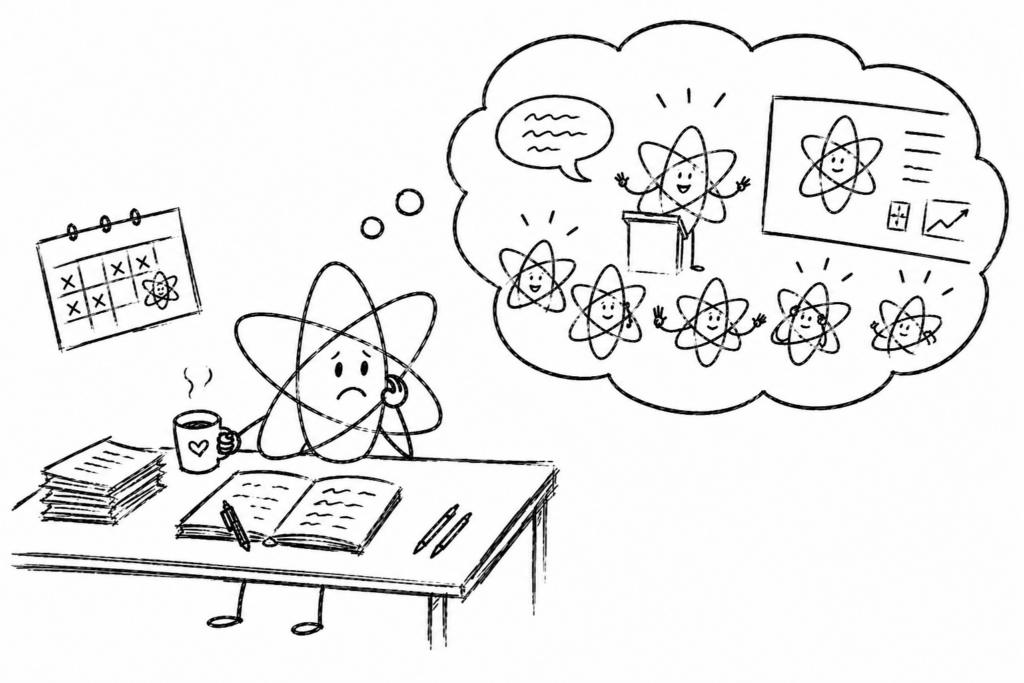
- If your first thought-response is: “But I already have too little time in my lecture to cover all the material so I just can’t lose any minutes to student activities!”, it might be wise to reconsider the number of lectures and the content covered in each lecture, to prevent information and brain overload, as described in
- Handout guide how to apply cognitive load theory to your course design by the Medical College of Wisconsin. For more information, see also our article Why active learning works in STEM.
- In tutorials, you can use ‘bigger’ active learning strategies than in lectures. Use activities that require deeper thinking and/or peer interaction, and that take from a few minutes to a full tutorial. Use the STEM active learning activity finder to find methods that fit your goal.
Bonwell, C. C., & Eison, J. A. (1991). Active Learning: Creating Excitement in the Classroom. 1991 ASHE-ERIC Higher Education Reports. ERIC Clearinghouse on Higher Education, The George Washington University, One Dupont Circle, Suite 630, Washington, DC 20036-1183 ($17. https://eric.ed.gov/?id=ED336049
de Jong, T. (2010). Cognitive load theory, educational research, and instructional design: Some food for thought. Instructional Science, 38(2), 105-134. https://doi.org/10.1007/s11251-009-9110-0
Dzaiy, A., & Abdullah, S. (2024). The Use of Active Learning Strategies to Foster Effective Teaching in Higher Education Institutions. Zanco Journal of Humanity Sciences, 28(4). https://doi.org/10.21271/zjhs.28.4.18
Lombardi, D., & Shipley, T. F. (2021). The Curious Construct of Active Learning. Psychological Science in the Public Interest, 22(1), 8-43. https://doi.org/10.1177/1529100620973974
Lugosi, E., & Uribe, G. (2022). Active learning strategies with positive effects on students’ achievements in undergraduate mathematics education. International Journal of Mathematical Education in Science and Technology, 53(2), 403-424. https://doi.org/10.1080/0020739X.2020.1773555
Evaluation, C. for E. S. and. (2026, februari 4). Cognitive load theory: Research that teachers really need to understand. NSW Department of Education. https://education.nsw.gov.au/about-us/education-data-and-research/cese/publications/literature-reviews/cognitive-load-theory.html
Gierczyk, M., Karwowski, M., Paas, F., & H. Tai, R. (2025). STEM Workshop Learning: Content Load Effects on Cognitive, Interaction, and Emotional Outcomes. The Journal of Experimental Education, 0(0), 1-22. https://doi.org/10.1080/00220973.2025.2513254
Lombardi, D., & Shipley, T. F. (2021). The Curious Construct of Active Learning. Psychological Science in the Public Interest, 22(1), 8-43. https://doi.org/10.1177/1529100620973974
Lugosi, E., & Uribe, G. (2022). Active learning strategies with positive effects on students’ achievements in undergraduate mathematics education. International Journal of Mathematical Education in Science and Technology, 53(2), 403-424. https://doi.org/10.1080/0020739X.2020.1773555
Singh, J. (2025). Correlation between cognitive load, learning strategies, and academic success in STEM subjects. International Journal for Research Publication and Seminar, 16, 35-44. https://doi.org/10.36676/jrps.v16.i4.319