




From Essay to Zine: Cutting, Pasting and Thinking in the Age of Generative AI
 |
How can an assignment reveal whether students are thinking for themselves when generative AI can produce polished academic prose in seconds?
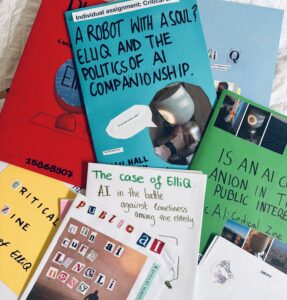
This question confronted Assistant Professor Delfi (Sol Martinez) Pandiani when designing Public AI, a capstone course within the Bachelor’s programme Global Arts, Culture and Politics. After teaching the 4-week course once, Delfi replaced the individual 2,000-word paper with something completely different the next time: a physical zine made with printed sources, handwriting, scissors and glue. The result was not simply a more creative assignment. It gave students a different way to read closely, analyze arguments and make their thinking visible. |
Concerns about the essayIn the first edition of the course, students wrote an individual paper in which they compared texts and developed their own critical position about the use of AI in the name of ‘public good’. While grading, Delfi noticed signs of generative AI use, with polished but very generic prose. More importantly, the papers did not always demonstrate the skills the assignment was meant to assess. Students struggled to distinguish arguments from facts, recognize assumptions and motivations underlying different public narratives about AI, and formulate a coherent perspective of their own. Because many were likely outsourcing the work to AI tools, they weren’t engaging in the intellectual heavy lifting. Rather than trying to make the traditional essay more difficult to complete with AI, Delfi decided to change the format of the assessment altogether. |
 |
 |
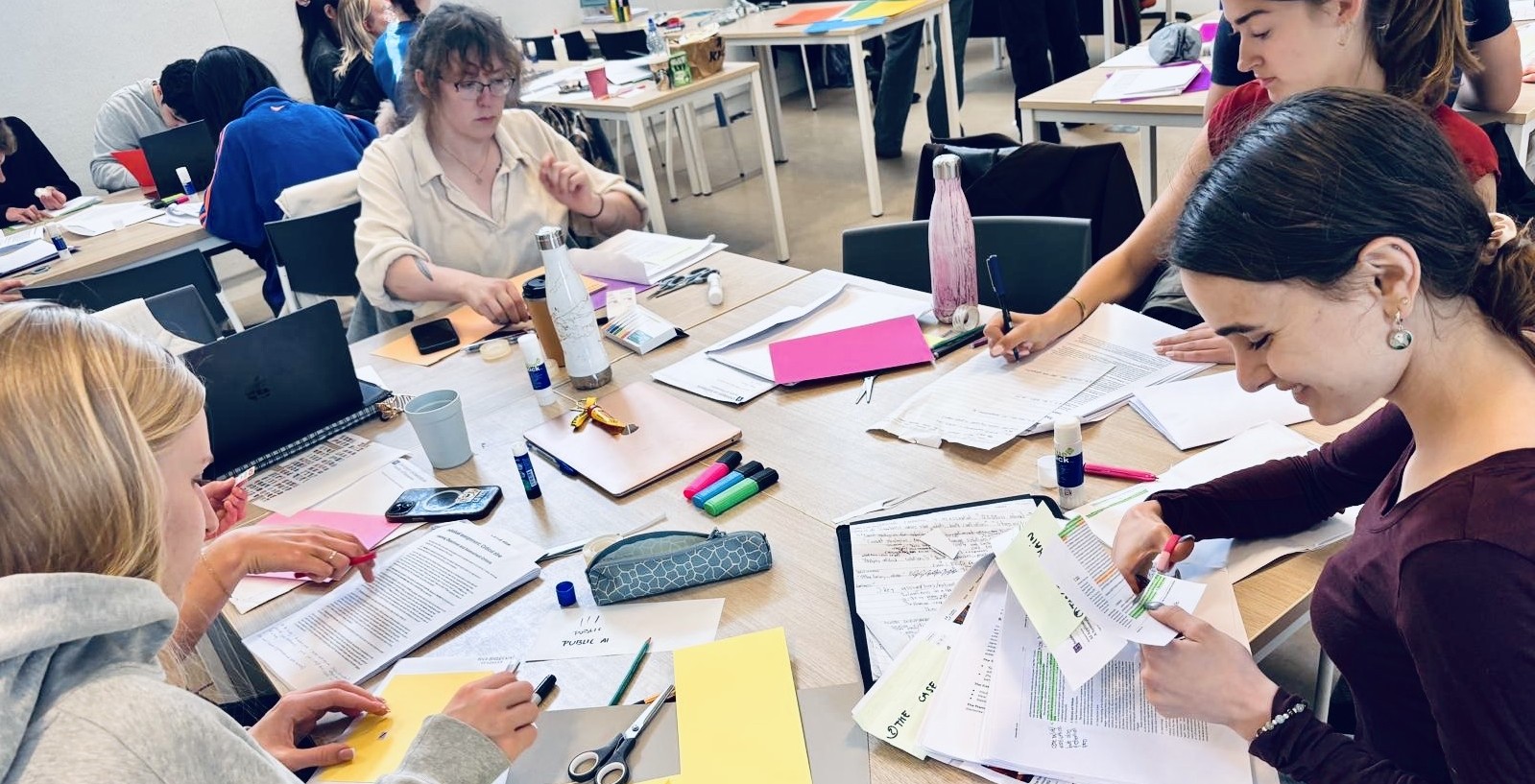
Reading, cutting and rearrangingIn the new version of the course, in the very first meeting each student received the same printed source pack containing a range of academic and public perspectives on a public AI case. Before beginning their zine, students had to read and annotate the printed material manually. In the following class, they cut up and reorganized the sources to identify arguments, assumptions and contradictions and develop their own position. They used handwritten explanations, quotations, spatial organization and visual connections to communicate their analysis. Delfi created a small “stationery station” with glue sticks, markers, coloured paper, sticker gems and other materials. Students were encouraged to bring their own pens, stickers and craft supplies. |
Making decisions visible
The physical format did not make AI use impossible. Students could still use it to brainstorm or clarify a difficult passage. However, it became harder to outsource the central intellectual work. Students had to decide which passages mattered, which arguments belonged together and how the relationships between sources should be represented. Those choices became visible on the page. One student described how the process encouraged closer reading:
“Sometimes I’d have two quotes and have to choose which one to include. It forced me to analyze the slight differences.”
The student explained that academic texts can sometimes be skimmed, whereas selecting and arranging individual passages required them to engage more closely with the language and content. The physical process also created a different sense of ownership. Completing the zine involved reading, identifying themes, organizing thoughts, cutting, collaging and gluing everything into place. Reflecting on the experience, the student pointed to that connection:
“I made this with my own hands.”
Enjoyable and academically meaningfulStudents responded positively to the new format. In an evaluation, 84% of respondents said they preferred the zine assignment to writing a traditional 2,000-word essay. One student described entering an “in the zone” state while working on the zine, something they did not always experience while writing. They found the assignment refreshing, visual and enjoyable, while still feeling that they were learning from it. One moment particularly stayed with Delfi. During the final discussion, a student said that the assignment had made writing their thesis seem more manageable. They planned to print the most important papers, literally cut them up and use the pieces to organize their argument visually. The assignment had therefore offered more than an alternative final product: it had introduced students to a method they could use in future reading, thinking and writing. |
 |
Stimulating creativity without assessing artistic talent
A zine assignment may sound intimidating to students who do not consider themselves artistic. Delfi was therefore careful to separate creativity from aesthetic perfection. Before introducing the assignment to the students, Delfi and their teaching assistant completed it themselves. One example was not particularly polished, but still demonstrated the required analysis and met the assessment criteria. Delfi showed it to the students to make clear that a beautiful zine would not automatically receive a better grade. Students were assessed on their ability to identify and evaluate arguments, recognize assumptions and contradictions, and develop their own position. The rubric was shared from the beginning to provide structure within an unfamiliar assignment. This balance was also important to one of the students who reflected on the course. Their advice to teachers was to make alternative assignment formats “out of the box, open and different, but not too open.” Creative freedom works best when students also receive clear materials, frameworks and assessment criteria.
Lessons for other teachers
Delfi believes that the combination of a curated (and printed) source pack and a physical design task could be adapted to other courses in which students compare sources and construct an argument. Their main advice is to test the assignment before giving it to students. A task that appears simple may take considerably longer than expected, and completing it yourself can reveal unclear instructions or unrealistic requirements. The rubric should also assess the intended learning objectives rather than artistic skills. Ultimately, Delfi’s advice is not to replace every essay with scissors and glue. It is about reconsidering what an assignment should make visible. As they put it:
“We don’t need AI for everything.”
When AI can reproduce the surface characteristics of academic work, alternative assignments can bring the interpretation, choices and thinking behind that work back into view.
Interested in reconsidering an assignment or developing an alternative form of assessment in the age of generative AI? TLC Humanities is happy to think along with you about course design, learning activities and assessment.