







Get co-lecturers on board with active learning
Active learning works best when it is a shared course approach, not the initiative of one enthusiastic course-coordinator. Involve colleagues early, agree on goals and a coherent design, and make space to try, learn, and adjust together. With shared goals and shared responsibilities, you can build a feasible course-design.
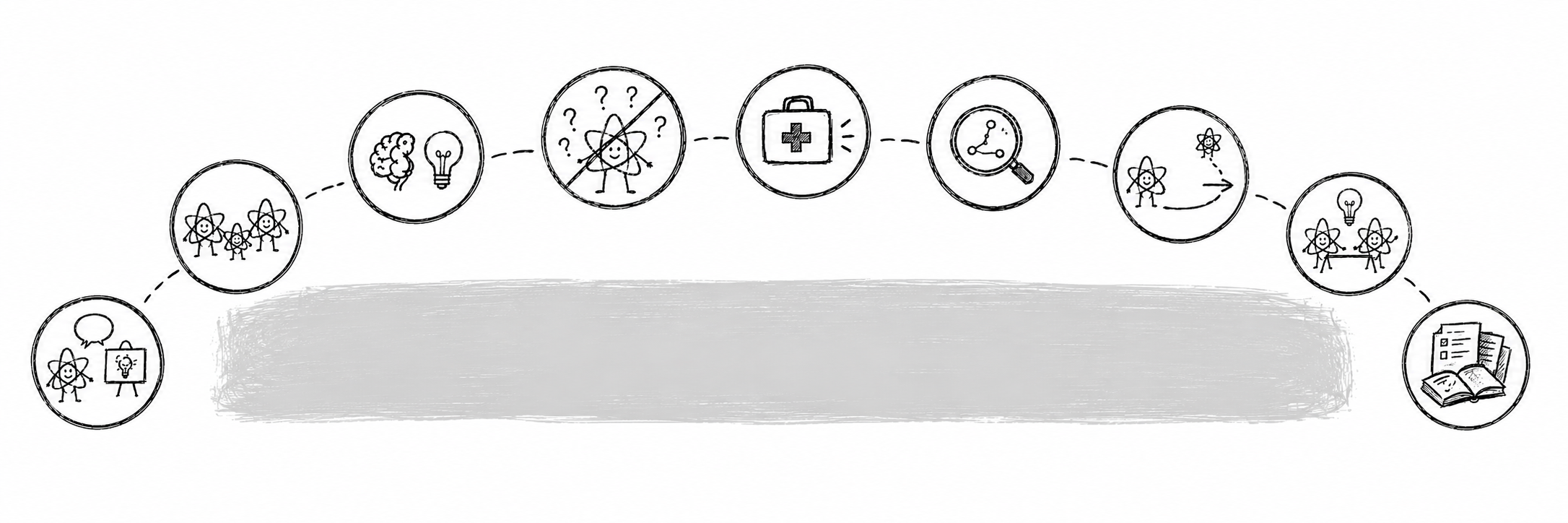
Here, you find 8 points of advice for getting co-lecturers and other regular instructors on board.
1. Work as a team from the start
 Invite co-lecturers, other regular instructors, and optionally also the TAs into the redesign before key decisions have been made. This creates shared ownership and makes active learning a course-wide approach rather than the coordinator’s personal project. Sustainable uptake is more likely where colleagues routinely collaborate on teaching and where active learning is supported as a shared practice.
Start with a kick-off meeting reasonably in advance of the course and in advance of the period in which you want to work on the (re)design.
- Ask each colleague what they want students to be able to do, not only know, by the end of the course.
- Agree on how decisions will be made and documented.
- If you work with TAs, but don’t necessarily wish to include them in the course design from the start (p.a. because they are different TAs each year, or you work with student TAs that haven’t been assigned yet), plan a separate meeting with the TAs to make sure that they are informed and on board with your design before the course starts.
2. Analyse the current course and set goals together
In your kick-off meting, start with a joint look at the present course: where do students struggle, disengage, or merely reproduce procedures? Which ILOs are (in)sufficiently reached? Then formulate a small number of concrete goals, such as improving conceptual reasoning, problem solving, participation, or collaboration. Based on those, decide how and which active learning methods can support those goals and learning outcomes.
If you wish, you can reach out to TLC Science for support or a fresh set of eyes for your teaching-team in this meeting.
- Map your course: make a timeline and add topics, learning outcomes, teaching activities and assessment moments.
- Divide your map into smaller portions (p.a. one or two course weeks, or per ILO) to add details such as specific assignments, homework, partial assessments, etc
- Identify one priority bottleneck per portion, such as misconceptions in a core topic or weak preparation for tutorials.
- Turn these into a measurable goal, for example: “Students can justify which principle applies before calculating.”
3. Start at a level that each lecturer can own

Do not require every colleague to begin with the most experimental or radically different teaching format if they are uncomfortable with that. A modest first step, such as structured small collaborative problem solving activities within a lecture, can be a sound entry point and can build confidence for later changes.
On the other hand, if the lecturers in your team are enthusiastic to experiment or use out-of-the box active teaching methods, offer space and autonomy for that.
- Offer a menu of activities at different levels of change, from one question per lecture to a fully flipped session.
- Do keep course coherence in mind; see the next tip (4).
- Let each lecturer choose one activity to try in the first weeks.
- Encourage colleagues to observe one another and borrow ideas that fit their own style.
4. Design a coherent student experience across lecturers
Students should encounter a recognisable approach throughout the course, even when lecturers have different styles. Avoid a situation in which one lecturer completely flips everything while others consistently return to uninterrupted lectures: this can make the active-learning sessions seem optional or unusual. Set shared minimum expectations, while allowing room for individual teaching personalities.
- Agree on two or three recurring short routines that everyone can do, such as a check-in and out, a short problem to solve in duos or triads, or recurrent types of polling using the same platform or style, etc.
- Use common wording when explaining why students are asked to participate.
- Share a simple activity template so that sessions have a familiar structure.
- Encourage colleagues to observe one another and borrow ideas that fit their own style.
5. Divide tasks fairly and visibly
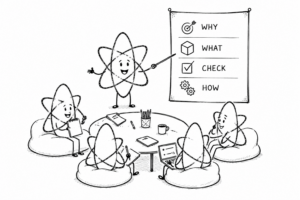 Active learning requires preparation beyond the classroom, including activity design, instructions, assessment alignment, and review of feedback. Divide this work according to colleagues’ expertise, interests, and available time, but make responsibilities explicit so that the innovation does not depend on one enthusiastic person.
- Create a shared task list with an owner and deadline for each item.
- Create an MS Teams for your course where you can share documents and course materials that are ‘in progress’ or finished.
- Divide tasks across designing activities, preparing materials, facilitating sessions, and gathering feedback.
- Pair experienced and less experienced colleagues to co-design one activity.
- Reach out to TLC Science for support, feedback or inspiration for new teaching methods and materials.
6. Meet during the course to monitor progress
Schedule short, regular progress meetings rather than waiting for the end-of-course evaluation. Use them to compare what lecturers observe, identify practical problems, and if necessary, decide on adjustments that an be implemented directly if something does not work well, before those become recurrent frustrations.
These are also good moments to share successes; if a certain approach worked very well for one lecturer, others can try to do the same.
- Hold a 20-minute meeting every two or three weeks with a fixed agenda: what worked, what did not, what changes next.
- Bring (one piece of) evidence, such as an exit-ticket response, attendance pattern, or common student question, to the meetings.
- Keep notes of every progress meeting; record decisions in a shared document so all lecturers work from the latest version.
- Create a Teams channel for the course where lecturers, and TAs, can quickly share experiences, observations, and materials, and where you can also store your meeting notes.
7. Explain the approach consistently to students
 Students may initially interpret the extra effort of active learning as a sign that teaching is less effective, especially when the format differs from what they expect. All lecturers should therefore explain the purpose of activities, clarify expectations, and connect participation to learning and assessment, and their validation should not be completely different from each other.
In the article Get students on board with active learning you can find more information and practical tips on how to support and validate towards students.
- Include a shared statement on active learning in the syllabus and introduce it in the first meeting.
- Before an activity, state what students will practice and why it matters for the course, and how it connects to a previous activity or lecture from another lecturer. U
- Prepare a slide with the course overview and/or course ILOs for all lecturers to use at the start of their lecture or tutorial, to highlight where the topic or activity of the day fits into the course as a whole. It will become a recognizable thread for the students.
- Similarly, prepare a slide or overview to use at the end of a lecture or activity.
8. Celebrate progress and reflect together
Make improvement visible, including small successes: a better student question, stronger group discussion, or an activity that reveals a misconception early. Highlight successes along the way, for example in a shared Teams channel or during progress meetings.
End the course with a structured reflection meeting on evidence, student feedback, workload, and each lecturer’s experience, then decide what to retain, revise, or expand next time. If you also have TAs in your course, include them in this meeting.
- Reserve part of the final team meeting for “what we want to keep.”
- Or, make a keep-kill-add wall: keep: what worked well and do you want to keep, kill: this didn’t work at all: test: this is what I’ve missed and want to try/what I’ve already added or tweaked. Let participants add their input in each section
- Share two or three examples of positive student work or feedback with the whole team.
- Encourage colleagues to observe one another and share something they found positive in their peers session
- Create a pleasant informal atmosphere by supplying snacks and drinks.
- If you have time, consider including a form of peer-consultation about a specific case or situation in the course. Peer-consultation (Dutch: intervisie) is a structured way to give collegial advice on a specific work situation. It can be about a problem, but also about a success (p.a. to find out what actions built the succes and how to use those for the future). In these template slides about peer consultation, you find more explanation and an example of an easy to use, 20 minute consultation technique. Other techniques can be found online.
Allen, G. K., Wedman, J. F., & Folk, L. C. (2001). Looking Beyond the Valley: A Five-Year Case Study of Course Innovation. Innovative Higher Education, 26(2), 103-119. https://doi.org/10.1023/A:1012288421619
Apkarian, N., Henderson, C., Stains, M., Raker, J., Johnson, E., & Dancy, M. (2021). What really impacts the use of active learning in undergraduate STEM education? Results from a national survey of chemistry, mathematics, and physics instructors. PLOS ONE, 16(2), e0247544. https://doi.org/10.1371/journal.pone.0247544
Dzaiy, A., & Abdullah, S. (2024). The Use of Active Learning Strategies to Foster Effective Teaching in Higher Education Institutions. Zanco Journal of Humanity Sciences, 28(4). https://doi.org/10.21271/zjhs.28.4.18
Freeman, S., Eddy, S. L., McDonough, M., Smith, M. K., Okoroafor, N., Jordt, H., & Wenderoth, M. P. (2014). Active learning increases student performance in science, engineering, and mathematics. Proceedings of the National Academy of Sciences, 111(23), 8410-8415. https://doi.org/10.1073/pnas.1319030111
Gaffney, J. D. H., & Gaffney, A. L. H. (2016). Student satisfaction in interactive engagement-based physics classes. Physical Review Physics Education Research, 12(2), 020125. https://doi.org/10.1103/PhysRevPhysEducRes.12.020125
Gilbert, R. O., & Gilbert, D. R. (2025). Student evaluations of teaching do not reflect student learning: An observational study. BMC Medical Education, 25(1), 313. https://doi.org/10.1186/s12909-025-06896-3
Nguyen, K. A., Borrego, M., Finelli, C. J., DeMonbrun, M., Crockett, C., Tharayil, S., Shekhar, P., Waters, C., & Rosenberg, R. (2021). Instructor strategies to aid implementation of active learning: A systematic literature review. International Journal of STEM Education, 8(1), 9. https://doi.org/10.1186/s40594-021-00270-7
Ryan, R. M., & Deci, E. L. (2020). Intrinsic and extrinsic motivation from a self-determination theory perspective: Definitions, theory, practices, and future directions. Contemporary Educational Psychology, 61, 101860. https://doi.org/10.1016/j.cedpsych.2020.101860
Semanko, A. M., & Ladbury, J. L. (2020). Using the Reasoned Action Approach to Predict Active Teaching Behaviors in College STEM Courses. Journal for STEM Education Research, 3(3), 387-402. https://doi.org/10.1007/s41979-020-00038-8