







Misconception 4: Students will resist active learning
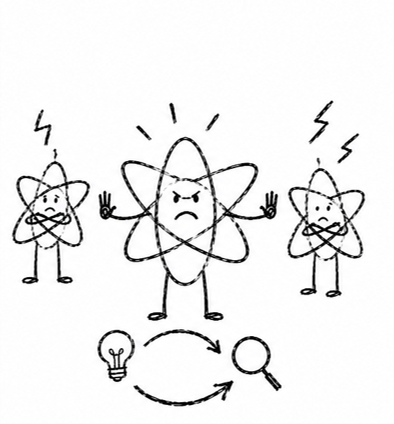
Student resistance is often assumed, yet in reality it is either short-lived, or absent. Deslauriers et al. (2011) found that 90% of students in an interactive physics course actually enjoyed the format, and believed they learned more. Only 1% disagreed.
Lecturers at our own faculty have good experiences too. In three courses that implemented active learning (physics, programming, and statistics), they reported that while technically the students did more work, they didn’t experience a higher workload at all. Rather, they appreciated the extra practice, and scored higher on their exams.
Resistance usually stems from unfamiliarity and perceived extra effort. Novice learners often don’t have strong insight into their own learning yet. Having to work instead of sitting back can make students feel that material is more difficult, whereas their grades actually improve.
In a controlled study in introductory physics, fluent, traditional lectures were compared to best-practice active instruction using the exact same content. Students in the active classes learned more, but reported feeling that they had learned less. They rated the passive lectures more highly, as those felt comfortable and easy, even though they students scored lower on tests.
That means that students may not always enjoy it from the start. There is some ‘discomfort’ to overcome. But when the course structure and goal and are explained upfront, and early assessment shows students where they stand, students see the gains in their own performance, and start appreciating the learning opportunities.
- Begin each activity with a brief “why this matters” explanation, and collect quick feedback so you can adjust expectations and support. Use the first introductory lecture of your course to explain course structure and activities. For more information, see this page about how to get your students on board with active learning.
- Give students early-on small (formative) assessments in which they can recognise where they stand and what they’ve learned.
- Keep in mind this statement from a physics student, about tutorials where a lecturer experimented with quiz questions and small group assignments: “I loved those tutorials, because there was an actual learning activity prepared for us. Even though the assignments were a bit too easy, they were actually the reason I would go to the tutorial.”
Deslauriers, L., Schelew, E., & Wieman, C. (2011). Improved Learning in a Large-Enrollment Physics Class. Science, 332(6031), 862-864. https://doi.org/10.1126/science.1201783
Deslauriers, L., McCarty, L. S., Miller, K., Callaghan, K., & Kestin, G. (2019). Measuring actual learning versus feeling of learning in response to being actively engaged in the classroom. Proceedings of the National Academy of Sciences, 116(39), 19251-19257. https://doi.org/10.1073/pnas.1821936116
Dzaiy, A., & Abdullah, S. (2024). The Use of Active Learning Strategies to Foster Effective Teaching in Higher Education Institutions. Zanco Journal of Humanity Sciences, 28(4). https://doi.org/10.21271/zjhs.28.4.18
Tharayil, S., Borrego, M., Prince, M., Nguyen, K. A., Shekhar, P., Finelli, C. J., & Waters, C. (2018). Strategies to mitigate student resistance to active learning. International Journal of STEM Education, 5(1), 7. https://doi.org/10.1186/s40594-018-0102-y