





From Bottles to Tsunamis: physics tutorials that build physics-intuition
In this best practice story, Sander Mann en Marcel Vreeswijk explain how they designed tutorials to build real physical intuition about waves and oscillations, for first‑year BSc Physics and Astronomy, with around 30 students per tutorial group. They combine in class online tests and card‑based group puzzles on realistic phenomena, and it super-boosted the pass rates and student attendance, even in non-mandatory classes.
Course: Trillingen en Golven (Waves and Oscillations), Institute of Physics
Students: 1st‑year BSc , ~180 students, ~30 students per tutorial group
Active learning design: Two tutorials, two complementary workflows
Each week, students can attend two different tutorials, each with a clear and distinct function:

Sander Mann
- Bonus test tutorial: Students work on a set of assignments, and the tutorial ends with an online, auto‑graded Canvas test that can earn bonus points for the final grade. The test is only available during a strict 15‑minute time window. Attendance is optional, but Sander is explicit: “This material will also be in the exam”.
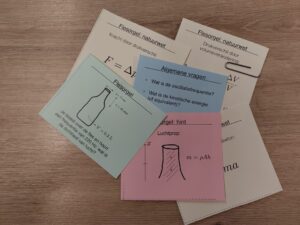
- Card‑set tutorial with realistic phenomena: Students work in groups of 4-6 with colour‑coded card sets. Each card-set comes in a fixed order: 1. the problem/assignment; 2. the basic physical laws that apply; and 3. hints, only available later in the tutorial.
Per tutorial Sander prepared six problems around phenomena described by differential equations and oscillations. Think: Blowing across a bottle, tsunami waves, molecular vibrations, or falling through a tunnel through the Earth. Student teams must connect those laws to lecture content and combine the formulae to find the solution.
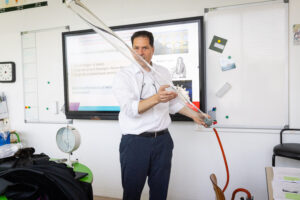
Marcel Vreeswijk (photographer: Peter Valckx)
The setup was inspired by a concrete observation: When a familiar equation used a different symbol (“u” instead of “x”), many students got lost. Sander wanted them to stop learning equations as tricks, and develop the kind of flexible reasoning physicists use. “Students need to see that oscillations occur in many contexts, and that the math is often the same, but you must learn to spot it.”
The redesigned tutorials were highly attended (almost 90%!) and students worked actively. Sander and Marcel think that three factors contributed to that:
- The assignments were challenging enough, so that coworking, sharing thoughts and knowledge, is visibly more effective than working alone.
- The bonus test was strictly timed. “I only awarded points if the test was completed within the correct tutorial slot. Else I have no way to check if they’ve taken it themselves, or had some AI help.” Students understood and accepted.
- Students got immediate insight in how far they understood the content. They quickly saw how attendance benefitted them. Some students who initially treated the course lightly (whilst enjoying student life) decided to step up their game. “And once they picked up the pace, they actually passed with good grades!”
Student experience: Engagement and practice

Students reported that the active tutorials added clear value for them. They enjoyed the puzzle aspect of the card‑sets and were motivated by the prospect of a bonus. And the pass rate was surprisingly high this year, even though the exam was not easy. “There were also quite a few tens!”. Sander had expected some workload complaints, but none came. Even though standard homework could not be finished entirely during tutorial time and thus became real homework, students were very satisfied with the course.
The format changed the role of the lecturers as well, constantly walking around and supporting student groups; students asked many questions this year. Groups differed in how far they got; some completed six problems, others did one or two, and that was fine. Marcel says: “I had to work really hard… But in a good way. I was in the active learning spaces in the G-building, and that worked very well. I could walk around and help to those who needed it for the topic they were working on, instead of plenary. I’m looking forward to teach the course again next year!”
Lessons learned and advice for colleagues: Presentations, workload and the role of structure
One surprising insight came from asking students to present their solutions at the whiteboard every now and then. Sander had heard horror-stories from colleagues about students hating this, but “They were actually very open to do it! I think the atmosphere in the classroom felt safe and informal.”
From an organisational perspective, doing it this way for the first time brought some start‑up issues, like errors in the online question set, or time-consuming handwork crafting the card sets. But the online tests have already been polished, and the investment in card sets will pay off in subsequent years.
Sander encourages other lecturers to use active teaching methods in tutorials, but stresses that the exact workflow should fit the lecturer and topic. “Pick a workflow that fits your course. If everyone does exactly the same, students will become fed‑up with it. Experiencing different designs across courses keeps students engaged, and challenges them in new ways”. Marcel further advices: “Use an active learning space, or one with flexible furniture. Make a group setting. It really helps with student-lecturer interaction.”
Get in touch and try it yourself
Sander and Marcel are open to get in touch with lecturers who want to know more, or try something similar. You can reach them via s.mann@uva.nl or m.c.vreeswijk@uva.nl.
Sander also recommends reaching out for support: “Definitely contact TLC Science to help you brainstorm, this gave me a basis to start the redesign of my course.”
You can also find this workflow in the activity finder: Card-set: Combine and calculate and Weekly test.