







Misconception 6: Active learning is always group work and too little individual practice
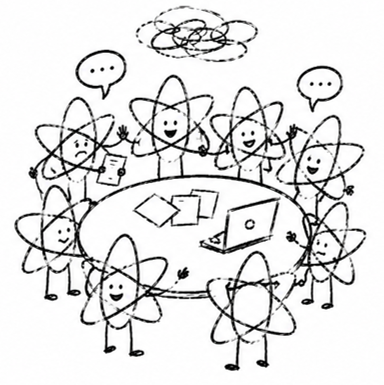
In fact, active learning deliberately balances individual practice with peer interaction and group work. It encompasses a wide range of strategies, many of which are actually individual, such as short written reflections, quiz questions, or problem‑solving worksheets. Nguyen et al. (2021) define active learning as activities that may be done “individually or in groups” and emphasize answering questions and solving problems on one’s own.
Individual practice can be combined with peer interaction in a set-up where students work solo but also compare solutions with neighbours, building further on a peers work (see the teaching activity Conveyor belt problem solving). Or, in tutorials that use an active learning method in the first hour, and leave time for solo practice and questions in the 2nd (see this best practice about building student ownership). Since many students also choose to do assignments at home rather than in a tutorial, individual practice can also be given as homework, allowing for deeper/ more complex content coverage in tutorials (see this best practice).
Interacting with peers in the field is a skill that students need to master, just like they should master the contents. Active learning methods that include peer interaction often require a deeper level of understanding the material. Applying such small activities can thus already be a win-win situation.
- Mix individual and collaborative tasks, alternate between them.
- Use activities such as think‑pair‑share, a 1 minute paper, or multiple choice voting to give every student a personal entry point before moving to peer interaction.
- Structure sessions in a way that a group session or task ends with an individual reflection moment around the learning goal, before any group debrief.
- In tutorials, create a balance between individual work and interactive work; divide tutorial time in active learning activities and solo practice time and be clear about this structure.
- Or, use one tutorial a week for interactive assignments and small group assignments, and another tutorial for individual work.
- Check the STEM active learning activity finder for teaching methods that suit your goal, or that you can easily tweak to your topic.
Bonwell, C. C., & Eison, J. A. (1991). Active Learning: Creating Excitement in the Classroom. 1991 ASHE-ERIC Higher Education Reports. ERIC Clearinghouse on Higher Education, The George Washington University, One Dupont Circle, Suite 630, Washington, DC 20036-1183 ($17. https://eric.ed.gov/?id=ED336049
Dzaiy, A., & Abdullah, S. (2024). The Use of Active Learning Strategies to Foster Effective Teaching in Higher Education Institutions. Zanco Journal of Humanity Sciences, 28(4). https://doi.org/10.21271/zjhs.28.4.18
Freeman, S., Eddy, S. L., McDonough, M., Smith, M. K., Okoroafor, N., Jordt, H., & Wenderoth, M. P. (2014). Active learning increases student performance in science, engineering, and mathematics. Proceedings of the National Academy of Sciences, 111(23), 8410-8415. https://doi.org/10.1073/pnas.1319030111
Nguyen, K. A., Borrego, M., Finelli, C. J., DeMonbrun, M., Crockett, C., Tharayil, S., Shekhar, P., Waters, C., & Rosenberg, R. (2021). Instructor strategies to aid implementation of active learning: A systematic literature review. International Journal of STEM Education, 8(1), 9. https://doi.org/10.1186/s40594-021-00270-7