






Welcome to the Science Park, new lecturer!
At TLC Science we offer support to all lecturers, relating to teaching, educational innovation, and professional development.
On this page you’ll find information and articles that are relevant for new employees with teaching responsibilities, and we’ll answer several frequently asked questions.
In addition, you can find extensive practical information on the faculty support for teachers page.
Frequently asked questions and relevant topics
If you’re (going to be) a course-coordinator, you can find extensive information in the introduction for course-coordinators.
NB first page currently in Dutch but all links are available in EN.
You can explore relevant educational topics on our website.
Training:
- For PhD students we offer specified didactical training modules on basic didactical skills. These are also open for other beginning lecturers.
- We also offer single workshops on various educational themes for all lecturers, and several useful e-learnings, ranging from blended learning and didactics, to AI and Canvas
Teaching Qualification:
- Lecturers who have already gained some teaching experience can can take a trajectory to obtain the University Teaching Qualification (UTQ a.k.a. BKO)
- Already have your BKO? There are various BKO+ tracks to deepen your skills.
If you want to increase your students’ learning outcome and boost engagement, we can support you in developing active learning methods. Whether you want to start small with a single tutorial or assignment, or aim to re-design a whole course, we offer:
- personalized advice, and 1 : 1 consultation; workshops on demand; and co-creation sessions for teaching teams. Get in touch to inquire
- Our faculty has several modern Active Learning Spaces with flexible set-up and various collaboration tools.
- We’re currently working on an Active Learning Toolbox specially for STEM classes – which generally include a lot of quantitative work. To be announced!
For a quick idea of what Canvas is, check the page on Canvas in the employee a-z list. For a detailed and helpful manual how to use Canvas, check the Canvas pages for UvA Instructors.
For Canvas-related questions: use the Help-button available on any Canvas page or e-mail datanose-fnwi@uva.nl
Prior to each teaching period, we offer a guided hands-on session to build your Canvas page.
Get acquainted with the UvA vision in the UvA Policy framework and guidelines on GenAI in education
You can browse the articles on Teaching and GenAI, and read about our UvA AI chat
Log on to the UvA AI chat here: aichat.uva.nl
You can also take a workshop on AI Literacy or on AI and assessment
The course-coordinator is responsible for assessment within a course. You can find extensive information and tips for course-coordinators on the course-coordinator support pages.
Do you want to change or refine the assessment in your course, or do you have any questions on grading and assessment? Check the online information on assessment, or take a workshop on AI and assessment .
You can ask for personal advice at the FNWI Assessment network.
In the A-Z list for employees, you can find information on plagiarism and fraud and the Teaching and Examination Regulations
TLC Science Library
Looking for books to expand your knowledge about teaching, assessment or other subjects relevant for lecturers? At TLC Science (SP B1.28b) there are many books you can borrow. In the next alinea you can browse the collection.
Link to Science Teaching Essentials on Science Direct
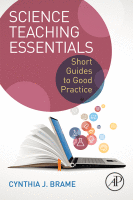 |
This online book, accesible for all, gives lecturers practical, evidence-based guidance for designing and improving science courses. Use its short, stand-alone chapters to develop a syllabus, choose effective teaching methods, assess students fairly and efficiently, and address common classroom challenges.
An accessible resource for lecturers in science, health sciences, and engineering, as well as for graduate students and postdoctoral researchers preparing to teach. |
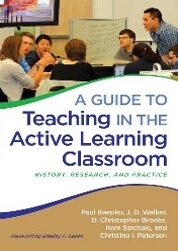 |
This book is intended for faculty preparing to teach in or already working in this new classroom environment; for administrators planning to create Active Learning Classrooms or experimenting with provisionally designed rooms; and for faculty developers helping teachers transition to using these new spaces
|
 |
How do you lead in the academic world? How do you support young as well as highly experienced staff members, and how do you manage your own manager?
In this booklet, Ben Verheijden offers a number of highly practical tools to help you gain a better grip on your work and think clearly about your next steps. |
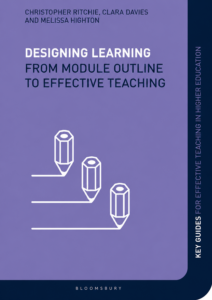 |
For lecturers designing or revising a course, Designing Learning provides practical, research-informed guidance for translating learning goals into a coherent learning experience. It supports the full design process, from early planning and selecting learning activities to preparing materials and communicating expectations to students.
The book also addresses common challenges in higher education teaching, including working with diverse student groups, using virtual learning environments and engagement tools effectively, and linking formal teaching with co- and extracurricular activities. Examples and case studies help lecturers evaluate and refine their course design over time. |
 |
Do you want to develop your teaching more systematically, but find it hard to turn insights and feedback into concrete changes in your courses and your career?
Developing Your Teaching: Ideas, Insight and Action offers practical, research‑based guidance for higher education lecturers who want to reflect critically on their practice and act on what they learn. The book provides structured prompts and strategies for enhancing teaching effectiveness, engaging students more deeply, using feedback productively, and planning your own professional and career development as a teacher. |
 |
Do you ever feel your lectures could be more engaging or better organised, but are not sure where to start—especially now that digital tools and diverse student groups add extra complexity?
Giving a Lecture offers clear, jargon‑free guidance for university and college teachers who want to design and deliver stronger lectures. Drawing on educational theory but focused on everyday practice, it covers planning and structuring lectures, using slides effectively, integrating podcasting and e‑lecturing, working with interactive handsets for active learning, embedding lectures in problem‑based learning, and lecturing in ways that support diversity and inclusivity. |
 |
Move beyond routine exercises towards inquiry-rich university mathematics teaching.
This book explores how students learn mathematics through inquiry in lectures, tutorials, and workshops—and how teachers can investigate and improve their own practice. Using a three-layer model of inquiry, it connects student learning, teacher development, and research communities. Combining a clear theoretical framework with practical cases, it is a resource for anyone seeking deeper mathematical learning in higher education. |
 |
Improve your day-to-day university teaching with practical, evidence-informed guidance.
Organised around four key areas—supporting student learning, course design, classroom teaching, and evaluation—this book offers clear strategies for lectures, seminars, and practicals. Each chapter includes examples, models, diagrams, and practical tools. |
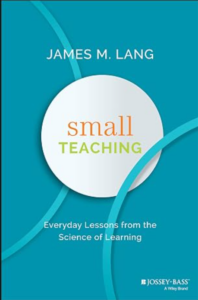 |
Do you want to use cognitive theory in your classroom, but struggle to translate research into concrete teaching practices? Many books stay theoretical and never really reach the level of your lesson plan.
This book is written for lecturers who want practical, research‑based strategies they can apply tomorrow. Drawing on cognitive theory, it offers a series of small, manageable changes that fit into a single class session, bridge the gap between learning research and everyday teaching, and can be integrated into your existing courses in any discipline. |
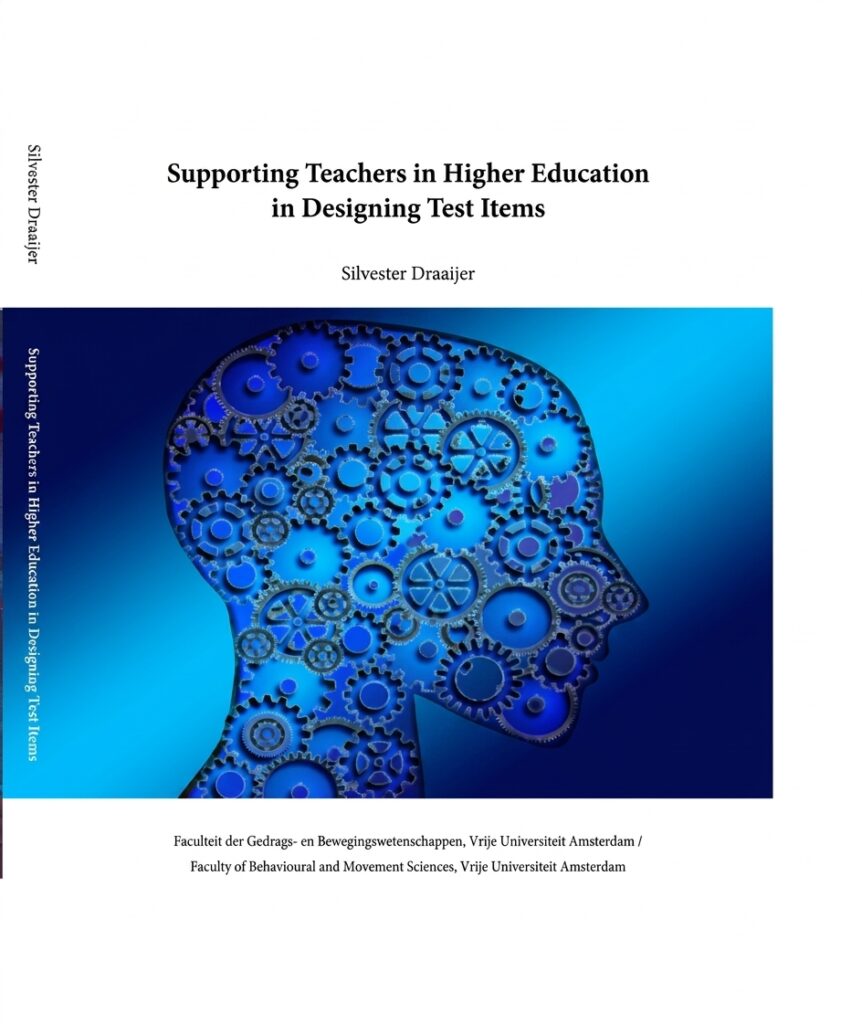 |
Do your tests really measure the kind of thinking you want students to develop—especially in large introductory courses where you often depend on multiple‑choice or other selected‑response items? When these items only tap memorisation, they steer students away from application, critical thinking, and problem solving.
This thesis examines how teachers actually write test items and how they can be better supported. Treating item writing as an ill‑defined design problem, it reports six studies that lead to practical tools and interventions. These resources help lecturers generate more – and better – ideas for test questions, and thus improve the quality of assessment and student learning. |
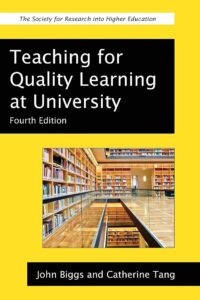 |
Align learning outcomes, teaching activities, and assessment to improve student learning.
This practical, research-informed guide explains constructive alignment in outcomes-based education. It helps you define clear learning outcomes, design activities that support them, and create valid assessments. With practical tsks and step-by-step activities, the book supports lecturers, educational developers, and university leaders in redesigning courses, programmes, and lessons. |
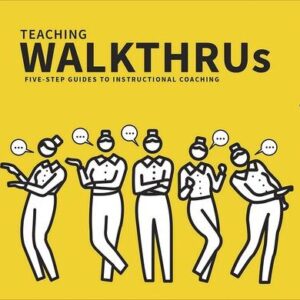 |
Put effective teaching techniques into practice straight away. This book presents 50 techniques for everyday teaching, each explained in five clear steps with simple visuals. It offers practical tools for building relationships, planning curricula, explaining and modelling, questioning and feedback, practice and retrieval, and Mode B teaching. Designed for immediate classroom use, these techniques help make complex ideas clearer and strengthen student learning. |
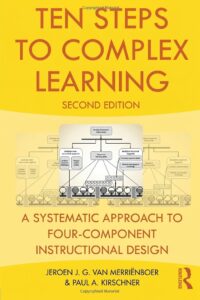 |
Do you need to design education for complex skills, but find it hard to turn training problems into concrete course designs? This book offers a clear, step‑by‑step approach from problem to training solution that you can directly apply in your own context. It can be used as a practical reference when designing courses, learning materials, or whole learning environments for complex learning. At the same time, it helps (future) instructional designers deepen their understanding of how to structure programmes that support students in mastering complex tasks. Designed for immediate classroom use, these techniques help make complex ideas clearer and strengthen student learning. |
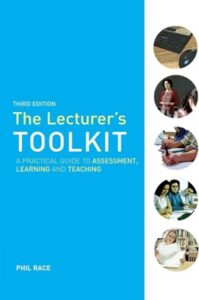 |
Strengthen your higher-education teaching with practical, research-informed strategies. The Lecturer’s Toolkit uses the Race model to help you improve your courses, whether you teach on campus, online, or with AI tools. It covers engaging learning activities, motivation, participation, assessment, feedback, group teaching, and teacher wellbeing. Clear outcomes, tips, and prompts make it easy to apply ideas directly to your own modules. |
 |
Do you want to improve assessment in your programme, but feel overwhelmed by all the forms, rules and dilemmas involved? This book offers a clear overview of assessment and grading methods in higher education, and addresses key aspects of the assessment process such as ethics, fairness and students’ legal protection. With numerous guidelines and real‑life examples, it serves as a practical and inspiring resource for programme coordinators, examination and assessment committees, and (future) lecturers who want to design high‑quality, responsible assessments. |
 |
Is higher education still keeping pace with today’s world? Your students have changed, the labour market is shifting and the knowledge society demands broadly skilled graduates, while competition between institutions is growing.
This book helps lecturers and programme leaders who struggle with these challenges, offering insights from over thirty Dutch and Flemish experts on flexible, demand‑driven curricula, competence‑based teaching and assessment, student success, effective use of ICT and modern learning psychology, and quality assurance and management in a knowledge‑intensive environment. |
 |
Build coherent, high-quality programmes that support effective student learning.
This book combines constructive alignment in teaching and curriculum with strategic alignment at organisational level. It clarifies responsibilities for educational quality and introduces the SIE model as a practical tool for programme development. Addressing issues such as performance pressure, student participation, and self-directed learning, it is for lecturers, educational specialists, managers, and students. |
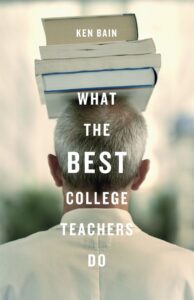 |
Why do some university teachers leave a lasting mark on students, while others barely register once the course is over? And what do those memorable teachers actually do differently?
Based on a 15‑year study of nearly 100 college teachers, this book distils the core principles of excellent teaching in higher education. Through vivid, often humorous stories, it shows how great teachers combine intellectual challenge with empathy and creativity, helping students discover new ideas and the depth of their own abilities—insights that any educator can adapt to their own practice. Addressing issues such as performance pressure, student participation, and self-directed learning, it is for lecturers, educational specialists, managers, and students. |