






Educational design
The educational design cycle
Designing a course, minor or even an entire programme is challenging: there are often good ideas, but also many challenges. For example, how do you ensure alignment with learning objectives and curricula, sufficient challenge for students, interactivity and more?
The ADDIE-model
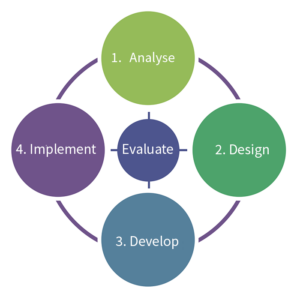 The educational design cycle can help you to start redesigning your course. This cycle consists of four steps that are based on the ADDIE-model (pdf 15p.), as well as teachers’, trainers’ and educators’ own experiences. It is an iterative model involving continuous evaluation. For each step, key points of interest are described.
4 steps in the educational design cycle
- Analyse: the aim of this first step, the analysis, is to map out all relevant information before you start designing.
- Design: for designing teaching and learning activities we use the principle of constructive alignment, developed by Biggs and Tang (1996).
- Develop: what else needs to be arranged before the course starts? Think of alignment with other courses and lecturers, study materials, course guides, etc.
- Implement: once the course has been developed, it is time to put it into practice. There are a number of important didactic considerations that help make the course a success.
Click on one of the steps in the educational design cycle to continue reading:
| 1. Analyse |
| 2. Design |
| 3. Develop |
| 4. Implement |
Below you can find articles from the TLC network about Educational Design. Also view the other didactic themes.

Education (re)Design Retreat
During 24 hours, innovate the design of your teaching with fellow UvA lecturers and TLC trainers.

Podcast: The Learning Curve
Introducing The Learning Curve! A podcast produced by Teaching and Learning Centre of the UvA Faculty of Social and Behavioral Sciences designed to inspire innovation and explore higher education. Tune in to The Learning Curve podcast today and join the global conversation on higher education!
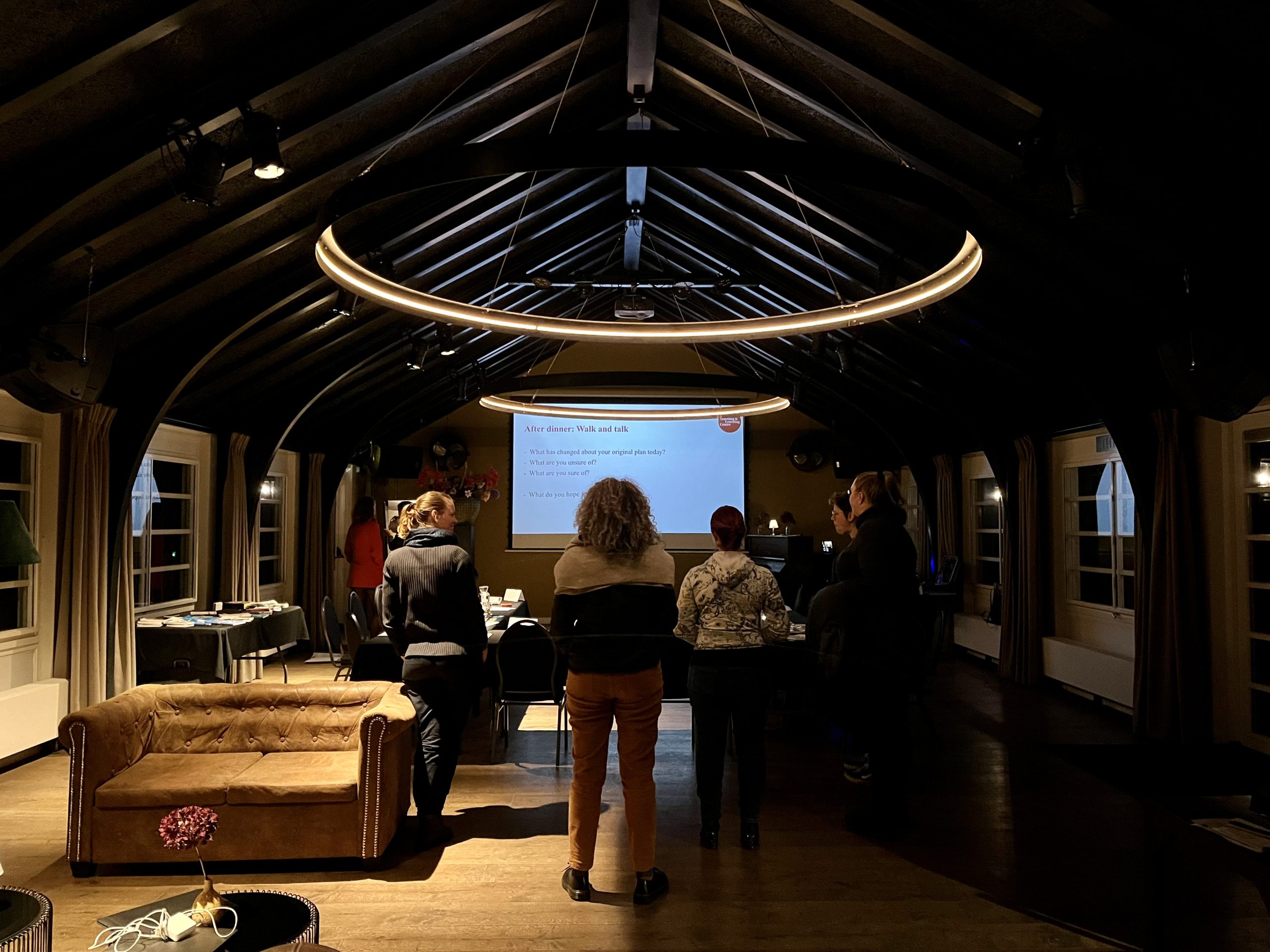
Recap: Education Retreat November 2023
On 16 and 17 November, UvA teachers from different faculties gathered at the 24-hour education design retreat. In this recap, the teachers themselves tell you about rapping colleagues, valuable workshops and (re)designing your education.

Getting started with the ABC learning design method
Education Design Cycle - Step: 4 implementing
The final step in the cycle is implementation. Once the craft has been developed, it’s time to put it into practice. There are some important didactic points to make the course a success.
Education Design Cycle - Step 3: developing
After designing the learning objectives, assessment and learning activities, you can move on to development: what else needs to be developed and arranged before the course actually starts?
Educational Design Cycle – Step 2: Design
To design education, we use the principle of constructive alignment: start with learning objectives, then assessment, finally learning activities.
Educational Design Cycle - Step 1: Analysis
The purpose of this first step, the analysis, is to identify relevant information before you start designing.