








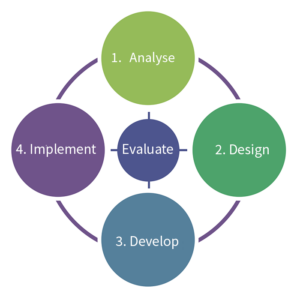
Educational Design Cycle – Step 1: Analysis
The purpose of this first step of de educational design cycle, the analysis, is to identify relevant information before you start designing. In the (re)design process, we tend to skip this step and start directly with the actual design (step 2). Yet an analysis can give you a lot: valuable information for the content of the design process but also involvement of colleagues, students and other parties. Below we ask you several questions linked to six key themes to guide your analysis.
1. Reason for the (re)design
What is the reason for the (re)design and how is it perceived?
There is almost always a reason for designing or redesigning education, such as: the student dropout rate is too high or the minor no longer meets students’ needs. It is interesting to engage with as many stakeholders as possible (students, colleagues, student advisors, etc.) so that the final product actually addresses the original problem. What do students experience in the course where the dropout rate is so high, what exactly is it due to? Do other teachers recognize this as well, how do they see this reflected in student behaviour?
Why is the subject relevant and/or useful to the student?
Often you know why you find the course relevant/useful as a teacher, but is this also clear to the student?
Questions to reflect upon
- How do the many other interested parties (students, colleagues, student advisors, etc.) view and perceive the reason for the (re)design?
- What exactly is the problem and how can it be solved?
- Can you use the programme committee, UvA-Q results or the work field to gather valuable information for the analysis?
- What do students learn and what does it contribute to?
- What do you want to train students to do?
- What would happen if you did not (re)design the subject?
2. Student characteristics
What student characteristics are important to consider during the design process?
Each group of students has different characteristics that can influence the learning process. By being aware of this prior to designing, you can cater to these characteristics as much as possible.
Questions to reflect upon:
- What exact prior knowledge do the students have?
- Is it a first-year BA subject or just a MA-subject and what does this mean for the independence/guidance the students need?
- Do the students already know each other well or not at all?
- What learning methods are they used to, such as group work or design-oriented teaching?
- What is the exact prior knowledge of the students?
- What group size do you expect?
- What percentage of international students do you expect and how can you take this into account?
- Are there any other specifics you need to take into account (mandatory/elective courses, disabilities, etc.)?
3. Assignment
What knowledge, skills and attitudes must the student acquire? And what is needed in terms of instruction/teaching to achieve this learning?
Try to concretise the content as much as possible and, in addition to the knowledge, focus precisely on the skills and attitudes students need to acquire.
Questions to reflect upon
- What did the students learn? What can students do after completing the course?
- What steps do students need to take to achieve the learning outcomes from their prior knowledge?
- What common misconceptions are there within the course content?
- What do you expect students to find most complex?
- What course elements do not necessarily need to be taught to achieve the outcomes? Kill your darlings…
4. Place in the curriculum
What place does the subject have in the curriculum?
We tend to (re)design subjects as stand-alone elements, while their place in the curriculum is crucial for learning outcomes.
Questions to reflect upon:
- What is the relationship with the learning guidelines and learning outcomes? Studying the learning guidelines and learning outcomes gives you insight into the goals of the program: what exactly are you working toward with the students? And what do the students need to achieve these goals? How do you ensure that the course matches the curricular and learning outcomes?
- How does the education to be designed relate to other subjects in the program? What knowledge and skills, related to the education you want to design, have the students already acquired before? And how do you connect the new subject to this ? Which learning objectives are already achieved (possibly at a higher level) in a previous course and can therefore be dropped/built upon?
5. Contextual factors
What contextual factors can influence your design choices?
In addition to the above themes, other contextual factors can also play a role in the design process.
Questions to reflect upon:
- What type of learning environment do you want to create? (e.g., powerful, safe, inclusive, etc.)
- What specific contextual factors play a role in your design? (e.g., online/offline, time constraints, peers, assessment opportunities, number of students, number and type of contact hours possible, parallel courses)
- What resources are available to you?
- What lessons learned from colleagues (inside or outside your programme) or from yourself can you use for your design?
- What (didactic) literature can you use to realise your design?
6. Feasibility
Is your (re)design achievable?
We often come up with very beautiful and big ideas during the design process, sometimes forgetting about feasibility for ourselves or the students.
Questions to reflect upon:
- Is the desired situation feasible within the time frame you have for this design?
- What additional knowledge and skills do you need to complete your design?
- Do you have all the resources needed to complete your design?
- Do you have possible blind spots during the development of your course? How can you gain a different perspective that will reveal these blind spots?
Support
Would you like to carry out this analysis systematically and would you like to spar with an expert? We are happy to help, you can contact us via the mail address of your TLC:
- EB: tlc-eb@uva.nl
- FdG/UMC:tlc@amsterdamumc.nl
- FdR: tlc-fdr@uva.nl
- FGw: tlc-fgw@uva.nl
- FMG: tlc-fmg@uva.nl
- FNWI: tlc-science@uva.nl
Support
Would you like to carry out this analysis systematically and would you like to spar with an expert? We are happy to help, you can contact us via tlc-eb@uva.nl.
Support
Would you like to carry out this analysis systematically and would you like to spar with an expert? We are happy to help, you can contact us via tlc@amsterdamumc.nl.
Support
Would you like to carry out this analysis systematically and would you like to spar with an expert? We are happy to help, you can contact us via tlc-fdr@uva.nl.
Support
Would you like to carry out this analysis systematically and would you like to spar with an expert? We are happy help, you can contact us via tlc-fgw@uva.nl.
Support
Would you like to carry out this analysis systematically and would you like to spar with an expert? We are happy to help, you can contact us via tlc-fmg@uva.nl.
Support
Would you like to carry out this analysis systematically and would you like to spar with an expert? We are happy to help, you can contact us via tlc-science@uva.nl.
 Go directly to…