





Looking back on the Higher Education Research Festival 2026
On Friday 19 June 2026, the University of Amsterdam welcomed teachers, researchers and policymakers to the Higher Education Research Festival: a full day dedicated to one central question: how can educational research and practice better inform one another in higher education? This festival offered an inspiring programme that ranged from classroom-based educational research to urgent debates about artificial intelligence (AI) in higher education.
This festival was hosted by the UvA’s Teaching and Learning Centre (TLC Centraal) together with the Amsterdam Interdisciplinary Center for Higher Education Research (AICHER).
A morning of Scholarship of Teaching and Learning (SoTL)
The morning programme centred on the work of participants in the TLC’s Education Research Fellowship: sixteen UvA teachers from across the university who are conducting research into their own teaching practice through the principles of the Scholarship of Teaching and Learning (SoTL). The Fellowship supports teachers in turning questions arising from their day-to-day educational practice into structured, practice-based research, with the aim of strengthening both teaching and student learning.
A broad range of projects
 Together, the Fellows offered a vivid picture of the range and relevance of educational research currently taking place at the UvA. Their projects were presented in three thematic rounds. The first focused on artificial intelligence and explored how AI might support student learning, including questions around feedback, assessment and the role of AI tools in educational design. The second addressed the challenge of teaching controversial or sensitive topics, with presenters creatively illustrating dilemmas through cartoons and references to popular culture, including South Park and Inside Out. The third round focused on the struggles students may face while learning, and on the ways teachers can support them, for example by strengthening self-regulated learning skills and helping students navigate complex learning processes more effectively.
Interactive poster session and a reflecting panel
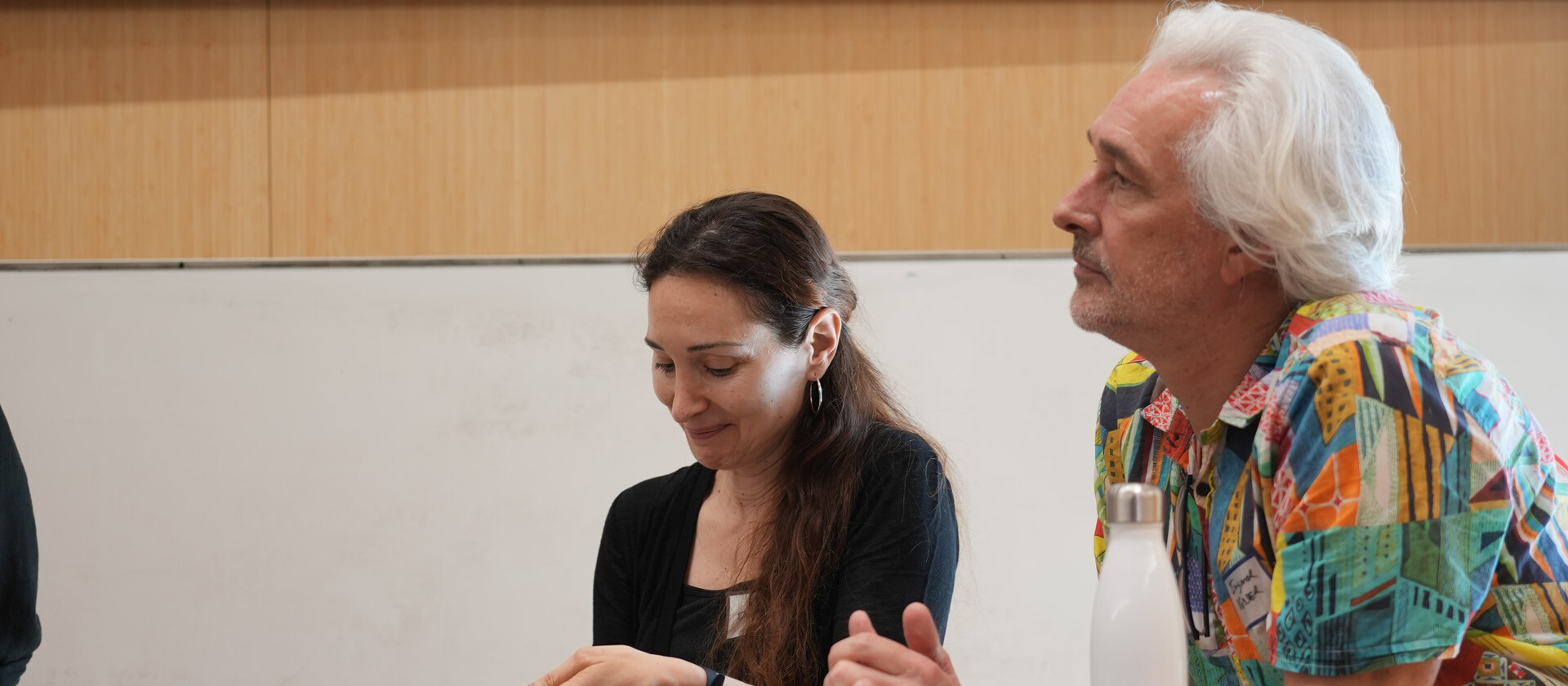
| Following short plenary pitches, participants were invited to “wander and wonder” through an interactive poster session, where they could engage directly with theFellows and explore the projects in greater depth. The format created space for lively discussion and exchange, and made visible what SoTL can offer as a bridge between educational practice and educational research.
A panel of SoTL experts from Vrije Universiteit Amsterdam (VU) then reflected on the presentations and posters, drawing connections with ongoing work at the VU and sharing insights from their own experience. Their reflections underlined the importance of community building in SoTL – something they praised as a clear strength of the UvA community – and pointed to the opportunities for building stronger bridges between institutions.
One message stood out in particular: while the projects were strongly student-centred, students themselves could be involved even more actively in SoTL research. Their perspectives, the panel argued, are invaluable in shaping research questions, interpreting findings and identifying what matters most in educational practice. |
 |
An afternoon of AI in education
After lunch, the festival shifted its focus to one of the defining themes in higher education today: artificial intelligence. The afternoon programme, hosted by AICHER, explored what responsible and meaningful uses of AI might look like in research, teaching and educational policy.
A keynote on AI and three AICHER presentations
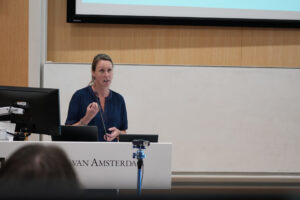 The keynote lecture was delivered by prof. dr. Inge Molenaar, Professor of AI and Education at Radboud University and Scientific Director of the National Education Lab AI (NOLAI). Her talk offered both a conceptual and practical lens on the role of AI in education. Rather than framing AI in terms of replacement, Molenaar argued for augmentation: the design of AI-supported learning environments in which humans and AI work in complementarity. The key question, she suggested, is not simply whether AI can perform educational tasks, but how it can be implemented in ways that genuinely strengthen learning rather than diminish it. Her keynote also connected directly to questions raised earlier in the day by the Fellows, including the role of AI in assessment and how tools might support, rather than short-circuit, student learning.
The keynote was followed by three AICHER presentations that brought the AI debate into concrete educational practice. Together, they explored a range of timely questions, including the responsible use of large language models in grading and assessment, the relationship between academic language and student success, and the potential of AI tools to provide students with personalised feedback. The presentations highlighted both the opportunities and the complexities of these developments, showing that AI is not a single phenomenon but a broad and evolving set of tools, practices and questions, each carrying its own pedagogical, ethical and institutional implications.
A lively panel discussion full of insight
| The day concluded with a panel discussion featuring representatives from the AICHER network, who reflected on what AI means for higher education policy, teaching practice and students themselves. One recurring theme was the relationship between AI, self-regulation and metacognitive skills. AI can support learning, but it can also encourage students to offload thinking in ways that reduce productive struggle and deeper understanding. The challenge, the panel suggested, is to find the “sweet spot” between using AI as support and relying on it so heavily that it bypasses the learning process.
A particularly lively part of the discussion focused on written assignments in the age of AI. If assignments are treated as “closed envelopes” that teachers only inspect once they are finished, panel members argued, assessment risks missing the most meaningful part of learning. Instead, they called for more attention to process: how students work, how they use AI, and what exactly we want them to learn. At the same time, the panel resisted simple narratives of AI as either good or bad. Its impact depends on how it is used, by whom, and in what educational context, which makes bottom-up policymaking, grounded in teachers’ experiences and educational research, more important than ever. |
 |
A shared agenda for the future of higher education
If one message resonated throughout the day, it was that the future of higher education cannot be shaped by research, policy, or practice alone. The festival highlighted the need to bring these domains together: through teachers who investigate their own classrooms, researchers who connect evidence to educational design, policymakers who create space for thoughtful experimentation, and students whose perspectives should remain central throughout.
Just as importantly, the day underscored the value of continuing to experiment, and to research those experiments carefully. As higher education grapples with questions around AI, assessment and student learning, initiatives such as the Education Research Fellows programme and AICHER create space to test ideas, share perspectives and reflect on what meaningful education should look like in a changing world.
Thanks to the inspiring contributions from all our participants, keynote speaker, and panelists, the Higher Education Research Festival offered not only a snapshot of current developments, but also a strong impulse for the conversations still to come.