








What is GenAI?
Generative AI (GenAI) refers to a category of AI systems that generates new content, such as text, images or audio, in response to user input. This differs from non‑generative tools such as Grammarly or traditional spelling and grammar checkers. Those tools mainly analyse and improve existing text instead of creating new content. This technology is evolving rapidly. Its outputs are increasingly difficult to distinguish from human work, which raises understandable questions in higher education.
When used responsibly, GenAI can support teachers’ workflows and help generate ideas for learning activities or lesson design, and it can act as a practice or feedback partner for students. To support responsible use, the UvA has developed its own AI Chat for academic purposes. This offers a safer and more reliable alternative to commercial tools such as ChatGPT or Claude. With clear guidance from teachers and thoughtful course design, GenAI can contribute positively to learning and to the skills students need to develop.
To make informed decisions about the use of GenAI in teaching and assessment, it is important to understand the basics of how the technology works. Watch the video to learn more about what GenAI is.
Generative AI explained
A conceptual model of AI domains
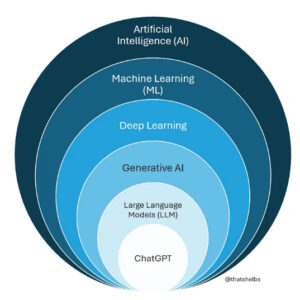
AI is often discussed as a single concept, but different types of AI do different kinds of work. As shown in the diagram, GenAI is a specific subset of AI, alongside machine learning systems that analyse data to classify, score or predict outcomes.
Machine learning systems typically produce constrained outputs, such as probabilities or categories. A familiar example is a streaming platform recommending a new series based on what you have watched and liked before. GenAI, by contrast, is designed to generate new content, such as text or images, in response to a prompt. Tools like ChatGPT are built on large language models. These models produce fluent and plausible outputs, but they do not evaluate correctness or understanding.
This distinction matters for teachers because it affects what AI should be used for, when its use supports learning goals and when it risks bypassing them. Machine learning can help identify patterns or risks in existing data. GenAI is better used to support explanations, practice, feedback or idea generation – when paired with intentional educational design.
Figure 1: A conceptual model of AI domains, illustrating how Generative AI fits as a specific subset within the broader fields of Machine Learning and Deep Learning. Source: Ragunitb @ Medium
How GenAI and LLMs work
GenAI that generates text (e.g. ChatGPT, Claude, etc.) is based on Large Language Models (LLMs) which learn language patterns from ‘training data’ (a vast collection of existing texts in books, articles, websites). Through probability, LLMs predict which word is most likely to come next in a sentence, and then sample from these possibilities, rather than always choosing the single most likely word.
This process enables LLMs to generate complex and well-written texts (called ‘output’) in different styles and languages in seconds, based on a user prompt (set of instructions or a question).
GenAI and limitations
Despite its many benefits, GenAI also has limitations. Users should be mindful of functional issues and ethical concerns, and use critical thinking to analyse and evaluate the output generated by GenAI.
Have a look at the e‑learning AI literacy for teachers or watch the video’s below to learn more about:
- the generation of false information (‘hallucinations’)
- bias in GenAI systems
- privacy issues
- sustainability issues
Videos
| GenAI systems | LLMs | Ethical issues | ||
Once you have a deeper understanding on what GenAI is and how it works, you can begin to plan how you might effectively design for or around it’s use, and build your AI Literacy.