








AI track within the Visible Learning Trajectories Programme
AI literacy at the curriculum level
 |
Generative AI (GenAI) has implications for what students need to learn, how we can ensure that assessment remains meaningful and valid, and how we can use GenAI to strengthen student learning. This calls for coherent decisions at the curriculum level, as well as support within the teacher team.
The AI track within the Visible Learning Trajectories Programme supports Bachelor’s and Master’s programmes in developing and implementing a coherent AI learning trajectory at the curriculum level.
During the AI track, programme teams make targeted, coherent decisions about the role and place of GenAI in the curriculum. These decisions are translated into concrete adjustments to learning objectives, learning activities, assessment and pedagogy, so AI literacy and the responsible use of GenAI become structurally embedded in education.
|
What does the AI track involve?
The AI track consists of three sessions across approximately three months.
Would you rather work on GenAI in your degree programme in one or two focused sessions? That is also possible. Degree programmes can follow the full AI track or choose one or two sessions that address their specific question and the stage they are at.
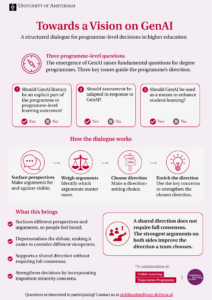 In a three-hour collaborative session, the programme team determines the direction for the role and positioning of GenAI within the programme. At the curriculum level, three key questions are central:
- Should AI literacy be explicitly included in learning objectives at the curriculum level?
- Should assessment be adapted in response to the possibilities and impact of GenAI?
- Do we want to use GenAI as a means to strengthen student learning?
The session can optionally be extended to include the formulation of learning objectives and/or learning trajectory objectives for AI literacy. This requires additional time.
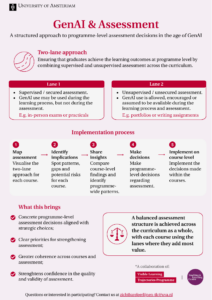 In this session, course coordinators explore what GenAI means for assessment using the two-lane approach: ensuring that programme-level learning outcomes are achieved through a combination of supervised and unsupervised assessment throughout the curriculum.
The central question is: which learning objectives should students master autonomously, without support from GenAI, and for which learning objectives is the use of GenAI permitted, encouraged or assumed to be available during the learning process and assessment? And what does this mean for how we assess these learning outcomes?
What does this bring?
- Concrete decisions about assessment at the curriculum level, aligned with the strategic choices made.
- Clear priorities for strengthening assessment.
- Greater coherence between courses and assessment.
- Greater confidence in the quality and validity of assessment.
In this session, the programme team explores where and how GenAI can be meaningfully used to strengthen student learning. For example, by exploring how students can use GenAI personas to practise different roles and perspectives, or how GenAI can support them in formulating and refining research questions.
We determine whether and how GenAI will play a role in learning activities, what conditions and safeguards should apply, and how we can ensure consistent and responsible use across the programme.
Two expert trainers provide the pedagogical and AI frameworks: one trainer from the Visible Learning Trajectories Programme and one trainer from the faculty’s Teaching and Learning Centre. This brings together central and faculty-level expertise.
For the AI track, we recommend participation from the programme director, course coordinators, the Academic Skills coordinator and, preferably, a member of the Board of Examiners. Bringing together different perspectives helps ensure that decisions not only work for individual courses, but also contribute to a coherent approach at the programme level.
For session 1, ‘Towards a Vision on GenAI’, we also recommend inviting other interested lecturers and a student to participate.
AI as both a means and an end, for students and lecturers

The AI learning trajectory is designed around four quadrants. This framework helps to approach GenAI from multiple perspectives: as an end (what do students and lecturers need to learn about AI?) and as a means (how can AI support learning and teaching?). It considers both the role of students and that of lecturers.
The framework approaches the responsible integration of GenAI as an interaction between learning about AI and learning with AI. These two dimensions — AI as an end and AI as a means — are connected to the roles of students and lecturers, resulting in four interrelated quadrants.
By approaching GenAI as both a means and an end, the framework helps to design learning objectives, pedagogy, assessment and conditions for use in an integrated way. This makes visible what students and lecturers need to learn, how GenAI can support the learning process, and how these choices affect teaching and assessment.
Read more about the framework and the findings from the pilot projects in our article Educating in the Age of GenAI: Exploring AI Literacy Through Mutual Reinforcement in Higher Education, published in Trends in Higher Education on 30 May 2026.
More information & registration
Bachelor’s and Master’s programmes that have completed the Visible Learning Trajectories Programme and want to embed generative AI (GenAI) at the curriculum level can register for the AI track within the Visible Learning Trajectories Programme.
Degree programmes can follow the full track or choose one or two sessions that address their specific question and the stage they are at.
Do you have any questions or would you like to find out more? Contact us directly at zichtbareleerlijnen-tlc@uva.nl.
More information about the Visible Learning Trajectories Programme can be found at uva.nl/zlp.