








How do you structure feedback in thesis supervision?
When supervising a student writing their thesis, it is important to organize supervision meetings effectively and provide constructive feedback that the student can actually use. We provide you with guidance on how to structure the supervision process. This includes planning the supervision process and the first meeting, types of feedback questions, and factors to consider in terms of time commitment.
1. Preparation: shaping the supervision trajectory
Beforehand, you should consider how your supervision trajectory – and therefore your approach to feedback – will be structured, so that students benefit from the feedback as much as possible. You should also ensure that this fits within the number of hours allocated to you for thesis supervision, and complies with the guidelines or rules set by your programme regarding the number of meetings between student and supervisor. Points to consider:
-
- Which points will you give them feedback on?
Link these as closely as possible to the grading criteria. If you already have experience supervising theses, you are aware of the challenges students face and can take these into account. If you are new to this, it may be helpful to discuss this with colleagues. - In what format?
There are various ways of giving feedback, and you can vary your approach throughout the trajectory. These include oral feedback during a meeting, feedback via email or an audio recording, and peer feedback and/or group feedback if you are supervising several students at the same time. One advantage of oral feedback is that you can check whether the feedback is being received as intended and that the student is drawing the right conclusions about the next steps they need to take to improve the issue. This can make an oral meeting well worth the time invested. - When is it useful to give feedback?

- Which points will you give them feedback on?
Moments to consider might include occasions when you can monitor progress and those that coincide with the completion of a section. In your schedule, allow the student sufficient time to process the feedback before the next feedback session. Take into account the amount of time you yourself have available to supervise the thesis.
Roles in the supervision process
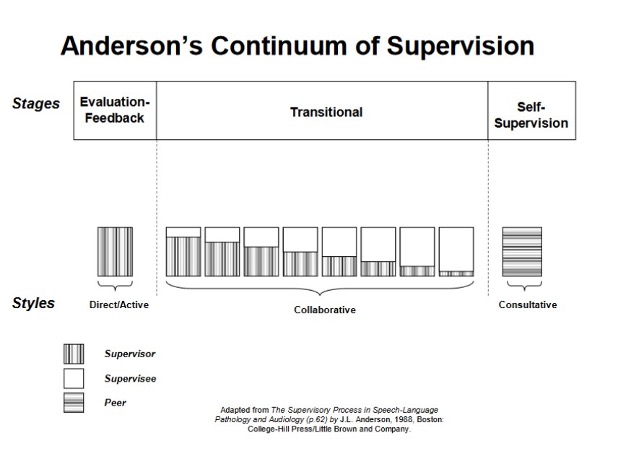
Students will need more and different types of supervision at the start than they will at the end. Anderson’s Continuum of Supervision illustrates how the supervisor takes on a more active and directive role at the beginning of the process. During the supervision process, the student increasingly takes the lead, whilst the supervisor assumes a more advisory role based on the student’s questions and needs (see figure opposite). This model illustrates the ideal scenario; the reality may vary from student to student.
2. Invest in the first meeting
During the first meeting, talk with the student to discuss your mutual expectations of one another in personal, procedural and academic terms (Kallenberg et al., 2014). This conversation provides valuable information to both parties for the remainder of the process. As a result, you will have a shared understanding of the supervision process and which aspects are important to both you and the student. The conversation is therefore explicitly a two-way exchange.
Clarifying expectations
- Substantive expectations
When it comes to substantive expectations, consider questions such as: Does the student know the requirements for the thesis? What is the student’s understanding of the thesis writing process? What ideas does the student already have for the thesis? - Procedural expectations
Points to discuss in terms of procedural expectations include, for example: How much time and how many feedback meetings are there for thesis supervision? What form will the feedback take? At what stages and on which aspects would the student like to receive feedback? And how? - The student’s personal expectations
It is also important to discuss expectations specific to the student in question: What are the student’s expectations regarding their own abilities? What motivates the student? What grade does the student hope to achieve for their thesis? What kind of support does the student need? What is important to the student when it comes to feedback? For example, do they feel it is important to receive plenty of positive feedback to help them stay motivated?
Any joint agreements can be put in writing. During review sessions throughout the trajectory, the supervisor and student can refer back to what has been discussed here.
3. Encourage students to ask targeted questions
When feedback is viewed as a shared responsibility, the basic principle is that both the student and the supervisor reflect on and address the learning needs of the other person and their own. This means that both parties ensure they provide and receive the relevant information.
Shared responsibility
De Kleyn identifies different types of questions that students use to seek feedback. To ensure that students retain ownership and, consequently, responsibility for their own learning process, they must first consider for themselves what information they need and what feedback question they should therefore ask. This can be done using the following questions, which you, as a supervisor, can ask the student to consider prior to each feedback meeting (De Kleyn, 2021):
Problem-based feedback request: ‘I’m stuck, what should I do?’
POWER:
- Problem description: What problem do I encounter?
- Option overview: What options do I see for solving this problem?
- Weighing options: How do I weigh these options in terms of pros and cons?
- Expressing preferred option: Given these pros and cons, what option(s) would I chose myself?
- Requesting feedback information: Could you give me feedback on this?
Next step feedback request: ‘Is this good (enoug)?’ or: ‘What do I need to revise?’
CLOSER:
- Current performance: My current performance, does (not) reflect the best I could do without additional assistance, because…
- Learning Objective: I would like my work to be evaluated on the following learning objective(s)…
- Self-Evaluation: This is what I think I did well and what I would need to further improve
- Requesting feedback information: Could you give me feedback on this?
Follow-up feedback request: ‘Is it good (enough) now?’ (When feedback has already been given before).
SUPER:
- Synthesizing: What are the main points of the feedback I got before?
- Use of feedback: How and why did I use the feedback?
- Performance/Product presentation: Hoe is dat terug te zien in mijn verbeterde product of prestatie?
- Emotional impact: What was the emotional impact of (working with) the feedback?
- Requesting feedback information: ‘Could you give me feedback on the extent to which my product or performance has improved as a result of my feedback use?’
This approach will enable students to gain a clearer understanding, through analysis and self-assessment, of what information they need to make progress. The feedback will be tailored to this need and better aligned with what the student requires. This could, for example, take the form of reassurance that they are on the right track, or a compliment if the student has developed or improved something effectively.
4. Feedback and time commitment
Giving feedback can be a very time-consuming task, so time management is crucial. Decide in advance how much time you want to spend on feedback. You might want to set a timer or start a set time before the student arrives for a meeting, so that you force yourself to focus on the most important points. First, read through the entire piece, decide what the three main comments are in relation to the final criteria, and write them down as concretely and specifically as possible. By reading everything through first and limiting the number of comments, you’ll also be able to provide feedback more quickly on higher-order issues such as structure, the central theme, the clarity of ideas and argumentation, and coherence.
Higher versus lower order aspects
Writers produce better second drafts when they receive feedback on higher-order aspects rather than lower-order ones (Underwood & Tregidgo, 2006). A well-known pitfall of giving feedback whilst reading is that you tend to focus too much on editorial aspects: word choice, spelling, punctuation and phrasing. This takes a lot of time and adds little to the student’s learning process. Furthermore, feedback on editorial aspects can be provided by AI and thus also processed by the student. Various faculties are working on the meaningful use of AI to support students in writing their theses and to provide feedback on various aspects. As soon as material is available for this, it will be made accessible.
Focus on the student’s learning process
In summary, there are quite a few factors that come into play when it comes to feedback and that determine its value. The most important thing is to have clearly articulated and discussed mutual expectations, and to keep the student and their (learning) needs in mind, whilst also taking into account the requirements of the thesis. This helps to ensure that, within the supervisor’s capabilities and requirements, the feedback aligns with what the student needs during the learning process to successfully complete the thesis.
- Anderson, J. L. (1988). The supervisory process in speech-language pathology and audiology. College-Hill Press.
- Kallenberg, T., van der Grijspaarde, G. L., ter Braak, A. & Baars, G. (2014, derde druk). Leren (en) doceren in het hoger onderwijs. Boom Lemma.
- Hattie, J., & Yates, G. C. R. (2013). Visible Learning and the Science of How We Learn. Routledge.
- Kirchner, P. Feedback verdwijnt nog te vaak in de boekentas | Blogcollectief Onderzoek Onderwijs, verkregen op 26/11/2024
- de Kleijn, R. A. (2021). Supporting student and teacher feedback literacy: an instructional model for student feedback processes. Assessment & Evaluation in Higher Education.
- Peschl M. F. (2007) Triple-loop learning as foundation for profound change, individual cultivation, and radical innovation: Construction processes beyond scientific and rational knowledge. Constructivist Foundations 2(2-3): 136–145. http://constructivist.info/2/2-3/136
- Winstone, N., Carless, D (2019) Designing Effective Feedback Processes in Higher Education. A Learning-Focused Approach. Routledge.
- Underwood, J.S., & Tregidgo, A.P. (2006). Improving Student Writing Through Effective Feedback: Best Practices and Recommendations. The Journal of Teaching Writing, 22, 73-98.