





Projects – TLC Didactic Innovation grant
The TLC Didactic Innovation grant
The TLC Didactic Innovation grant supports you in finding innovative solutions to your didactic challenges. These solutions can contribute to behavior change, engagement and knowledge transfer in education. On this page you can read more about the ongoing and completed project and their grant holders. The TLC Didactic Innovation grant changes themes annually. This academic year’s theme (2025-2026) is Assessment Reimagined.
Read more about the TLC Didactic Innovation grant and how to apply
Assessment reimagined (2025/2026)
Redesigning the Dental Skills 1 and 2 course with a psychomotor skills strand, shared rubrics and tools for student self-direction.
Maud van Dijke, ACTA
Shifting the assessment from the final report to substantiated research reasoning, methodological choices, reflection, and transparent use of AI.
Anna Kroese, ACTA
Integrating 3D scanning and AI-assisted analysis into preclinical dental education.
Oscar Carreres Talens, ACTA
Developing an in‑class challenge format as a new type of formative assessment to replace take‑home assignments that are vulnerable (to AI).
Siri Boe Lillegraven, EB
Students develop personas as a formative assignment, and are then summatively assessed in an oral examination on their critical evaluation of the persona output.
Johanneke Kroesbergen‑Kamps, Faculty of Humanities
Developing a curiosity‑driven, tinkering‑based assessment framework in which experiment, reflection and dealing with uncertainty matter more than a polished final product.
Ellen Jansen, Faculty of Humanities
A programmatic assessment approach to academic writing.” This project replaces the traditional single‑mark thesis model using multiple low‑ and high‑stakes assessment points, separating the roles of coach and assessor, and providing targeted support for supervisors.
Remco Jongkind & Lotte Barmentloo, Faculty of Medicine
An AI‑supported platform that continuously makes students’ study behaviour and competence development in pharmacotherapy visible.
Glenn Dumont, Faculty of Medicine
Shifting from students producing text themselves to evaluating and correcting AI‑generated content.
Ivana Busljeta Banks, Faculty of Social and Behavioral Sciences
Integrating generative AI into assessment as a source of structured formative feedback, in combination with instructor-designed assignments, rubrics, and student self-assessment.
Erdem O. Meral, Astrid C. Homan, Hannes Rosenbusch, Faculty of Social and Behavioral Sciences
A pilot of an integrated Academic Essentials curriculum in three Bachelor’s programmes, weaving academic skills into content courses, supported by bootcamps, clinics and coaching, with a programmatic redesign of assessment.
Tjomme Schilstra, Lisa van Pappelendam, Mimi den Uijl, Faculty of Science
Developing a scaffolded assessment framework for makerspace skills (e.g., microcontrollers and 3D printing) with clear criteria, formative micro‑tests and transparent rubrics.
Mimi den Uijl, Pim Linnebank, Morten Strømme, Faculty of Science
Redesigning the Research Designs course into a two‑part trajectory with a knowledge test and a skills‑lab portfolio, in which students follow a personalised workshop path and build a multimodal portfolio with reflection.
Anne Uilhoorn, Faculty of Science
A redesign of the thesis trajectory in light of GenAI possibilities for legal research and writing, so that the master’s thesis becomes an assessment of deep understanding and collaborative problem-solving.
Marco Loos & Lisa Lasseur, Faculty of Law
Student Engaged Learning (2024-2025)
An interactive e-learning module in Cadens helps students practice clinical reasoning through virtual consultations.
Floris Bikker, Academisch Centrum Tandheelkunde Amsterdam
By integrating game elements into math tutorials, this project increases engagement, corrects misconceptions, and enhances students’ learning experience.
Jacques Masuret, Economics and Business
By applying game-based learning to supply chain coordination, students can experience tactics in practice and better understand the underlying mathematical models.
Alex Kuiper, Economics and Business
Integrating creative writing assignments enhances student engagement and facilitates improvement in academic writing skills in the critical classroom.
Marc Farrant, Faculty of Humanities
By implementing weekly group projects in a biomedical context, students actively apply statistics through the entire empirical cycle.
Tomas Meijer, Faculty of Science
Students from different educational levels; vocational (MBO), applied sciences (HBO), and university (WO); collaborate seamlessly to tackle complex societal challenges, such as labor rights for vulnerable groups.
Francis Singleton, Amsterdam Law School
Amsterdam Law School
Gamification (2023-2024)
Aiming to enhance student engagement and teamwork in seminars, this project introduces Escape Room sessions for the Business Operations Processes course. The innovative approach goes beyond traditional exercises, creating a dynamic, fast-paced learning environment. The Escape Room seminars aim to improve overall student experience, stimulate critical thinking, and prepare students for future challenges in the field of business.
Addressing challenges in the Living Information – Media Studies course, this project aims to revolutionize the exam protocol. With a focus on large-scale engagement and the incorporation of gamification elements, the goal is to create an inspiring, fun, and constructive summative assessment approach. By pushing the boundaries of traditional exam methods, this innovation seeks to benefit not only the course itself but also serve as a model for improving assessments in other UvA large lecture courses.
This project introduces an “Escape the Classroom” game to enhance learning in Literature Swedish and ‘Van Yggdrasil tot urban slang.’ By fostering collaboration, critical thinking, and problem-solving skills, the game aims to create a cohesive understanding of course content. The adaptable format allows customization for broader application within and beyond the Faculty of Humanities, providing an interactive and enjoyable educational experience.
This project aims to revolutionize the teaching of qualitative data analysis in the Research Master’s Social Sciences program by introducing elements of gamification. The current challenge involves students’ varying levels of enthusiasm for coding and the disconnect between theoretical knowledge and practical application. By modifying existing board games and role-playing games, the project seeks to make coding more engaging and intellectually stimulating. The proposed games will guide students through analytically specific themes, fostering teamwork and structured collaboration. The desired outcome is an improved understanding of data analysis, increased motivation, and constructive group dynamics during coding sessions. The project not only aims to benefit the current course but also offers potential applications for qualitative research courses across the University of Amsterdam.
This project aims to develop an improved Python course for third-year BA Psychology students. The current issue is that students heavily rely on ChatGPT to solve tasks during the course, hindering their ability to learn Python competently and autonomously. The proposed solution involves changing the nature of the assignments, focusing on conceptual understanding and debugging existing code. This shift in focus aims to develop skills less accessible to AI, better preparing students to write their scripts with AI assistance.
This project proposes a unique approach to enhance students’ understanding of global security issues within the Politics, Psychology, Law, and Economics (PPLE) program at the Faculty of Law. The Integrative Seminar on Security, typically focused on theory, will incorporate active learning by having students design and run a crisis simulation. The simulation will encourage students to delve into diplomatic, military, and ethical aspects of international conflicts. By actively participating in the creation and execution of a crisis scenario, students will gain a more profound understanding of the complexities surrounding global conflicts. The project aims to bridge the gap between theoretical knowledge and real-world application, providing students with valuable experience in crisis management and international relations.
This project aims to address the challenges in the traditional teaching approach of Criminal Sanctions Law within the Faculty of Law. The current method lacks practical engagement, making it difficult for students to grasp ethical dilemmas and the real-world impact of legal decisions. The proposal suggests the development of an online, interactive serious game that immerses students in realistic scenarios, prompting them to make decisions from the perspectives of different legal roles (prosecutor, defense attorney, and/or judge). Leveraging modern technologies such as interactive and adaptive videos, quizzes, and online assignments, the serious game will be integrated with physical sessions to create an engaging and practical learning experience. The project aims to enhance student motivation, active learning, and ethical awareness by providing a safe environment for experiential learning.
This project aims to enhance the experiential learning experience in the MA Staats- en bestuursrecht module, specifically the “Migration game.” While the game introduces valuable elements, it needs refinement to align with the Dutch context and cater to the unique needs of the Dutch student population. The grant will facilitate the adaptation of content, incorporating national migration law and specific actors from Dutch legal practice. Additionally, educational support will be provided to optimize the game for diverse students, ensuring an engaging and relevant introduction to migration law.
This Faculty of Medicine project tackles the deficiency in lifestyle education within the Bachelor of Medicine program. By integrating gamification through challenges like the Supermarket Safari and Eiffel Tower Challenge, the initiative aims to move beyond theoretical knowledge. The project strives to empower future healthcare professionals with practical skills to promote active lifestyle changes, enhancing the overall health education experience.
Completed projects
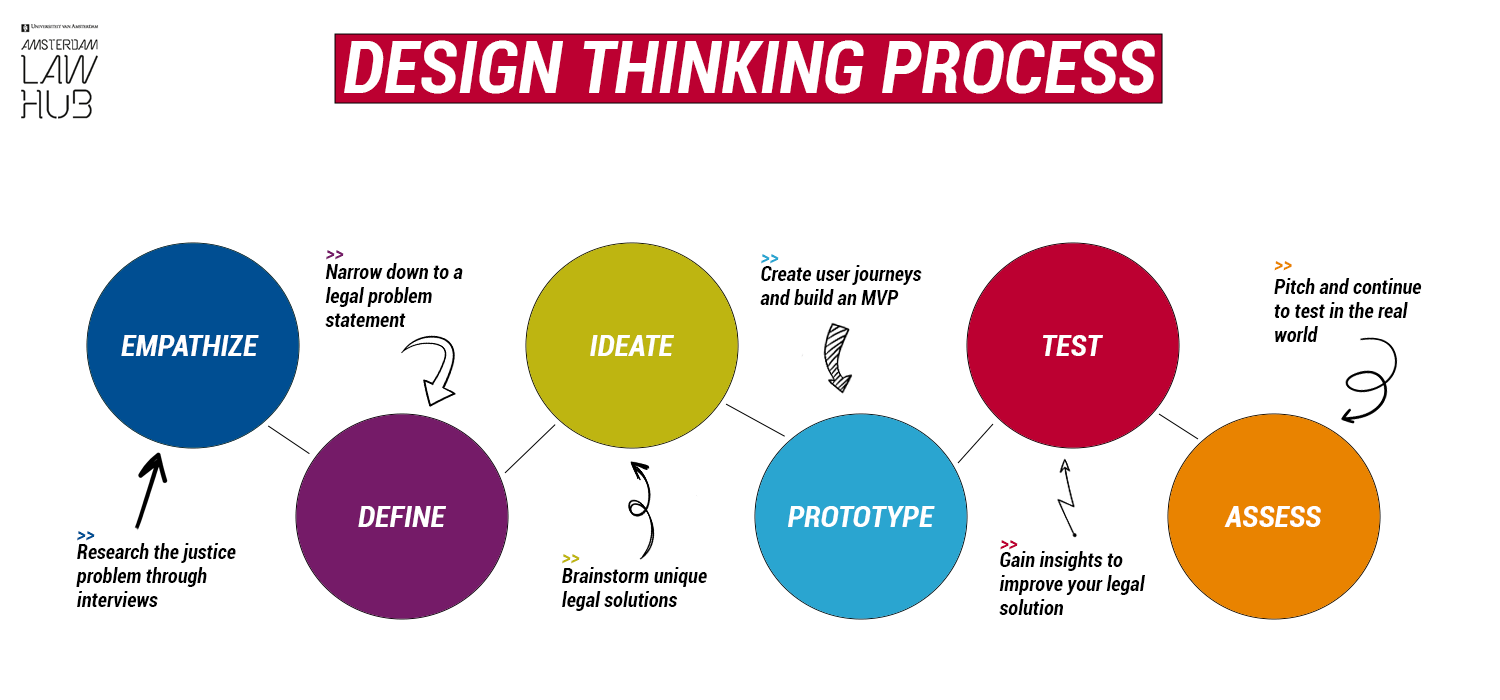 Nathalie Dijkman en Frances Singleton (FdR) give the master course Justice Entrepreneurship, for master’s student at the Faculty of Law. During this course, students develop a new legal product or service based on he design thinking method. With the TLC Didactic Innovation grant, they developed a digital design toolkit that students can use to support the development of their legal innovation.
 Lies Jacobs (FNWI) focused with the TLC Didactic Innovation grant on teaching three skills needed to navigate the increasingly complex world of (big) data collection and processing in environmental science: building self-confidence, essential coding skills and digital independence. Building on the principle of gamification and scaffolding, she developed the project as part of the World Food and Ecosystems course, a course for which the value of big data processing is self-evident. Read Lies her story of experience.
 Audiovisual communication has become an urgent necessity for biomedical scientists, and life scientists in general. The use of social media by scientists is strongly promoted by academic and funding institutions as a means of communicating with the general public and funding agencies. Scientific journals also often require scientists to be able to communicate their findings in simple terms using audio-visual forms of dissemination. However, most scientists are not formally trained for this task and therefore approach it in an amateur way or call on communication professionals. Such cooperation is often costly and coordination is often difficult. With the TLC Didactic Innovation grant Carlos Fitzsimons (FNWI) developed a set of learning activities aimed at promoting skills in multimedia and audiovisual communication, with broad applicability within the Bachelor of Biomedical Science, and other Bachelor’s programs organized at the FNWI.
 How can we train students from different backgrounds and majors to share their disciplinary knowledge in an accessible way? With the TLC Didactic Innovation grant Lela Mosemghvdlishvili (FdR) aimed to explore best practices of knowledge sharing among students from different disciplinary and methodological backgrounds, specifically in the context of designing an interdisciplinary research project. The main objectives were (1) to identify the essential skills and competences for successful interdisciplinary knowledge-sharing practices and (2) to design corresponding learning activities and assessment tools. Read the story of experience of Lela.
Within the clinical courses of one of our grant holders, they found it important to familiarize students with ‘real’ client cases to prepare them for their future work. Until now, this was mainly done through paper cases that were made up by the teacher. Students however indicated that they find it difficult to really empathize with such cases. That is why the grant holder wanted students to learn about the treatment experiences of real clients, while listening to podcasts. They recorded clients’ experiences about different stages of treatment among which: the first meeting with the therapist, the treatment itself, the relationship with the therapist and ending of the treatment. The goals were among others to improve student’s listening skills, increase their level of empathy and compassion and reflect on the effect of these experiences on themselves.