







Misconception 5: Active learning does not work in large groups
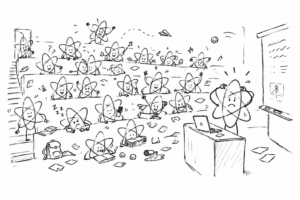
Actually, strong evidence that reports higher exam scores and lower failure rates with active learning comes from large lecture courses, often with hundreds of students in the room. Active learning is not just for small groups, but can easily be implemented even in very large classes.
The question is rather how to structure interaction so that it scales in a large group. There are many small activities that can be used in lectures and tutorials without you having to individually respond to each student, or to give feedback to hundreds of separate hand-ins. Check the examples in these best practice stories by your peers in maths or in cell biology. Or watch this video on using worksheets in a large algebra lecture to engage students.
- Design a small set of simple activities that you repeat every week so you don’t get lost in plans and logistics, such as these tweaks.
- Use fixed seating groups or “neighbours as partners” so you don’t waste time forming groups.
- Rely on peer explanation rather than trying to visit and speak with every row of students. Vary which rows you do catch up with.
- If you have teaching assistants or student assistants, deploy them as roaming facilitators to spot patterns and feed them back to you.
Apkarian, N., Henderson, C., Stains, M., Raker, J., Johnson, E., & Dancy, M. (2021). What really impacts the use of active learning in undergraduate STEM education? Results from a national survey of chemistry, mathematics, and physics instructors. PLOS ONE, 16(2), e0247544. https://doi.org/10.1371/journal.pone.0247544
Bonwell, C. C., & Eison, J. A. (1991). Active Learning: Creating Excitement in the Classroom. 1991 ASHE-ERIC Higher Education Reports. ERIC Clearinghouse on Higher Education, The George Washington University, One Dupont Circle, Suite 630, Washington, DC 20036-1183 ($17. https://eric.ed.gov/?id=ED336049
Deslauriers, L., Schelew, E., & Wieman, C. (2011). Improved Learning in a Large-Enrollment Physics Class. Science, 332(6031), 862-864. https://doi.org/10.1126/science.1201783
Dzaiy, A., & Abdullah, S. (2024). The Use of Active Learning Strategies to Foster Effective Teaching in Higher Education Institutions. Zanco Journal of Humanity Sciences, 28(4). https://doi.org/10.21271/zjhs.28.4.18
Freeman, S., Eddy, S. L., McDonough, M., Smith, M. K., Okoroafor, N., Jordt, H., & Wenderoth, M. P. (2014). Active learning increases student performance in science, engineering, and mathematics. Proceedings of the National Academy of Sciences, 111(23), 8410-8415. https://doi.org/10.1073/pnas.1319030111