







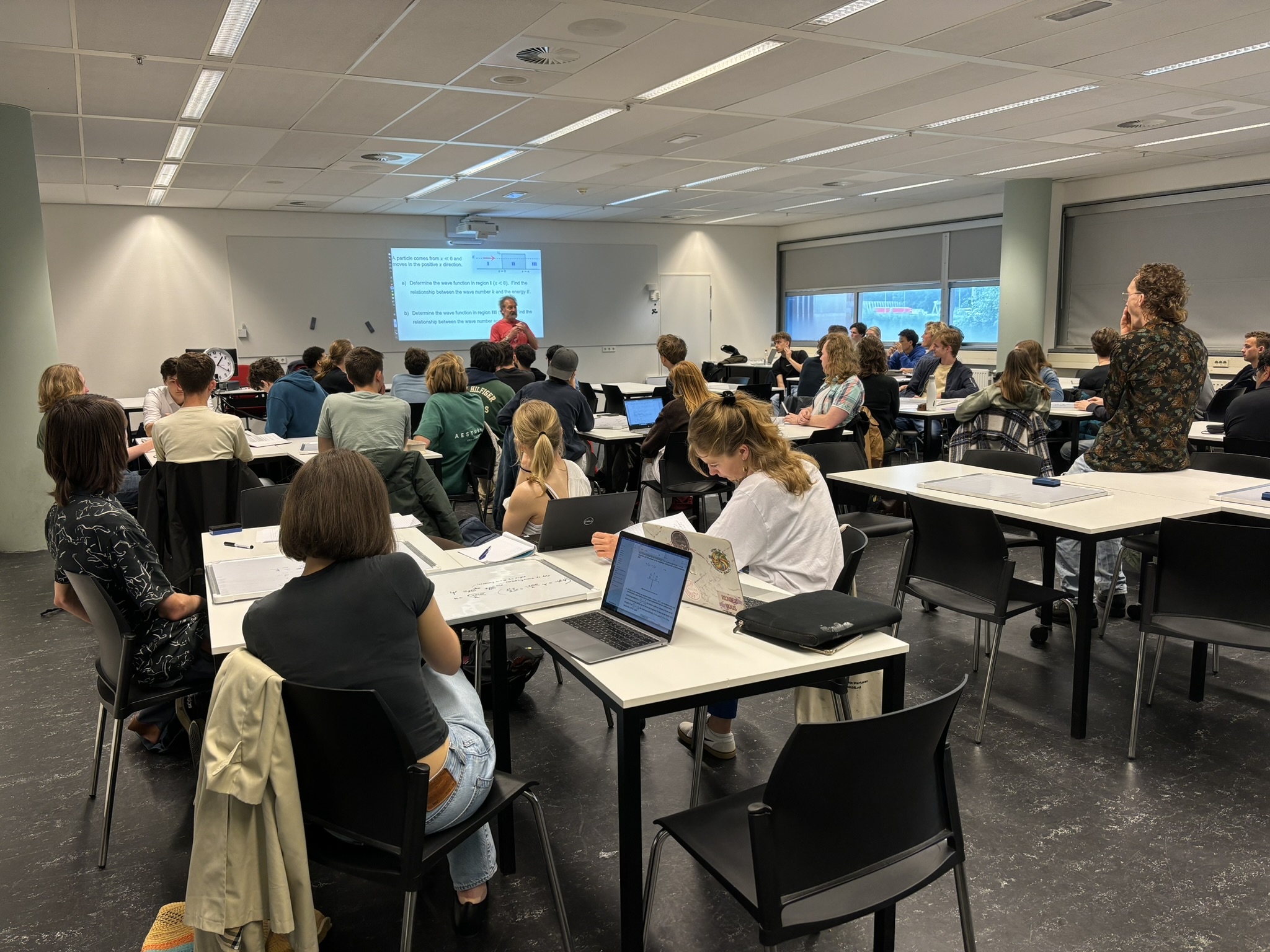
ActIOn: Activerend & Intensief Onderwijs (Active & Intensive Education)
Active learning encourages students to engage actively with course material rather than passively receiving information. This supports deeper understanding and participation. However, STEM lecturers may experience a threshold in applying active teaching methods as not all methods are suitable for complex, quantitative work. With the ActIOn project, we aim to offer accessible guidance, tailored support, practical examples, and reassurance about finding methods that specifically suit STEM subjects.
One of its results is the STEM Active Learning Guide: A digital platform filled with ready-to-use teaching formats and templates, evidence, peer-inspired practices, tailored advice and work sessions for STEM lecturers and teaching teams. It provides a central place for lecturers to explore approaches that fit their own course and teaching context.
Project information
 |
Project leader(s): Nina Scheres (TLC Science) and Emma Wiersma (TLC Science)
Educational innovation: Accessible guidance in any form, in-person and digital, for lecturers and teaching teams to support a transition towards active and intensive education at the Faculty of Science.
Duration: June 2025 – present |
Aims & objectives
Our ambition is to promote active and intensive teaching at the Faculty of Science, creating a learning environment in which students learn more deeply, and in which engagement and collaboration develops between students and lecturers. Lecturers who are not accustomed to active teaching need inspiration, motivation, and support to make this transition. However, if lecturers often encounter methods that do not seem suitable for complex and quantitative work, they experience a threshold to get started with active teaching methods. We therefore aim to provide targeted guidance and practical tools.
 Specific aims:
- To enable lecturers, individually and in teams, to sustainably design, implement, evaluate, and experiment with active learning.
- To offer opportunities for co-developing active teaching approaches with lecturers, tailored to the characteristics and challenges of STEM education.
- To lower the threshold or time investment for lecturers to experiment with active teaching methods, by offering ready-to-use or adaptable teaching formats.
- To provide lecturers with background knowledge and evidence on how active learning fits the way students learn complex subjects.
- To provide evidence-informed educational advice on the design of activating teaching activities.
- To challenge the traditional model of passive, lecturer-led education by sharing successful peer experiences with active learning in STEM.
- To support the availability of active learning facilities and resources at the campus.
Project highlights
 The STEM Active Learning Guide was created in response to many personal conversations with lecturers and/or teaching teams regarding their questions, courses, successful experiences and brilliant failures, examples or templates of their teaching materials, and their passion for good teaching.
We specifically thank Ellen den Ouden, Gerald Feldman, Jelle van Assema, Krystal Guo, Linde Lichtenberg, Lise Stork, Marcel Vreeswijk, Martijn Stegeman, Maurizio Costabile, Ricardo Paap, Dirk Hilbers, Richard de Boer, Sander Mann, Teun de Vries, Tom Meijer, and Vincent Blum for sharing their best practice stories with us. We also thank Morten Strømme for advice and support in designing the GenAI-created artwork with project mascotte ‘Stemmy’.
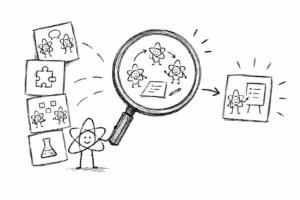 In the activity finder, lecturers can find easy‑to‑use (and adaptable) teaching activities suited for STEM or quantitiative education, each presented with a 5‑step implementation plan, a brief explanation of why it works, assessment advice, tips or alternatives, a hint of the teaching style to quickly see if it fits you, a handy list of requirements, and, when available, templates, examples, and links to peer best-practice-stories.
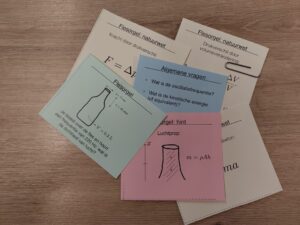 Together with lecturers in the Physics course ‘Waves and Oscillations’ , a course plan was designed in which traditional tutorials were transformed into active learning sessions.
A combination of in‑class online tests and card‑based group puzzles on realistic phenomena super-boosted the pass-rates and student attendance, even in non-mandatory classes.
 In the BSc physics, students asked for more structured TA-led tutorials, whilst lecturers were looking for easy-to-implement active teaching methods for their courses. In this pilot project, the program committee, lecturers, and TLC joined together to design a lesson plan based on student evaluations. It should assist TAs in planning and activating their tutorials, and it includes basic requirements and suggestions for activities, leaving room for personal choices. Lecturers and course co-ordinators provide extra TA support, and decide how detailed (or free) the lesson plan can be.
Three courses are currently trying out this lesson plan:
- Advanced Quantum Physics, 3rd year
- Electrodynamics, 2nd year
- Astronomy 1, first year