








Education Design Cycle – Step 3: developing
After designing the learning objectives, assessment and learning activities, you can move on to development: what else needs to be developed and arranged before the course actually starts? Here are some important things to arrange prior to the course.
Aligning content with other subjects and teachers
Coordinate the content of the subject with teachers of other subjects in advance. What place does your subject have in the overall curriculum? What knowledge and skills, related to your course, have students already acquired? And what learning objectives have already been achieved in a previous course that you might be able to build on? See also step 1: Analysis of the Educational Design Cycle. Don’t forget to coordinate with your fellow teachers and student assistants as to who has what role and what tasks everyone takes on.
Setting up digital tools
It is useful to determine in advance which digital tools you will use during the course to achieve the learning objectives. An overview of available tools can be found in the Tool selector on the TLC website. Tools for which the UvA does not have a license may not be used in education, because then the privacy and personal data of students cannot be guaranteed. Please find more information about processing personal data on the UvA employee website.
For questions and advice about using digital tools, you can always contact TLC Science and/or Team DataNose.
Setting up Canvas
Set up your course’s Canvas environment in advance. There are two points to watch out for:
- Make arrangements within the course about the Canvas setup. Keep approximately the same structure for all courses so that it is clear to students where they can find certain information.
- There are two logical ways to set up Canvas: one is chronological (content per week), the other is by topic (one module per topic).
Support
For questions and advice about using digital tools, you can always contact TLC Science and/or Team DataNose.
Arranging guest lecturers
If you would like to use guest lecturers or guest speakers, it is helpful to ask them far in advance about their availability so you can still adjust the weekly schedule accordingly.
Making a course manual
At the start of the course, your students will have access to the course manual through Canvas. This manual contains all information about the course, such as learning objectives, schedule and assessment procedure. Visit the course manual page on the employee website for more information on the required content, a sample, and information on managing and publishing the study manual.
In the course manual, also pay attention to UvA’s fraud and plagiarism regulations. Make it clear when fraud or plagiarism occurs in your course and what the consequences are.
Developing teaching materials
In advance of your course, you will develop all teaching materials you will need during the course, such as: PowerPoints, handouts, instructions for students and any student assistants, planning, formative tests and summative tests. It is important to pay attention to the accessibility and inclusiveness of all educational materials so that all information is accessible to everyone.
Arrange resources
Make sure all necessary resources are available to you and your students, such as:
- Textbooks
Students order their textbooks based on the information in the study guide. Check that the correct textbooks are listed for your course. If not, please notify the education coordinator. - Scientific articles and videos
Be mindful of copyright rules when using journal articles, book chapters or images in your teaching. See also the Library’s Copyright Checker for more information on what is and is not allowed at UvA and the information from the UvA Copyright Information Point. - Facilities in lecture rooms
On the staff website, you can find an overview of teaching rooms and how to book them. Also take a look at the dedicated FNWI Active Learning rooms. - Requesting Software
Standard software packages are installed at your workstation and in the teaching rooms. If you wish to use other software, you must request it in time. For more information, see the software page on the staff website. - Requesting Hardware
Request audiovisual equipment via the staff website, or view the hardware options under ICT > Hardware.
Students with disabilities
Students with a disability (such as dyslexia or autism) or a chronic illness are entitled to extra support. Please find more information about the support for students with dissabilities offered by the UvA. More information about extra exam time and other facilities can be found on the student website.
Making a student evaluation
At the end of a course, a standard UvA Q student evaluation is taken. These student evaluations help course coordinators and teaching teams to evaluate their teaching and ensure quality. You may add additional questions to assess how certain parts of your course were perceived.
Assessment
- Exam scheduling
The organisation and scheduling of examinations depends on the type of examination. Examinations can be conducted on paper or digitally in appropriate rooms. In addition, exam watchers can be hired. The course coordinator is responsible for passing on all necessary information for scheduling exams and resits. The programme’s Onderwijs- en and Examenreglementen (OER) specify when the date and time of the exam must be set by the latest. Please note: Digital exams must be requested in good time, and the options for digital testing depend on timetabling. See the ‘Organising exams’ page on the staff website for more information about exams. - Digital testing
Digital testing has several advantages, such as the use of functionalities not possible in a written exam (such as multimedia), automated review of closed questions and no unclear handwriting. Digital testing applications allow for different question formats, such as multiple choice, sorting, matching, hot spot, fill-in-the-blanks, short answer and open essay questions . In addition, you can use mathematical formulas, code and graphs. Tips on constructing good test questions and the number of questions in a test for reliable results can be found in Step 2: constructing in the Test Cycle. Support: If you are interested in the possibilities of digital assessment, please contact the Digital Assessment team at digitaletoets-fnwi@uva.nl. - Assessment plan
Please find the Assessment plan per programme on the staff website. - AI-proof
Increasingly, students and teachers are using Artificial Intelligence applications in education. These applications offer many possibilities, but can also be a threat to your current testing. It is important to make your testing resistant to unwanted use of AI. More information on this topic can be found in the didactic theme: Teaching & GenAI.
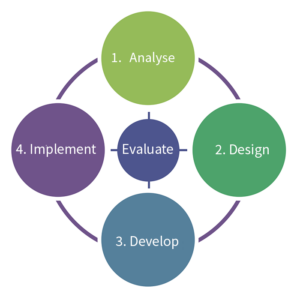 Go directly to…
| 1. Analyse |
| 2. Design |
| 3. Develop |
| 4. Implement |