







SCALE-UP: large quantum tutorials turned into vibrant sessions with co-working students
In this best practice, Gerald Feldman describes how he brought the SCALE‑UP collaborative learning approach from George Washington University to a first‑year Quantum Physics I course at our Science Faculty. Because of the numbers and the need for a specific room set-up, the class was split into two sections of 65-70 students, that were hosted by Gerald and assisted by 4 TAs per session. This made it possible to run highly interactive sessions with intensive guidance, even in a large‑cohort setting.
Course: Quantum Physics I, Physics and Astronomy (joint degree)
Students: 1st year BSc, ~140 students, divided into two sections of 65-70
Active learning design: SCALE‑UP for first‑year quantum
The course had a steady weekly schedule: Traditional lecture on Mondays, classic tutorial on Tuesdays, and SCALE-UP on Wednesdays or Thursdays (half the cohort each). On SCALE-UP days, students worked in groups of three on numerical and conceptual quantum problems and regularly presented their solutions, which became the basis for whole‑class discussion.
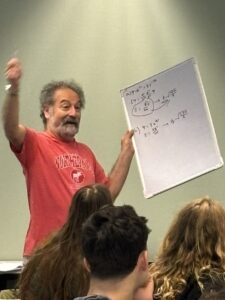
Gerald Feldman
In practice, a typical SCALE-UP session followed this repetitive structure:
- Gerald poses a quantitative or conceptual topic and question to the whole class.
- Students work in triads to solve the problem at their tables using a light-weight, hand-held whiteboard. TAs walk around and assist.
- One group is selected to present its reasoning and answer; Gerald would hold-up their whiteboard for the whole class.
- Students and Gerald together discuss the solution, compare approaches, and address misconceptions, before going to the next problem or topic.
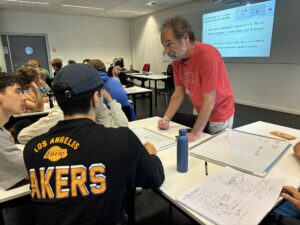
Gerald has used SCALE‑UP since 2008 for introductory courses at his home institution. In the original design, the room design plays a crucial part to stimulate student interaction. Applying the set-up here, to different quantum mechanics content and in a classroom that was not so interaction-friendly, was a bit of a challenge. But, creatively making do with what they had, room F2.04 was rearranged as in the picture below.
Student experience: Tackling complex quantum problems together


Students engaged seriously with relatively complex quantum problems in their groups. They did not just passively follow derivations; they actively tried to make sense of them. “I saw how students embraced the new classroom format, even though it was unfamiliar” says Gerald, “they collaborated within their groups, and were not hesitant at all to share their results in front of the full class”.
He notes that, although this active‑learning approach was new to most of them, “the students really committed,” and many themselves acknowledged how much it helped their learning. “I find it much better than the traditional way of teaching because you can discuss the material with your fellow students a lot, and even if you don’t know something, or even if your whole group doesn’t know, it’s easier to find the right answer together” a student commented in the evaluation.
That benefit seems to last. “Since we were so much stimulated to work together, it got easier to connect and work together also in other courses”, says student Julia, who took part in the course. “In the courses up to then, everyone was mostly working individually, but now we know that together you can go through the material more quickly. When you get stuck at a certain point, input from a peer gives a new perspective, so we reach out to each other.”
Here, Julia also sees a benefit for the future: “I also think that the skill to think and work together makes us nicer colleagues in the scientific field later on.”
More classwork, less homework
 Thus, the overall student reactions were very positive, with some natural variation in opinion. The team, in which Natasa Brouwer, Marcel Vreeswijk, Auke Pieter Colijn and André Heck of the Science Faculty took part, were even selected to write a book chapter for GIREP (the International Research Group on Physics Teaching), using evaluation data and student comments to analyse the impact.
From the course evaluations, they saw good overall ratings and they got insightful free‑response comments, which gave a nuanced picture. While a few students found the pace of work either too fast or slow, and some had to get used to the murmur of active work, most students highly appreciated being engaged during the full tutorial. And during the course, students who really wanted to work alone for a day, could do so.
An extra benefit: SCALE-UP it reduced the homework load: “Because you’re so engaged with the subject matter, you also have to do less work at home!, a student wrote, and another added: “For a student like me who struggles with self-motivation, the SCALE-UP classes actually make me do assignments that I probably wouldn’t have started at home until it was too late.”
Lessons learned and advice for colleagues
The most important confirmation for Gerald was that first‑year students can handle collaborative quantum work, and when the approach is well designed, they enjoy it and do well within it. Gerald had expected that first‑year Dutch students would respond as well to this approach as his students ‘at home’, and they did. “Even demanding topics can be taught through active, collaborative work.” concludes Gerald. “SCALE‑UP really squeezes the best out of the students!”
Looking back, Gerald regrets not having more time for the structured collaborative sessions. If he could redesign the course, he would shift more content towards the SCALE-UP format, and less towards traditional lectures or tutorials. On the other hand, Julia adds: “That one traditional lecture was also sort of nice because it created a balance between at one point getting hard theory the traditional way, and as a next step applying it together.”
Advice: ‘Do not give up!’
For lecturers considering a similar design, Gerald advises: “Proceed carefully and properly motivate the rationale for the group work. That way, the students know in advance what to expect. Be aware that this approach is novel for them, and so it can be a bit uncomfortable at the start”.
Some classroom management advice is also in place. Getting the students’ attention back after group work murmur is a skill one can grow. As Gerald says: “Persist and DO NOT GIVE UP. Make it fun and use a whistle, why not?” And on a more general note: “There might be obstacles in the educational path, but they can be overcome; giving up will accomplish nothing. Or try a new approach like this with a partner instructor.”
Get in touch and try it yourself
Gerald is happy to share his experiences and advice, and would love to talk to you via Zoom, or even come over as a guest lecturer and help you build your SCALE-UP course. You can reach him at feldman@gwu.edu.
You can also watch this short interview with Gerald when he was at the Science Faculty. And you can find this workflow in the activity finder: SCALE-UP.