







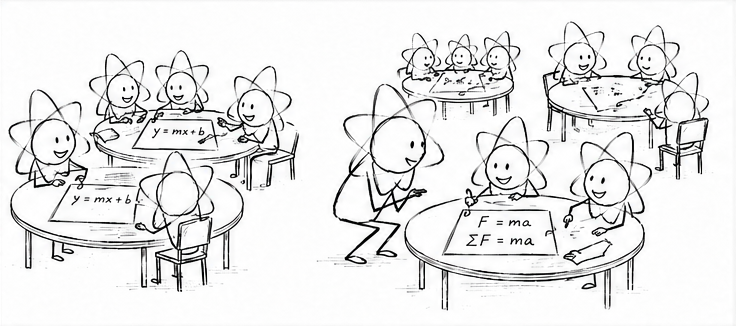
SCALE-UP
Instead of long lectures, students work in fixed teams of three at round tables on short hands-on tasks, while you coach, question, and use their work for brief plenary explanations.
Teaching complexity
This requires some dare, some growing into it, and persistence. Let students do the intellectual and practical work in teams while you orchestrate short, well-timed explanations and feedback moments around their solutions. You need to be active in the room, adapt to the situation and level of understanding of the students, and keep things organised yet lively.
Why it works
SCALE-UP tackles passive, lecture-heavy teaching by turning class time into structured group problem solving and experimentation. The aim is to improve understanding, retention, and motivation by having students apply concepts, discuss approaches, and get rapid feedback in a highly active and participatory environment.
Five step plan
- Set-up the room: SCALE-UP requires group tables that seat groups of three students each (e.g., tables of 3, 6, 9 or 12). The table configuration must facilitate collaboration. Provide each table with a small whiteboard, markers, and any required lab or demo equipment.
- Design mixed tasks: Redesign your classical lectures to alternate short plenary explanations with “ponderables” (paper-and-pencil problems) and “tangibles” (hands-on activities), using worksheets and instructions that require critical thinking and concrete application.
- Adopt coaching role: Your role will shift from being a traditional lecturer to facilitator. Plan to speak less in long blocks and more in short, targeted explanations. Create an atmosphere where students feel safe to ask questions, test ideas, and learn from mistakes, supported where possible by TAs circulating among the tables.
- Use student work plenarily: While groups work, you walk around, listen, and spot useful or contrasting solutions. Invite selected groups to share their whiteboards in brief plenaries. Ask for whole group interaction in comparing answers across teams and ask students to explain their reasoning. Students also become an active part of the plenary parts in this.
- Embed ongoing feedback: Continuously assess student understanding through formative assessments and provide timely feedback. Monitor student progress and adjust teaching methods as needed to ensure that all students benefit from the SCALE-UP approach. Digital assessment tools and feedback forms can help to track student performance and identify areas where additional support may be required.
Formative: The frequent in-class tasks and whiteboard function as formative assessment, optionally supported by simple rubrics or feedback forms, to track progress and target follow-up teaching.
(Round) tables of 6 with hand-held whiteboards.
- State clearly how much time students have for each task and use a visible timer to help close activities on time.
- Practise and consistently use a routine for getting plenary attention back (e.g., signal, countdown or raising your hand when you want plenary attention and asking everyone who sees that to do the same); students will quickly learn the pattern.
- Explain to students why you use SCALE-UP so they recognise the benefits and stay engaged.
- Provide a roaming microphone for students who present or ask questions in plenary so everyone can hear and their contributions feel valued.
- Coordinate with any TAs so that support across teams is consistent.
- Classroom that allows round tables for groups of three (or six) and room to walk between them.
- Small whiteboards and markers (one per group) plus any necessary lab or demo materials.
- (For large groups) One or more TAs to help coach teams.
Key advice
Give yourself time to grow into this teaching style and do not give up too easily. Being active in the room during student work on the one hand, and getting plenary attention back when you need it, are skills to be developed and perfected.