







Ranking the rats – Students step into expert shoes
In this best practice, we follow along one of the project days of the learning trajectory ‘Perspective on Biomedical Sciences’ (POBW), which is part of the BSc Biomedical Sciences. In project Ranking the Rats, students try to step into expert shoes, where they are confronted with the ethical, and often difficult, choices behind testing animals.
Course: Perspective on Biomedical Sciences (POBW) and Regulation of Form and Function in Animals
Students: 1st year BSc Biomedical Sciences, ~140 students, working in groups of 4-5
Active learning design: Developing professional skills beyond pure course content
This image was generated with the assistance of GenAI
In the learning trajectory POBW, every course in the 1st year of the BSc Biomedical Sciences includes a project day that connects course content to a current societal and/or scientifical issue. Think: Making infographics, launching a (fictional) new medicine, creating patient information, or diving into vaccine workings.
In Ranking the Rats, students are confronted with the ethical, often difficult, choices behind testing animals. Rats, to be specific… Today, students take the role of an animal ethics committee, and they’ll rank real-life-based research ideas on whether, and why, they would (‘nt) allow the use of rats.
The project begins with an introduction by lecturer Rob de Heus, who, as head of the animal facility of our faculty, explains the concepts of the day: Animal welfare vs. discomfort. Then, guest lecturer Dirk Hilbers, biologist, philosopher, and member of several animal ethics committees, explains the considerations such a committee makes. While students receive practical guidelines on how to judge research proposals, Dirk also urges students to “keep thinking for yourself!”.
At first, students are a bit shy to respond when asked who finds moral issues with using animals weigh heavier (5 out of ~100 hands raised) or scientific value weighs more (~15 hands). But soon, they are asking sharp questions: Who determines how great a scientific value is? Why is a non-recovery procedure -in which an animal doesn’t wake up from anesthesia- considered only ‘light’ discomfort?
Student experience: Engagement in teams
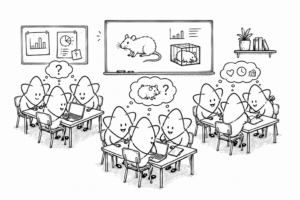 Student teams, who invent creative names like Team Ratatouille, The Squeek Squad, or Rate-a-Rat, then get to work. In a 2h tutorial they analyse and rank 8 research proposals. The vibe is serious as students read and discuss with peers about the 3 R’s for animal research: Replacement, Reduction and Refinement.
“This is an important and interesting topic”, several students state. “It feels good to learn about this now already, instead of later”. The course in which the project fits also includes anatomy sessions where students dissect a rat. They hadn’t given such deep ethical consideration to using rats before, but “This brings it all the more close!”.
Opinions differ on whether it’s difficult to make the choices. Yes, “because there are so many factors to consider” but also no, “because there is no right or wrong, and… no grade! It’s all about your personal view”.
Dirk checks up on the students and is constantly engaged in discussions. One, for example, is about how different species of animals are valued. Someone adequately quotes George Orwell: “All animals are equal, but some are more equal than others”.
Closing the day in a popular quiz format
Once the students have handed in their verdicts they can enjoy a break. For coordinator Ricardo Paap, the pressure now rises: Within an hour, he and his co-lecturers review all rankings, prepare the final lecture, and calculate which team has ranked most similar to the ethics-expert. Again, no right or wrong here, but that team will win a playful prize.
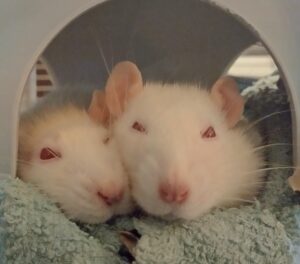
Ex lab-rats
The final lecture is inspired by Dutch TV show ‘Ranking the Stars’. Although only one student admits to ever having seen that show, the format brings an informal and engaging vibe. The specific quiz-lecture was designed by former lecturer Nina Scheres, who developed RATR together with Rob de Heus. “This project day was always one of my favorite to teach. I could see students building their vision on an important aspect of scientific research, and it has also impacted my own view on that. It has even led me to adopt lab-rats at home”.
One by one, the research proposals and the according student and expert rankings appear on screen, as do some of the most interesting or critical student arguments. Expert (Dirk) and public (students) opinion sometimes match, and sometimes don’t; that makes it all the more interesting. Students have been quite strict; they’ve handed out several penalties for claiming too many rats, or unclear descriptions.
This year, the winner is team ‘Schattig Ongedierte met Inhoud’ (Cute Vermin with Content). “I knew it!” someone in the team shouts. They pose smilingly in front of the lecture room with their prizes: A pluche rat for each team member. Their main take-away: “We worked very well as a team”. They did, and in fact, all teams did very well.
What works: More than ‘just science’
After a few closing words by Dirk, who hopes “above all that students will keep thinking critically”, the students are off to study for the midterm. The lecturers are satisfied; students were deeply engaged in the material today, and the atmosphere was pleasant. And the project served an important goal: To give students a perspective on what they may encounter in a future career.
That’s why Ricardo is happy that next year, his POBW learning trajectory will become an ‘official’ course, with EC granted, rather than a series of separate project days. “Personally I love how POBW is more than ‘just science’ for the students”, Ricardo says. “It underlines the value of connecting scientific knowledge to societal discussions for learning.”
Get in touch and try it yourself
If you want to know more about Ranking the Rats, or other innovative project days within this learning trajectory, you can contact Ricardo, via r.h.paap@uva.nl. If you’d like to create a project day/days for your own course(s), you can reach out to TLC Science for support or advice.
You can also find this workflow in the activity finder: In the expert’s shoes.