







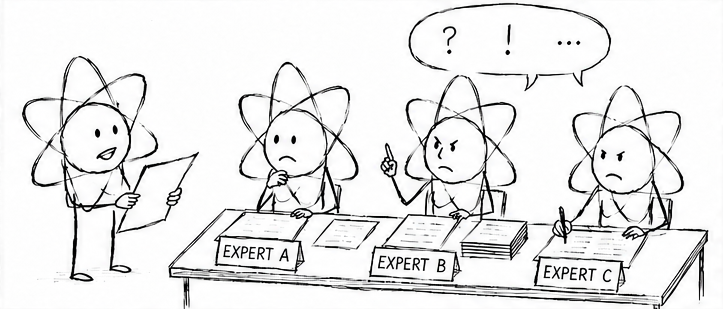
In the expert’s shoes
Students act as an expert committee that evaluates and ranks realistic submissions from the field, practising critical judgement and argumentation.
Teaching complexity
This activity needs a clear vision, realistic materials and careful preparation, but is often highly appreciated by students. During the session you need to brief clearly, monitor closely and facilitate discussion so that students take the expert role seriously rather than treating it as a game.
Why it works
When dealing with fundamental or abstract topics, students can lose sight of how the material connects to real practice or why it matters. Putting them in the role of an expert committee (e.g., ethics board, grant panel, competition jury) shows how course concepts are used to evaluate real cases. The aim is for students to connect theory to authentic professional tasks, make justified decisions under clear criteria, and argue their evaluations convincingly.
Five step plan
- Design the scenario: Choose a realistic committee setting from your field (e.g., ethics committee, grant review panel, competition jury) in which experts assess and rank submissions. Create 5-8 simplified but authentic submissions that require students to apply key course concepts; adjust number and length to fit available time.
- Set the criteria and context: Decide what information and rules students need to evaluate well: Committee purpose, workflow, criteria, cut-offs or minimum standards. Provide these clearly via a short introductory lecture or written instructions, and, if possible, invite a real expert to introduce how such committees work in practice.
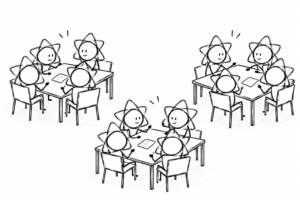
- Have teams evaluate: Put students into teams, give them the outline for the work, submissions and criteria, and allocate sufficient time to read, discuss, and decide. Ask them to make concrete decisions (e.g., rank all proposals, select winners, allocate a fixed budget) and to record both their verdicts and brief written arguments for each submission.
- Compare and discuss outcomes: Organise a structured comparison of team results. For example, have teams post their rankings on a board, briefly present choices, or compare with an expert or real-life outcome. Guide a discussion on where teams agreed or differed and what reasoning lay behind that.
- Optional – Plenary quiz and wrap-up: Close with an interactive plenary session in which selected teams explain their choices for particular submissions. Invite alternative viewpoints, highlight strong argumentation, and optionally award a small, playful prize (e.g., for best-argued decision or closest to expert judgement). Summarise what this reveals about applying course concepts in real evaluative work.
Summative: This can be a pass/fail or required participation component of your course.
Formative: Team evaluations and discussion of outcomes are formative evidence of students’ ability to apply course concepts and justify decisions. Optional: Reinforce with a playful, prize-based element.
Small groups.
- Where possible, anchor the activity to an existing guest lecture and ask the guest expert to introduce the committee’s work and help choose a “winning” team.
- Provide guidance on how teams can handle internal disagreement and reach a decision all members can accept.
- Offer a simple form or table for recording scores and arguments so students focus on reasoning rather than formatting.
- In longer projects, you can spread the activity over multiple sessions (e.g., preparation, evaluation, then plenary comparison).
- A set of simplified but realistic submissions tailored to the course.
- Clear evaluation criteria and an argumentation form or template.
- Optional: Introductory and closing slides; small prizes.
Key advice
Stay actively involved during team work. Circulate, listen in, question reasoning and prompt students to justify and refine their choices rather than settling too quickly.