







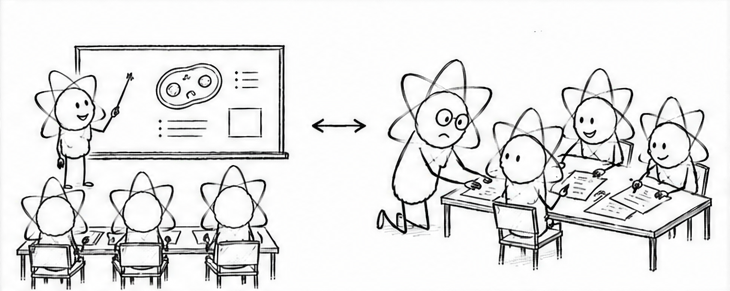
Lectorial
A lecture and tutorial combined into one, that alternates short theory blocks with focused assignments so students work and discuss with peers.
Teaching complexity
Be prepared to cut lecture content, plan clear alternations between theory and tasks, and stick to strict timing. You switch from lecturer during plenary parts to coach during student working parts.
Why it works
Student attention and note-taking typically drop after about 20 minutes (see this active learning article for more information). That means that long, uninterrupted lectures reduce engagement and deep learning. By breaking the session into short theory chunks followed by interactive “brain break” assignments, students immediately apply new ideas and get feedback. The aim is to keep attention high, make students actively process the material, and reach a deeper level of learning during lectures.
Five step plan
- Redesign sessions: Review your lecture topics and decide where to insert assignments. Drop non-essential content or replace some two hour lectures and tutorials with a few (but less) longer lectorials to create space. For example, SCALE-UP uses 4-hour sessions.
- Chunk the content: Divide each lectorial into theory blocks of max. 20 minutes, each followed by an assignment that students can do on paper or laptop and then briefly discuss with neighbours.
- Create varied tasks: Design short tasks that fit each theory block (e.g. predicting outcomes, solving a problem, comparing models, finding examples, brainstorming, writing a short script, analysing a case).
- Run work and discussion: Give students a clear time window to work and talk in pairs or small groups; walk around, answer questions, and note good or contrasting examples for the plenary. Give a clear sign when it is time for plenary again.
- Debrief and transition: Bring the group back together, invite a few answers or use a voting tool, highlight strong or instructive examples, clarify misconceptions, and then move to the next theory block if there are no more questions.
None or formative: The assignment work and discussions are immediate formative feedback for students and also for yourself to see what students do and do not yet understand.
Lecture hall or an active learning space with multiple screens.
- Make a simple time schedule per lectorial (theory vs. assignment minutes) and share it with your TAs and students.
- Use a visible timer on the main screen so everyone knows how long they have per task.
- Decide in advance whether students first work individually or directly in pairs, but always include some peer discussion.
- In larger groups, request a suitable room (e.g. with multiple screens and group tables) and, if possible, extra TAs.
- If you run out of time, move remaining explanations and assignments to Canvas and refine your timing for next time.
- A longer lectorial (3 or 4 hours) can replace a traditional set of a two-hour lecture and a two-hour tutorial on another day.
- Room setup that allows brief peer discussion (lecture hall, tutorial room or active learning space).
- Student access to paper/whiteboards or laptops for assignments.
- Timer, prepared slides, and assignment instructions (optionally a tool like Wooclap).
Key advice
Prioritise a clear, timed alternation between short theory blocks and focused assignments, and be willing to cut non-essential content so you can fully switch from explaining to coaching while students work.