







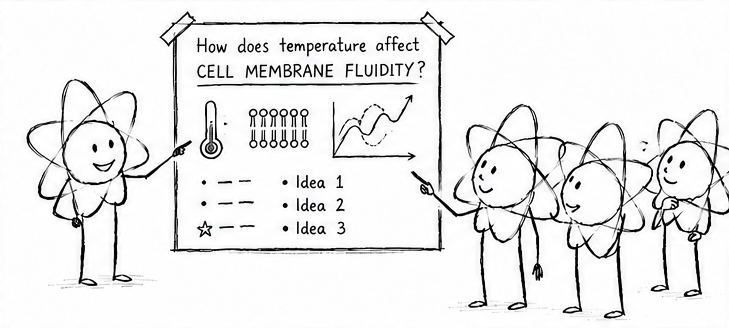
Gallery brainstorm
Students circulate between posters or stations with problems or concepts, adding answers and insights so that a collective overview of solutions and perspectives emerges.
Teaching complexity
Be ready for most content to come from students and adopt an exploratory, non-judgemental stance. Walk around , guide, and keep an eye open for misconceptions.
Why it works
Complex problems or theories often allow multiple valid approaches, but students may latch onto a single method or viewpoint. A gallery brainstorm exposes them to a range of ideas and partial solutions in a visible way. The aim is to collect and connect student insights so they can extend their own understanding and problem-solving strategies.
Five step plan
- Prepare stations: Select challenging concepts, questions or problems and write each one clearly on a whiteboard, flipchart sheet or other visible surface at separate stations. Ensure there is enough physical space for small groups to gather around each.
- Organise student groups: Put students into pairs or small groups and assign them a starting station. Ask them to add their definitions, ideas, steps, solutions or answers to the prompt, leaving space for later groups to contribute.
- Rotate and build: Have groups move around the room, visiting each station in turn within a set time. Instruct them to read existing contributions and then extend, refine, exemplify, question or visually organise what is already there, rather than simply repeating it.
- Guide and correct: While students rotate, circulate between stations to answer questions, encourage quieter students, and highlight ways to add value when “everything seems already written”. Correct or annotate visible misconceptions so they do not spread.
- Debrief and capture: Conclude by briefly discussing each station with the whole group, commenting on the richness, creativity and accuracy of the collected ideas and resolving any remaining misunderstandings. Take photos or otherwise record the boards and share them so all students can refer back.
Formative: Use the collected contributions and debrief discussion as formative feedback on how well students grasp the concepts and on the variety of their problem-solving approaches.
Preferably an active learning space.
Or put all tables aside.
- Provide example “ways to add” (e.g., give a counterexample, draw a diagram, add pros/cons, link to another concept) to help students go beyond repeating answers.
- Allow students to visually signal agreement or disagreement (e.g., ticks, question marks, coloured post-its) so patterns in responses become visible.
- Reuse the gallery in later sessions, for example by having students design a study, critique solutions, or prioritise ideas generated earlier.
- In large groups, split the class into halves to avoid crowding at stations.
- Set a visible timer for each rotation to maintain pace and energy.
- Multiple writable surfaces (mobile whiteboards, large paper sheets, or boards).
- Markers or pens in several colours.
- Space for students to move safely between stations.
Key advice
Welcome all contributions and explicitly coach students who feel they have “nothing new to add” to deepen, connect or represent existing ideas in a different way.