







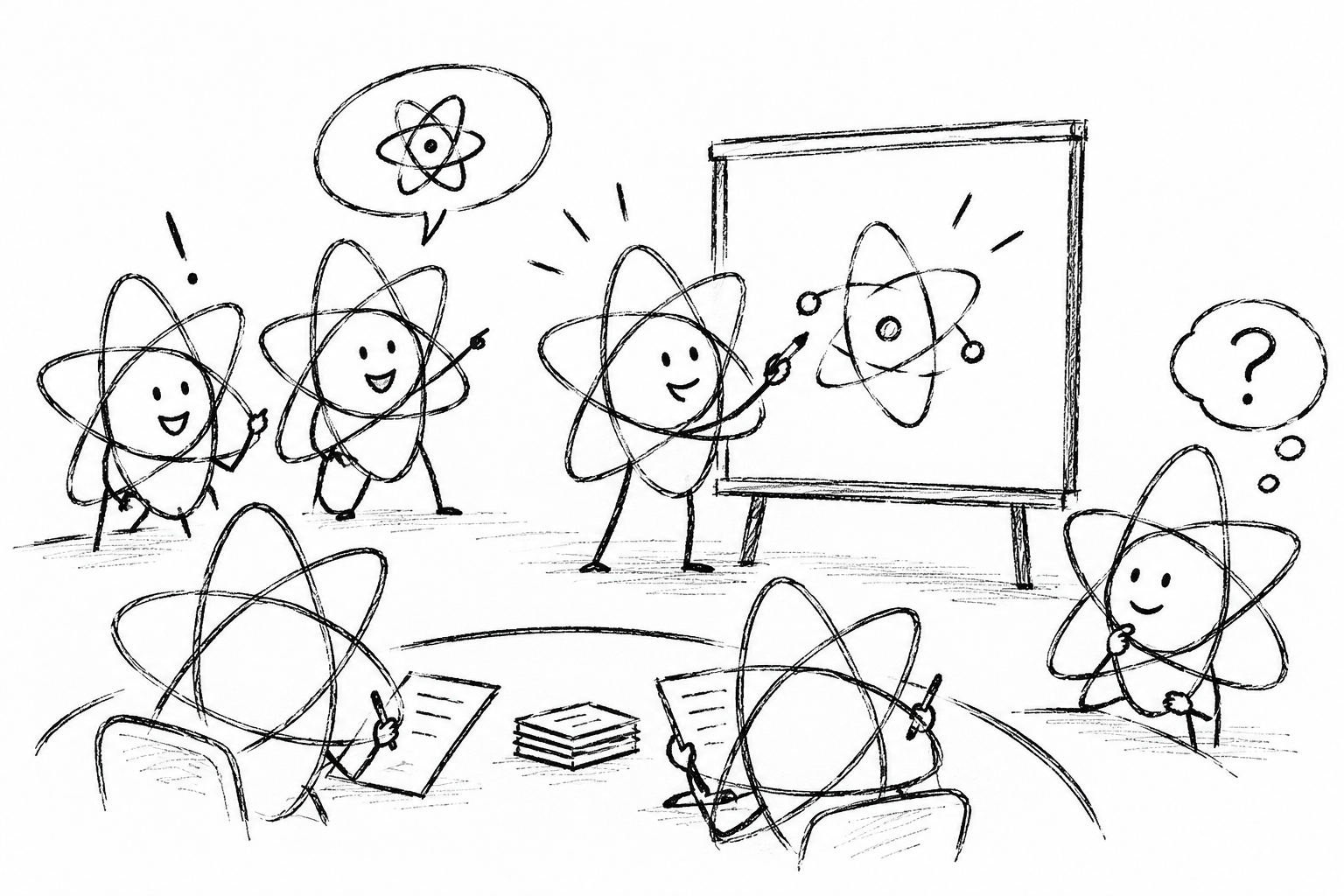
Drawn to STEM
Students take turns drawing a concept while peers guess and explain it, then discuss how the visual representation captures its essential features.
Teaching complexity
As this is game-based it can get a bit noisy or messy, but with proper organization and time-management that does not have to be a problem. It can functions as a real energizer.
Why it works
Students may recognize a term or use an equation without being able to explain the underlying relationship or mechanism. This activity asks them to approach familiar content differently: the artist chooses what to show, while the other players connect emerging visual clues to their course knowledge. A sketch can reveal useful connections as well as misconceptions that need clarification. Next to that, it offers a light, playful moment to break up struggling at challenging problems or staring at a screen. The main goal is to learn from explaining and checking the visual representations, not simply naming the concept quickly.
Five step plan
- Choose concepts/prompts: Select familiar concepts that can be meaningfully drawn, from simple to more abstract. Prepare prompt cards and note each concept’s key features and likely misconceptions.
-
Explain the rules: Form groups who work simultaneously and choose an artist per group. Give the artist 60–90 seconds to draw while team members guess. They may use diagrams, arrows, and graphs, but not speak or write the concept’s name or defining equation. Clarify whether standard symbols are allowed, and emphasize that artistic skill doesn’t matter.
-
Draw, guess, rotate: Peers guess and vocalize their reasoning from visual clues. Reveal the concept if needed, without penalty, then rotate the artist.
- Discuss the drawing: Spend 1–2 minutes discussing what the sketch shows, what helped identify the concept, and what is missing or misleading. The artist explains their intent; students can add labels or equations. Clarify misconceptions. Don’t treat a correct guess as proof of understanding.
- Reflect individually: End with a 1–2 minute reflection: “Which sketch helped you see a concept differently, and what did it help you understand?” or “What did you find hard to draw and why?” Optionally ask what they would change to make the sketch more accurate.
None.
Any in which teams have access to a visible drawing surface.
Tutorial room: small groups or standing up around a whiteboard.
Lecture set-up: the artist coming to the front.

- You can gamify more by awarding points for correct guesses or extra-clear drawings, or running it simultaneously with shared rules and rotating artists, as in the original Pictionary game. Keep competition friendly and optional. NB: do leave time for interpretation and reflections afterwards.
- For a lecture format, invite a willing student or the teacher to draw on the board. Pause for everyone to think before taking guesses, so the fastest voices do not dominate; they may start calling in guesses after x seconds. You can give an example by going first.
- Use it recurrently as a break or energizer, p.a. just before or after the break in each session; to break up long sessions of screen work or complex problem solving. You can do a short session (p.a. 1-2 concepts) and different students get to draw every time. NB: do leave time for interpretation and reflections afterwards.
- Use related prompts, such as velocity and acceleration, and discuss which visual feature distinguishes them.
- After discussion, ask students to improve a representation by adding a missing relationship or correcting an ambiguity.
- Provide a broad topic category or a small set of possible concepts if open guessing is too difficult.
- Don’t allow pictures that merely sound like the concepts’ name .
- Offer a co-artist, extra drawing time, a digital tool, or an alternative role such as interpreter or conceptual checker. Avoid forcing public drawing.
- Use fewer rounds if necessary to preserve time for explanation and reflection.
- A set of course-aligned concept cards with suitable difficulty.
- Paper, mini-whiteboards, mobile whiteboards, or a digital drawing tool.
- Clear rules, a timer, and a role-rotation plan.
- A visible drawing surface for each group.
- A short individual reflection question.
Key advice
A recognizable sketch is not necessarily an accurate one; ask students to connect visual features to the underlying concept and discuss the strengths and limits of the representation. Ensure the game leads to conceptual discussion rather than guessing alone.