







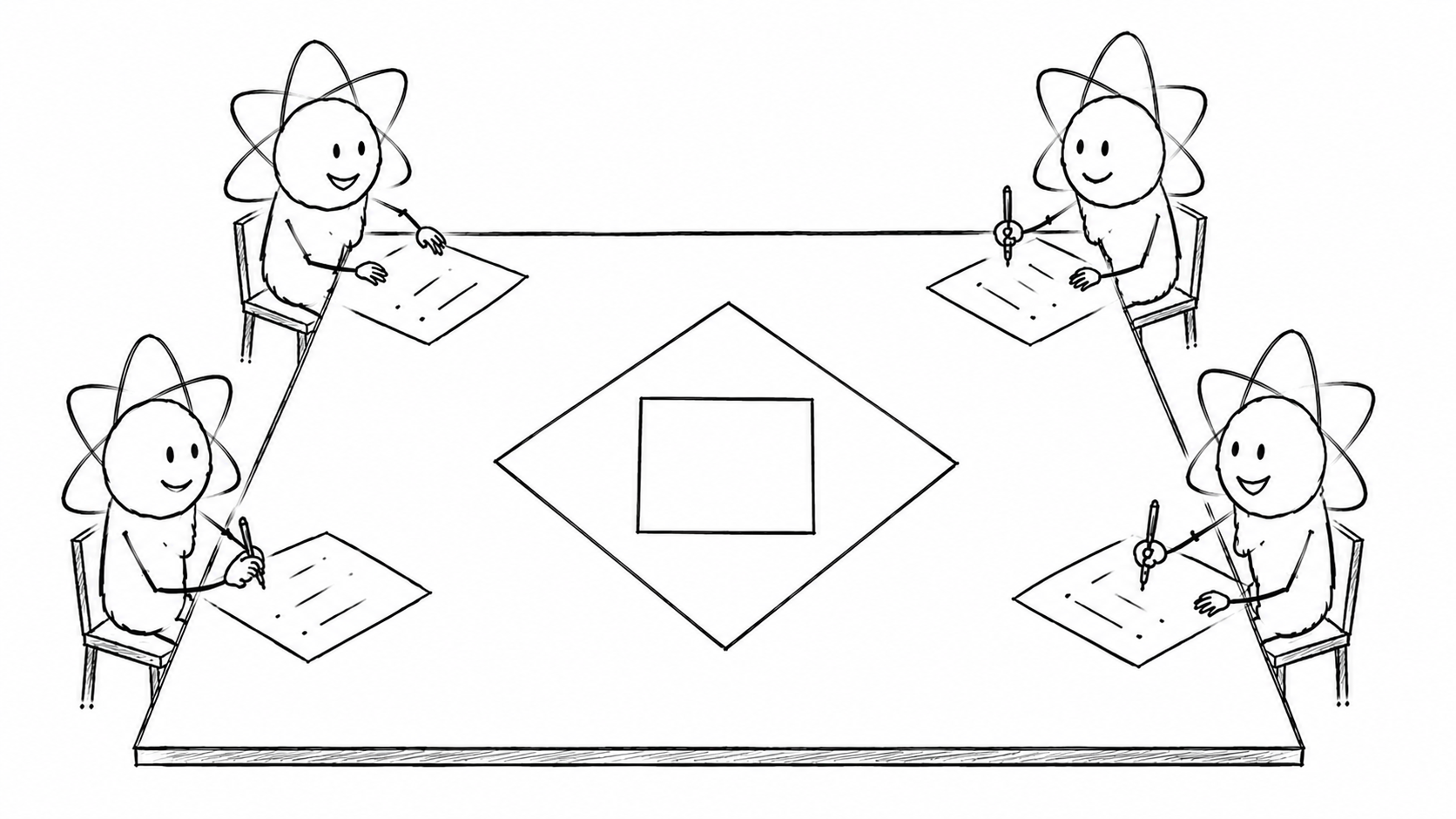
Discussion diamond board
Students first generate their own ideas or solutions and then combine them in small groups into one shared “diamond” solution on paper or a whiteboard.
Teaching complexity
Be open to student ideas and guide students clearly through the phases (individual → group → plenary). Be explicit that all ideas are welcome, especially early on.
Why it works
In complex problems or concepts, students often stick to their own thinking and do not naturally search for other viewpoints, especially more introverted students who prefer to first think alone. The diamond structure offers both quiet individual thinking time and a focused group discussion phase so everyone can contribute. The aim is to combine individual strengths in small groups and stimulate students to openly share, compare, and refine their ideas.
Five step plan
- Choose focus: Decide on 1-3 key concepts, problems, or assignments that students will work on, and prepare a short, clear task description.
- Form groups: Put students in groups of four at tables with a large sheet of paper or small whiteboard. Explain the task and give each group the same or different topic, depending on your goals.
- Think individually: Ask each student to think silently and write any ideas, thoughts, or solutions in their own corner of the sheet/whiteboard. Explicitly normalise “half-baked” or unusual ideas to lower the threshold for participation. Everyone needs a starting point.
- Build the diamond: Students discuss and combine their ideas and try to reach a consensus solution in the middle (the diamond). They can write, draw, connect, calculate; anything goes.
- Share and debrief: Close in plenary by briefly viewing some diamonds (and, if desired, letting neighbouring groups exchange and discuss), appreciating the range of ideas, and clarifying common misconceptions.

Formative: Use the individual corners and the final diamond as formative input for in-class feedback and brief peer discussion.
In small groups.
- Add an extra round where neighbouring groups swap diamonds, briefly present them to each other, and react.
- If using mobile whiteboards, let students do the individual phase on paper and then build the shared diamond on the whiteboard, clipping individual notes on with magnets.
- Optionally take photos of the diamonds and share via Canvas for later reference.
- Sheets of paper or hand-held whiteboards, markers/pens. Hand-held whiteboards are available in classrooms A1.04-A1.14; mobile whiteboards are present in the active learning spaces.
- Optional: Short grading model and guidelines.
Key advice
Protect time for genuine individual thinking, then actively encourage groups to use and combine all ideas so quieter students’ contributions also shape the final diamond.