







Alternative Assessment in the age of AI
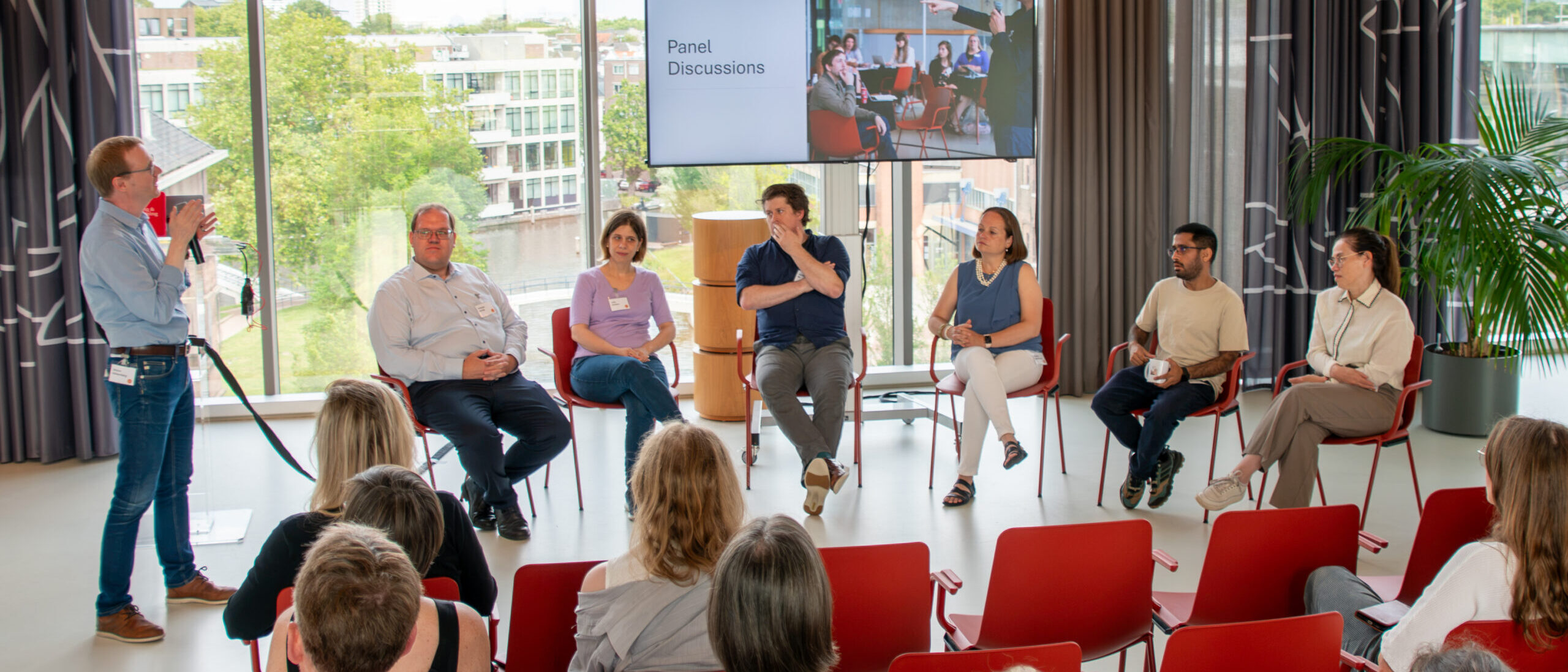
On 7 July 2026, six invited experts shared their perspectives on assessment in the age of GenAI at our annual FMG-TLC event. The core issue: generated works are nearly undetectable making traditional assessment through exams and assignments increasingly unreliable.
The pitches and discussion, moderated by Sharon Klinkenberg, focused on one question: how can you redesign assessment so that it still measures a student’s academic performance, even when GenAI is everywhere?
Key Takeaways
- Oral assessments are a valuable addition for you to test students’ performance.
- You should design oral assessments with clear criteria to prepare students for their professional development and test reasoning.
- You should make students aware of the limitations of GenAI.
- AI tools can assist lecturers to ascertain whether the class grasps the core learning objectives of the course.
- Students earn their degree by achieving the overarching learning objectives, the AI can assist in this but should not replace the student.
Panelist Pitches


Opportunities and challenges
The emergence of GenAI has brought both opportunities and challenges to academic environments. On the one hand, your students risk outsourcing too much critical thinking to GenAI. To combat this, Dr. Krisztina Lajosi-Moore developed an AI literacy course for history students to show students what the limits are of LLMs, and what unique capacities they bring as trained members of the academic community. Students learn to evaluate LLM outputs critically in the context of their field of study and use it in ways that support their own judgment.
AI support in the classroom
On the other hand, Dr. Saurabh Khanna showed how AI can support you in the classroom. He connected Canvas to the UvA AI Chat API to provide a tailored learning experience for students. He has developed five tools that can be used by UvA teachers: a tool to train yourself to spot generated texts, a scan that estimates how susceptible your course is to GenAI use, a conversational agent that takes surveys for you, a worksheet for matching an assessment to its learning goals, and a tool to strategically use the Discussion board embedded in Canvas. Explore the GenAI tools provided by TLC-FMG.
Two-Lane Assessment
Dr Brenda Jansen proposes a two-lane approach when it comes to assessment. In the first lane, students are explicitly allowed to be assisted by GenAI, mirroring its use in research, journalism, and professional practice. Moreover, with the help of GenAI students can produce amazing works of writing, without losing academic focus. In lane two, the students are placed in a supervised setting without GenAI, so they train their critical thinking skills needed for academic independence. If you are unsure if you should allow GenAI, then the two-lane approach provides a solution to this. Want to learn more about two-lane assessments? The University of Sydney implemented this approach successfully.
An example from thesis writing
One way in which this two-lane assessment is already put into practice is with thesis writing at the Economics and Business faculty. Dr. Philippe Versijp gave their perspective as a member of their examination board. He emphasises that students must reach their overarching learning objectives. For theses, the faculty tests methodological skill through four supervisor meetings. Students who demonstrate understanding of their method may write with GenAI assistance.
Oral Examinations
What became clear during this afternoon is that oral assessments are becoming the foremost way to test a student’s independent academic skills. Dr. Alessandro Nai gained experience with this form of assessment during a three-year pilot with master’s students. This pilot was successful: while the scalability for bachelor programmes remains uncertain, students value this personalised form of assessment.
Three Design Principles for Oral Assessment
Do you want to design your own oral assessment? Dr. Julia Hülsken outlined three core principles:
- Discussions should address real-world scenarios.
- You should probe the student’s reasoning during the examination.
- Write up clear criteria to guide your assessment.
Discussion Recap
What is the vision for higher education in 2036?
There are fears that AI might replace teachers in higher education, or that it makes higher education redundant for future students. But, as Sharon noted, new technologies mainly change our daily tasks. Mundane work will be handled by GenAI, while students should focus on interpretation, linking existing concepts, and independent critical thinking. At the same time, teachers will still be needed to provide soft skills: inspiring and enthusing students – something an LLM cannot do.
How do we ensure that students still learn to write if the focus shifts towards oral assessments?
In the end, oral assessments will not replace the written paper. Students still need to learn how to write a proper academic text. GenAI can support this process through supplementary tasks, such as grammar. The oral assessment functions as a parallel grading tool alongside the submitted paper.
How do we combat discrimination, stereotyping, or other forms of harmful subjectivity while grading students orally?
It was suggested during the discussion that oral assignments had been discontinued because of concerns about discrimination. Two suggestions were made to address these pre-existing issues. First, oral assignments can be assessed on a pass/fail basis. Second, students should be properly prepared for oral assessments, for example through mock assessments.