







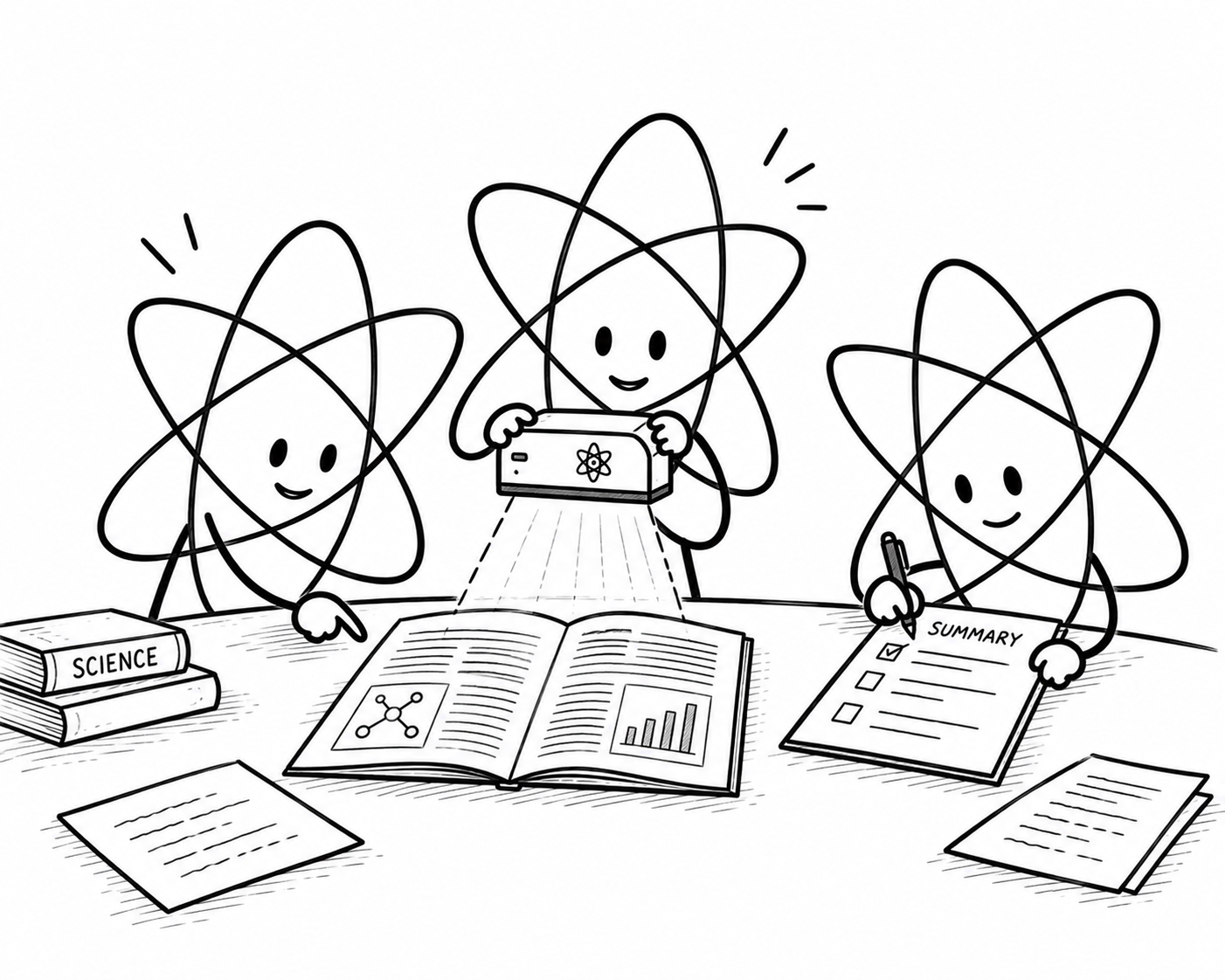
Article scan in ten minutes
Students quickly map the structure, core claim, audience and uncertainties of a scientific article in small groups, without needing to understand every detail.
Teaching complexity
The main point is to normalise that students are not expected to fully understand the article yet. Select a suitable article or excerpt, provide a fixed set of guiding questions and manage time so all groups can share a short report.
Why it works
Beginners often try to read scientific articles linearly, word by word, which quickly undermines overview and motivation. This format shows that an article can first be explored strategically. The goal is to help students perform an orienting read: Recognize the main question or claim, identify key sections, estimate required prior knowledge and pose targeted reading questions.
Five step plan
- Choose article: Select an accessible article or excerpt that fits the course and share it digitally or on paper.
- Form groups: Ask students to work in pairs or groups of up to four and give them a maximum of ten minutes to scan title, abstract, headings, introduction, figures/tables (if present), conclusion and references.
- Answer scan questions: Let each group answer: What is this article probably about? What is the main question or claim? Who is the intended audience? Which concepts or methods seem central? What do we not yet understand?
- Report briefly: Each group reports in about one minute: “This article is about…; its main contribution seems…; to understand it we probably need…; our reading question is…”.
- Compare interpretations: Discuss differences and similarities in the groups’ interpretations and ask which text elements they used as evidence for their answers are normal and useful for learning. Keep track of which teams’ work you use across tutorials to vary whose solutions are highlighted.
None. Assessment threatens the safety of practicing for your students and this is a first practice to get acquainted with scientific articles.
You can give feedback; per group while walking around, or via the plenary discussion afterwards.
Small groups; tables of 4 (2×2), or a U-shape and students work in in duo or triad.
Also possible in classic lines format; students working in pairs
Tips for instructions:
- Use a shared online form or polls for large groups.
- For first-years, pick an article with a clear abstract or only use title, abstract and introduction.
- In empirical fields, focus questions on research question, method, results and limitations; in theoretical fields on definitions, claims and argumentation.
Variations:
- Repeat later in the course with a more complex article to show progression.
- Depending on what you want students to understand/learn from the article, make a larger variant where you ask a few deeper questions about the article, and allot more time.
- One scientific article or suitable excerpt.
- A short scan form with guiding questions (paper or online).
- Optional: Laptops/tablets or printed copies for all students.
Key advice
Make explicit that the goal is not to understand every word but to produce a useful first map of the text.