







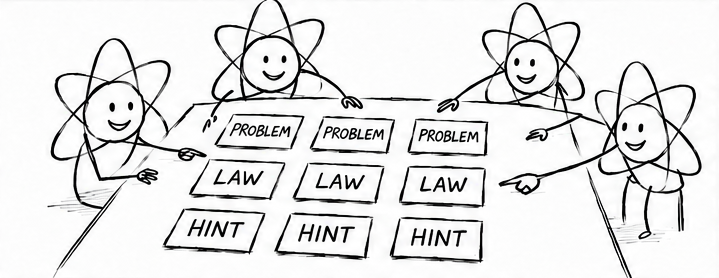
Card set: Combine and calculate
Turn a complex, relevant phenomenon into a collaborative puzzle in which student teams use colour‑coded cards (problem, law, hints) to work through and discuss quantitative solutions together.
Teaching complexity
Be ready to get active, walk around and constantly interact with student teams; they will work at different paces.
Why it works
Students often memorise formulas without seeing how they model real phenomena or how to decide which law to use. This format starts from a concrete problem and explicitly connects it to the relevant law and step‑by‑step hints, so students must choose equations, interpret them in context, and negotiate solutions. The aim is to move from rote memorisation to deep, transferable understanding and fluency with physical or mathematical principles; in the best‑practice example it also boosted attendance and engagement.
Five step plan
- Define learning goals and phenomena: Select specific concepts, realistic phenomena, and the associated mathematical/physical/molecular laws and tools students must practise in this tutorial.
- Build the colour‑coded card sets: For each problem, create three cards: Problem (short realistic scenario), Law (governing mathematical/physical/molecular law(s) and core equation(s)), and Hints (step‑by‑step prompts such as “identify the unknown → isolate it → substitute values”). Use a fixed colour for each type, label each set clearly (e.g. “Set A‑1”), and save as PDFs or printable sheets.
- Plan the tutorial logistics: Decide group size, timing, number of card sets per tutorial, and (optional) attendance rules. Prepare a brief intro slide explaining the workflow. Expect variation in pace: In the best‑practice case six sets were available, and some teams completed only one while others did all six.
- Run the activity in class: Hand out or rotate card sets per group, instruct students to work in order (Problem → Law → Hints), and let them solve and discuss together before checking hints. Circulate to answer clarification questions, spot common misconceptions, and, if time allows, invite one group to present their solution on the board.
- Reflect and improve the card sets: Close with a quick question (e.g. “What helped?” or “What is still unclear?”) and collect brief feedback. After the session, refine problem wording, hints, or colour coding where needed, and store the final card sets in a shared folder for reuse and adaptation.
Formative: The cards are practice for exam‑relevant topics. You monitor the group work and closing discussion to check whether students can select and apply the correct laws independently and give feedback on that.
Small groups; tables of 4 or 6 (2×3).
- Use the format regularly (e.g. one tutorial per week) so students quickly recognise the workflow.
- Explain and justify the tutorial set‑up in the first lecture, including how it helps them prepare for exams.
- Withhold the hints initially (or add a playful “cost” to using them) so students first try to solve the problem with only the Problem and Law cards.
- Ask TAs to help with printing, cutting, laminating, and organising the card sets.
- Clearly defined topics, phenomena, and associated laws/equations.
- Coloured paper, printer, scissors (optional: laminator).
- Shared digital folder to store and update card sets.
Key advice
Decide on topics early and design the card sets well in advance. Although creating them takes time, they are highly reusable in future runs.