







To escape the room, you need to know your statistics
In this best practice, Linde Lichtenberg (dept. Psychology, FMG) describes how she and co‑lecturer Iris de Vries use a digital escape room in their course on Scientific and Statistical Reasoning. The final tutorial closes with a playful, exam‑relevant learning quest. Students work in teams through a story‑driven sequence of puzzles that cover the course content, giving them a competitive yet cooperative challenge while immediately seeing how well they master the contents.
Course: Scientific and Statistical Reasoning, Psychology
Students: 2nd year BSc , ~500 students, 16 students per tutorial group
Active learning design: Wrapping up a big methods course

Linde Lichtenberg
The escape room is used in the last tutorial of the course, and the puzzles and clues all come from the content that will also be in the exam; nothing is “extra”. It thus stays focused on the core learning goals while offering a very different format from regular tutorials. “It’s a literal escape at the end of the course,” Linde says, “students get one last chance to show what they can do before the exam.”
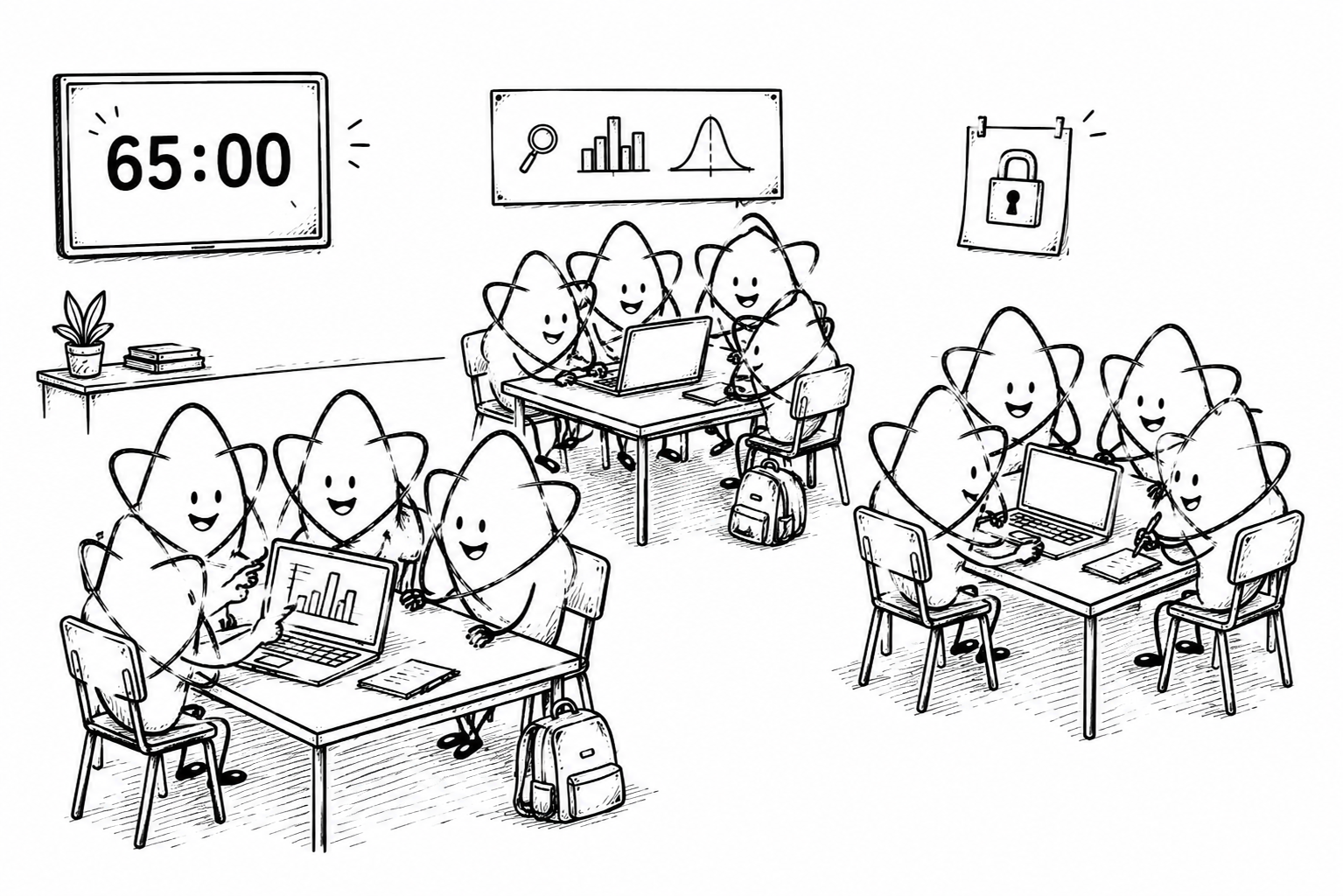
During the COVID years, Linde saw how escape rooms could also work online. And she already had an earlier physical escape‑room‑style activity in the course. This inspired her to create a digital escape room, which became a hybrid activity that is still in use now that the students are back in the tutorial room. They work together in small groups, using the digital materials on their laptops. In the physical room, Linde creates a real escape-room atmosphere: “You can really set the mood…a tense soundtrack, a big clock counting down…and suddenly the same content feels more urgent and exciting!”
The escape room also serves as self-assessment. Because everything in it is exam material, students get immediate insight into which parts of the course they already master and which topics still need attention.
 Linde’s personal enthusiasm for puzzles, supplemented with brainstorm-sessions and trial runs with colleagues, shaped the story and design. It combines competition, cooperation and narrative, and there’s a ticking clock; that really engages the students.
Linde deliberately created a story in which students are “pulled into” a scenario and have to solve statistical and scientific reasoning puzzles that resolve around the statistic method they have to learn (mediation analysis) to get out. As a platform she uses a One Drive folder on the UvA server, with password-protected files. Students have to solve the puzzles to get the passwords. No need for privacy-unsafe third parties.
Student experience: “Can we do the long version too?”
 Students respond with enthusiasm. Linde describes them as “pleasantly surprised” when they realise that the last tutorial is an escape room rather than a standard session.
In one recent year, time pressure caused her to run a shortened version of the escape room. And students actually asked her to send them the extended version from the previous year so they could play through that one as well! For Linde, that’s a clear sign that students did not see the activity as a gimmick, but as something they genuinely wanted to experience in full.
What worked: Atmosphere and insight
For Linde and Iris, the biggest success is how the format changes the energy in the room. Students often become completely absorbed in the story and the race against the clock. “It is almost a literal escape from the course. Students reach the end, but also get a final, activating check. Are they truly ready to “prove their skills” and walk into the exam with confidence?”
Linde is pleased with this strong self‑assessment function. “It’s fun and engaging, but it also holds up a mirror. Students see very clearly where they’re strong and where they need one more look at the material.”
Lessons learned and advice for colleagues: Fun to make, but not a quick job
Designing the escape room was a learning experience for the lecturers, too. Though the creative process of crafting puzzles was “very fun and entertaining”, it was also an investment of time.
“It is not something you put together in an afternoon. It required effort, iteration and a good deal of trial and error to get the difficulty level and flow right”, Linde notes. She luckily had the time and hours to sit down and really focus on the design, and she recognises that not every lecturer can carve out that much space in their schedule.
Start small and enjoy the work
For lecturers considering a similar activity, Linde’s advice is to enjoy the making-process and to start modestly. “If you’re creating something you want students to enjoy, it really helps if you enjoy making it too”, she says. “Students notice and appreciate the energy you put in.”
It doesn’t have to be perfect from day one. With limited time, it is better to build a smaller, workable version and then expand or refine it in later iterations. Elements can always be added once the basic structure is in place. And: “Keep having fun in education!”
Get in touch and try it yourself
Linde is open to being contacted by colleagues who are interested in the escape room, or who want to build one themselves. You can reach her at l.lichtenberg@uva.nl.
Good to know: Escape rooms can also be built using Canvas, using modules and password-locked quizzes, and you could have UvA AI Chat help you build puzzles, or write code for online puzzles (similar to the Online Laboratory Practice Hub, described in this best practice from Maurizio Costabile).