








Recognising, identifying and referring
As a lecturer, you are often the face of the University for students, which means they may turn to you to share their problems, for example. Or you may recognise that one of your students needs support. This may relate to academic matters, such as help with writing (theses), planning or studying with a disability, or to personal matters, such as coping with stress, loneliness or (serious) psychological problems. Signs that can indicate this can be absence from classes, changes in behaviour or performance, emotional distress (anger, sadness), a unkept appearance, or being under the influence (drugs, alcohol).
What can you do as a lecturer?
- Recognise: Do you notice signs that a student may need support? Or does a student come to you with a request for help?
You are not expected to diagnose or interpret these signs. It is enough to notice that things do not seem to be going well. - Ask further questions: Listen without judgement and ask what the student needs at that moment. Raise what you have noticed briefly and calmly, for example: ‘I’ve noticed that you’ve been absent / seem to be struggling lately. How are you doing?’
Your role is not to solve the situation, but to help the student find appropriate support. - Referral: Discuss which form of support might be appropriate and point the student to the UvA support services (see infographic) or, where appropriate, to their own GP. Encourage the student to make contact themselves and, if needed, take the first practical step together, for example by looking up the right contact details.
If there is an acutely unsafe situation or immediate danger, call professional help immediately on 112. If you are worried that the student may be suicidal, they can also contact 113 Suicide Prevention via 113.nl. In addition, always follow the applicable internal UvA procedure for acute or serious concerns. - Follow up: Follow up briefly at an appropriate moment: ‘Were you able to get in touch with someone who can help?’
Respect the student’s privacy. You do not need to ask about substantive or medical details. - Self-care: A conversation with a student who is experiencing serious problems can also affect you. Discuss your concerns — within the boundaries of privacy and in line with current procedures — with a supervisor, study adviser or designated colleague. Ask for advice if you are unsure what is appropriate. You do not have to carry this on your own.
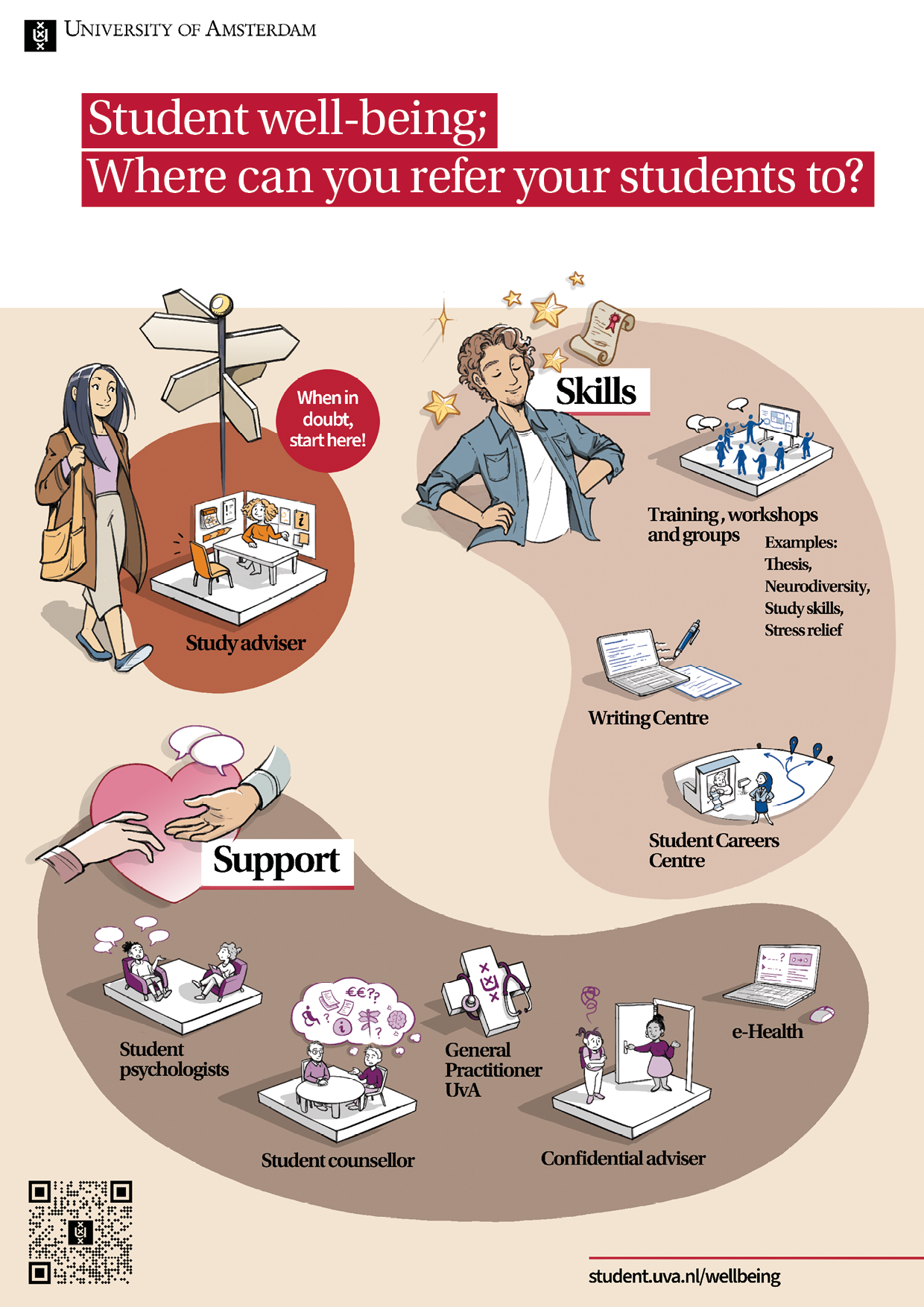
Additional resources
Would you like to know more about what you can do if you suspect a student is at genuine risk due to mental health issues? You can visit the 113.nl website. Faculty of Science (FNWI) staff can also apply to attend the Gatekeeper training via TLC FNWI. If you are not a member of FNWI staff, please contact the email address on the relevant page to discuss what might be possible.
Sources: Mental Health Support Protocol – Student Advisors UvA EB 2021 en Richtlijnen signalering en vervolgstappen suïcide-risico van UvA Bureau Studentenartsen UvA 2016