







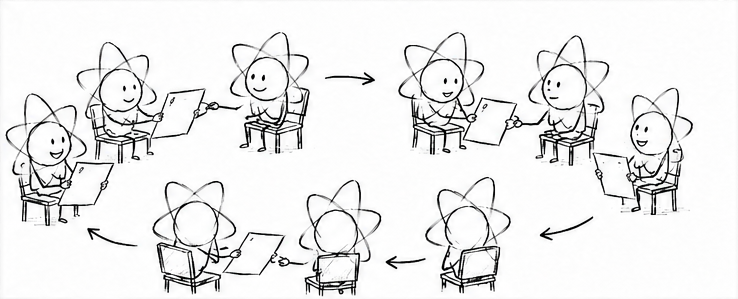
Review roundabout
Students review each other’s work in several short, focused rounds, each with a specific feedback point and clear instructions.
Teaching complexity
You do the preparation, but students do most of the work in class. In the reflection round, you are the coach and stimulate discussion and exchange.
Why it works
Peer review helps students understand content more deeply, recognise strengths and weaknesses, and practice formulating feedback. But many feel insecure about their reviewing abilities or doubt the value of peer comments. The review roundabout makes peer review a guided, synchronous in-class activity with short, defined rounds, reducing insecurity and uneven effort. The aim is to support students in giving and receiving targeted peer feedback in a guided, structured, and low-threshold way.
Five step plan
- Choose assignment and focus points: Select the piece of work to be reviewed (e.g., code, proof, poster plan, draft text) and decide which aspects students should focus on in separate rounds (e.g., reasoning, annotation, style, logical structure). For each focus point, prepare brief written instructions (slides, board, hand-out).
- Students bring their work: Ask students to bring a printed version of their assignment to class, or another format that can easily be passed around (paper preferred, but laptops are possible).
- Explain method and first round: In class, explain the value of peer review and how the roundabout works. Introduce the first focus point, give simple guidelines on how to annotate feedback, and set a visible timer for the round.
- Run review rounds: Students pass their work to the neighbour (e.g. to the right) and review only on the current focus point, working silently so others can concentrate. You are available for questions. After each round, briefly check for urgent issues, then explain the next focus point, and have students pass the work on again in the same direction.
- Reflect on received feedback: In the final round, students get their work back, read the comments and discuss unclear or conflicting feedback with their reviewers. Walk around and check with students how the feedback is received. Give time for individual reflection so each student notes their main point to work on and a concrete next step.
Formative: The peer feedback is low-stakes formative input. Students gain insight into their own work without formal grading. They also consider concrete next steps for themselves to take in their work.
U-shape or small groups according to the number of rounds.
- Limit to about 5-6 rounds; a shorter version with 1-2 rounds is also effective.
- Emphasise that feedback should include both strengths and points for improvement.
- Agree on a simple rule together: Be critical but polite and clear.
- Seat students in small circles matching the number of rounds so reviewers are already together for the final discussion.
- Provide an optional “extra task” (e.g., check spelling, suggest alternative phrasing) for early finishers.
- You can also let students rotate instead of the papers, and allow laptops if needed.
- Student work (preferably on paper).
- Prepared instructions for each feedback round.
- Pens or markers.
Key advice
Keep each round sharply focused with clear instructions and strict timing so peer review feels doable, fair and useful rather than overwhelming.