







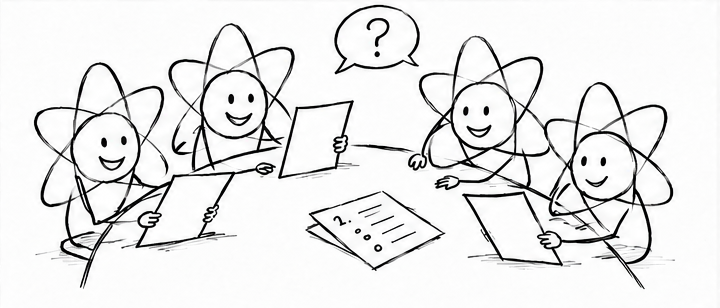
Discussion-based test
Students take a short test on content knowledge or skills and then discuss their answers in small groups before submitting their group answers for feedback or a grade.
Teaching complexity
Be explicit about the rules for collaboration (e.g., equal participation and consensus on answers) so all students actively contribute and stronger students do not dominate. Design questions that genuinely benefit from discussion (such as those requiring reasoning or multiple steps) and be clear in advance about how (and if) group answers are graded. Decide in advance to what extent TA-help is offered during the tutorial.
Why it works
Traditional assessments can be stressful and solitary. In a discussion-based test, students verbalise and compare their reasoning, which helps reveal misconceptions and strengthen understanding. Because all group members receive the same feedback and/or grade, this format emphasises preparation. The aim is to deepen students’ understanding and at the same time develop collaborative problem-solving skills and a shared responsibility.
Five step plan
- Design the test: Prepare a test in the format that fits your goals (e.g. short multiple-choice, open/essay questions, calculations, drawings, proofs, or assignments).
- Inform students: Let students know in advance when the test will take place and what content or skills they must prepare.
- Form groups: Organise students into groups of three to four and arrange seating. Each group takes the test as a group, they submit one joint answer form, and all members of the group receive the same feedback and/or grade.
- Facilitate during testing: Walk around during the test, monitor the group process, and offer clarification only where necessary.
- Debrief plenary: Discuss the answers plenary using an answer key or slides, clarify misconceptions, and invite questions or alternative correct answers.
Summative: Tests are graded and students receive a grade as a group. Think beforehand what options there are for students who miss the tutorial due to illness or for students who come unprepared and/or do not contribute to the group.
Formative: It is also possible to not grade the test but use the handed in results to give formative feedback.
Small group tables.
- Alternative: Let students first take the test individually and then in groups. You can combine individual and group scores or use this sequence for formative self-reflection on gaps in knowledge. Find out more at the website Team-Based Learning Collaborative.
- Alternative: Let students submit an individual version, discuss with peers, then submit a revised individual version so they can use group input but make their own choices.
- For a Team-Based-Learning setup, use a digital platform for individual tests and scratch cards or similar tools for group answers to provide immediate feedback and a “pub quiz” atmosphere.
- For purely formative use, allow students to choose their own teams and/or give a “surprise” test, but clearly explain its formative purpose and create a safe atmosphere.
- If used as in-class assessment, you can exclude the same material from the final exam to manage workload and redundancy.
- Prepared test on paper or digital.
- Answer model / answer key for plenary discussion.
Key advice
When the test is summative, clearly communicate that careful preparation and active contribution are responsibilities students owe to their peers.