







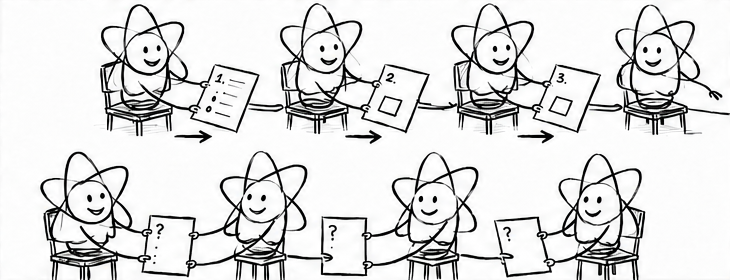
Conveyor belt problem solving
Students work on a problem step by step, each completing one part before passing their partially solved solution to the next student, who continues with the next step until the problem is fully solved.
Teaching complexity
Deconstruct the problem into clear, independent steps and make sure each stage includes enough guidance so students can meaningfully continue from a partial solution. Consider briefly checking intermediate answers to prevent errors from accumulating as the solution moves through the “conveyor belt”.
Why it works
This format gives students focused practice with multi-step problems (e.g., equations, proofs, programming, quantitative tasks) while exposing them to different solution approaches. The aim is for students to practice stepwise reasoning, compare their choices with peers, and learn to recognise and discuss errors, working individually as well as together.
Five step plan
- Design the problems: Split complex assignments into clear, consecutive steps where the outcome of one step is needed for the next. Present them on paper or in Canvas.
- Start individual work: Give each student an assignment and have them complete step 1 individually before passing their work to a neighbour.
- Rotate and continue: Ask students to complete the next step on the partially solved assignment they receive, then pass it on again until all steps are done. You can pass in one direction (more students per problem) or back and forth (easier for later discussion).
- Compare with an answer model: Once all steps are completed, provide an answer model and let students compare it with the final solutions, identifying where they would have made similar or different choices and where any wrong turn occurred. Walk around to answer questions and spot misconceptions or creative approaches.
- Plenary debrief: Close with a brief plenary discussion to acknowledge strong solutions, highlight common misconceptions, and invite a few students to share their main insight.
Formative: In-class feedback and peer discussion helps to check students’ reasoning at each step.
U-shape or tables of 6 or 8 with 3 or 4 seats per side.
- Use a clear time limit per step and indicate what students should do if they finish early or need more time.
- If assignments have for example 3 or 4 steps, have students sit in groups of 3 or 4, so that peer discussion and TA support in the final phase are easy.
- If a solution is stuck because an earlier step is wrong, allow a student to redo that neighbour’s step so the chain can continue.
- Multi-step assignments where each step depends on the previous one.
- Answer models or worked solutions for comparison at the end.
- Means to distribute work (printed sheets or online system) and something to write/type with.
Key advice
Anticipate likely misconceptions in each step and decide which errors still allow meaningful continuation so the conveyor belt keeps moving.