







Assignment X
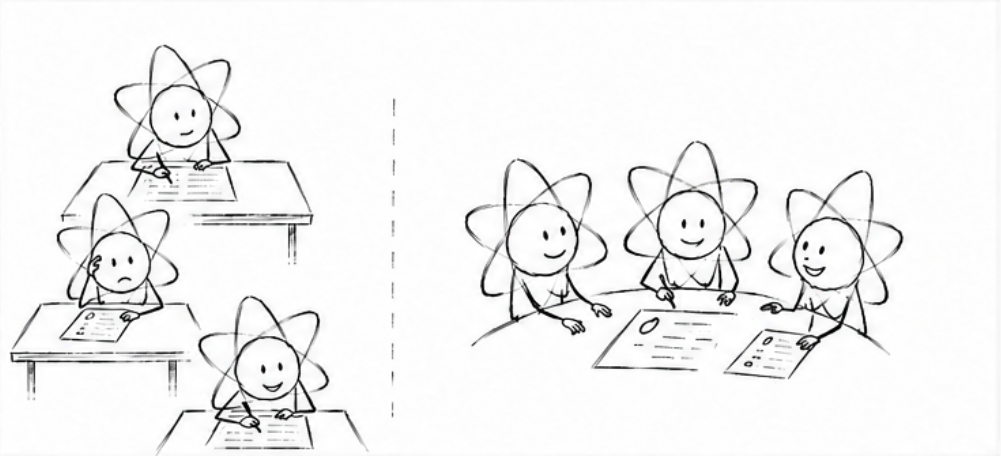
Students work (individually and/or in small teams) on a key assignment, submit their solution, and one or more student approaches are used for plenary explanation and feedback.
Teaching complexity
Deliberately step back and let students struggle productively, offering only small scaffolding when they are truly stuck. Ask diagnostic questions before helping, and manage the room so group work and the plenary discussion run on time and in a safe, constructive atmosphere.
Why it works
In many tutorials students work alone, see only the official solution and remain unsure whether their own approach is sensible. Assignment X creates structured peer discussion around one well-chosen problem and uses authentic student work (mostly anonymously) as the basis for explanation. The aim is to increase peer interaction and provide low-threshold formative feedback on problem-solving strategies and common misconceptions.
Five step plan
- Select assignment X: Choose one (or a few) assignments that best represent the topic, a crucial skill, frequent misconceptions, or that allow alternative correct approaches. It should not be too easy; preferably the assignment is a bit hard to solve solo, and working together really adds value. Label these clearly as “Assignment X” in your materials.
- Have students solve and submit: Ask students to work on Assignment X in trios (optionally first individually, then compare) and write down both their approach and final answer on a whiteboard, large paper or digital platform. Set a clear in-class deadline and hand-in method. Explicitly validate peer discussion and the value of imperfect solutions so students dare to show their thinking. Let students struggle together; do not give too much help on Assignment X.
- Choose solutions: After the deadline, select one or a few student solutions that are representative, insightful or illustrative of common errors. Decide whether you will keep them anonymous or, with consent, name or even actively involve the authors.
- Discuss plenary: Present or project the chosen solution(s) and walk through the reasoning, highlighting strengths, alternative approaches and frequent mistakes. Invite short comparisons from other teams without putting individuals on the spot.
- Close and normalise: Thank students for their input, ask for remaining questions (especially from teams with different solutions), and stress that not knowing immediately and making mistakes are normal and useful for learning. Keep track of which teams’ work you use across tutorials to vary whose solutions are highlighted.
None. Assessment threatens the safety of practicing for your students. Unless there is an ILO on collaborative reasoning or problem-solving, it’s not recommended to use this as a proxy for any specific skill or understanding.
Small groups; tables of 4 or 6 (2×3).
Tips for instructions:
- Arrange tables in small clusters rather than rows to make teamwork and your circulation easier.
- Use Assignment X regularly so students learn the routine and prepare for it.
- Decide in advance whether and how you might occasionally have students present their own solution, and safeguard a supportive climate if you do.
Variations:
- Use a few Assignment X’s per tutorial and assign a different Assignment X to different teams.
- Think about your tutorial format: Would you like the students to do áll the assignments in the teams or only Assignment X? Or perhaps can students from one team discuss their solution with another team? Etc.
- Assignment X can also be used non-anonymously. For example by asking some students for clarification or elaboration on their solution. Students can also be asked to present their solution themselves. If so, always be aware of a safe atmosphere and be clear about your set-up. Highlight what is correct and welcome mistakes. Before discussing, check with the selected students if they are OK with them being included.
- One or more pre-selected assignments clearly marked as “Assignment X”.
- Writing space for teams (whiteboards, large paper or digital tool).
- Preferably flexible furniture to support small-group work.
The Cell (year 1) & Molecular Biology (year 2)
In these two life sciences courses, Assignment X was used in the first course of the first year as a low-threshold method for peer interaction and peer-work discussion. In the first year, student teams of three handed in their answers to short essay questions using Wooclap. The TA would select one or two solutions and discussed them at a fixed time in the tutorial. In the second year, students worked in groups of 4-6 and all teams were assigned a different assignment. The teams would present their solution on a mobile whiteboard. At a fixed time, each team would take their whiteboard to the front and present their answer, with the lecturer asking supportive questions. In both courses, this tutorial set-up led to increased peer interaction and students were more motivated to do the assignments well and work together, rather than just doing assignments for themselves.
Physics tutorial
In this course, Assignment X was used for a quantitative assignment calculating waves and oscillations. In this setting, students worked individually before sharing their ideas, which is not necessarily a problem, but they also asked for a lot of help from TAs. This led to all solutions being perfect, leaving little room for interesting plenary discussion. Also, not all TAs performed Assignment X in the same way or let it go after one tutorial. This underlines that a suitable assignment with room for mistakes, and not too much help, is crucial, and that validation and explanations regarding teaching style is important to make this work.
Key advice
Choose assignments with genuine room for error or alternative approaches, and resist the urge to over-help so that student work remains rich enough for meaningful plenary discussion.