






A social and educational activity – Fishing and exploring diversity in the Waddenzee
Sixty biology students, a fishing vessel, and the Wadden Sea as an open-air lab: to boost social coherence and give students a unique opportunity to learn, teacher Hans Breeuwer (IBED) organized an unforgettable fishing trip for students of the BSc Biology. This trip was stimulated (and funded) by faculty budget aimed at increasing student social connections and sense of belonging at the FNWI. Read the story below to learn how the trip was organized, what it brought for students and teachers, and what to consider when planning an activity yourself.
Activity: A day of fieldwork on the Wadden Sea
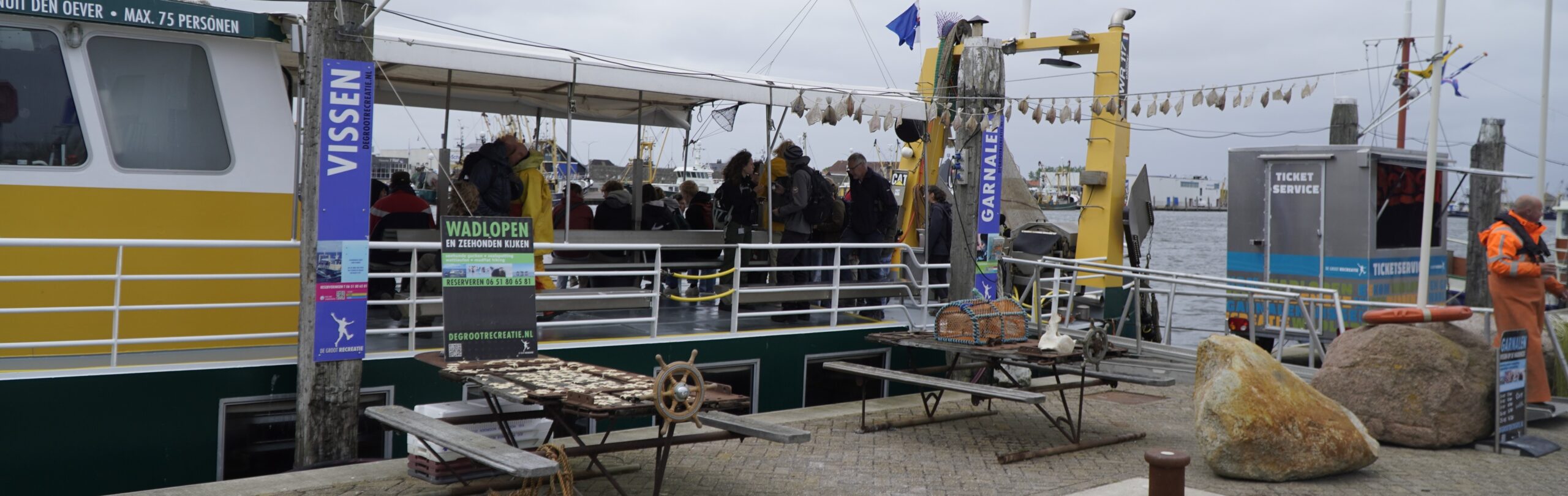
Lecturer Hans Breeuwer (IBED) organised a one‑day excursion for BSc Biology students in which the lecture hall was replaced by the Wadden Sea. In the morning, a bus with around sixty students left for Den Oever, where a chartered fishing vessel was waiting. In consultation with the fishing company, a special programme was designed: not aimed at tourists or at catching as many kilos of fish as possible, but at the biodiversity present. The company was happy to take this on.
During a trip of about four hours, the group fished at various locations on the Wadden Sea. On board, in addition to lecturers, there were also experts from Ravon and fishers with many years of practical experience. “A unique opportunity to take a fun look at what lives under the surface of the Wadden Sea,” is how Hans describes it. Catches were temporarily placed in transparent containers, and students eagerly took photos of everything that was brought in.
The set‑up was deliberately open: no assignments, forms or tests. The main goal was to introduce students to fieldwork, to let them see what lives there, and to get them talking with people from professional practice. After the trip, many students stayed on in small groups to have dinner in the harbour, on their own initiative.

What does the activity offer students?
Some students spent the entire time at the front of the boat watching the catch come in, while others stayed more towards the stern for the social side of things. And both were perfectly fine; it was a social activity in any case. Hans also noticed that the relationship between students and lecturers changed: “They see you not in the lecture hall, but on that boat, getting completely excited. That lowers the threshold for later in the programme.”
At one point it became just a little too convivial. A small group had brought spirits and suddenly started passing around a bottle on the boat. With good explanation, a friendly yet firm stop was put to this.
Educationally, the gain was that students got an insight into the biodiversity of a special underwater area. “We had little squids and pipefish; they were really beautiful.” The knowledge of fishers with many years of experience also gave students a wealth of information and a very different view of the discipline. For some students this may even have sparked ideas for internships or an interest in marine biology.
Next time: what stays and what can be improved?
The application for the next excursion has already been submitted. Participation was high, after all, and students soon asked: “Are we doing this again next year?” At the same time, there are opportunities to connect the day more solidly to the rest of the programme.
Hans plans, for the next edition, to take a selection of the catch back to the university, freeze it, and later use it in practicals, for instance for species identification and biodiversity assessments. “That way, a few weeks or months later you can refer back to what they themselves saw being brought out of the water,” he says. In this way, the excursion gets a second life in the curriculum.
Why this activity sticks
The Wadden Sea excursion shows how a single well‑organised day off campus can simultaneously strengthen social cohesion and provide substantial learning experiences. Students experience biodiversity literally up close, see lecturers and experts in action in the field, and build their own network within the programme. As Hans himself puts it: “It took place outside the regular curriculum and was simply a fun activity. And we actually could have used more of those.”
Practical tips for fellow lecturers
- Choose a location that logically fits your programme. For Biology, biodiversity and the Wadden Sea are obvious choices, but you might also think of heavy industry, a water treatment plant, the harbour area, or a data or control centre – as long as it is a place where “real” professional practice takes place and students can see the scale and context of their field.
- Involve local experts or partners with practical expertise. According to Hans, the fishers and Ravon staff were crucial for the conversations on board.
- Arrange the logistics in good time. Boat, bus and timetables all need coordination, especially if you want to bring an entire cohort. Hans communicated in advance that signing up meant a commitment: even if it is cold or windy, the trip goes on! That helps to keep expectations clear.
- End the day with a collective moment of reflection, however informal. Taking a moment together to reflect on what you have experienced and learned contributes to social connection.